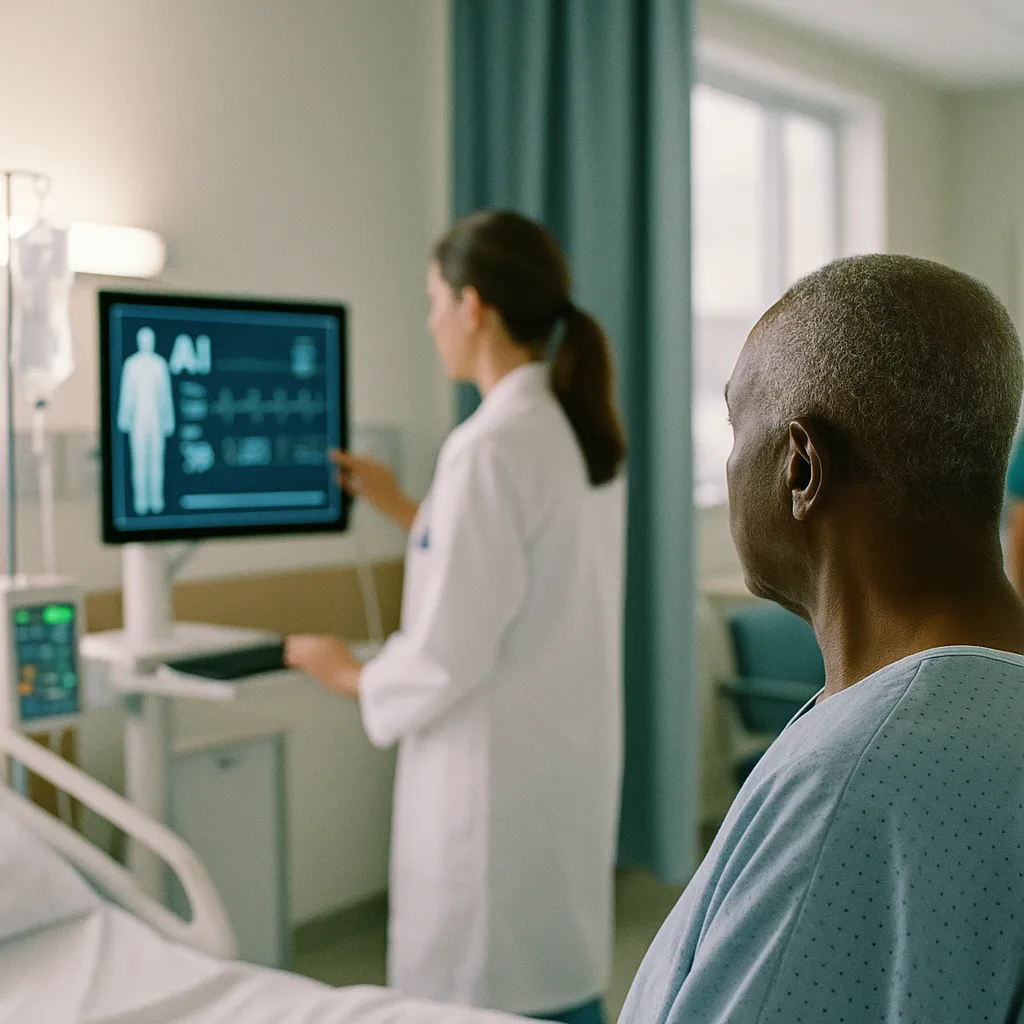
80% of U.S. hospitals now use AI, but fewer than 20% report sustained success in core clinical diagnosis — a Stanford-Harvard report quantifies the gap between pilot and production.
A joint Stanford-Harvard State of Clinical AI report released this week finds that while roughly 80% of U.S. hospitals now use AI in at least one clinical or operational function, fewer than 20% report sustained high-success deployment in core clinical diagnosis. The performance gap between initial AI pilots and long-term integration is the defining challenge for healthcare AI in 2026 — and the report is the most comprehensive attempt yet to quantify what that gap looks like across the system.
The headline numbers tell two stories simultaneously. Adoption is nearly universal. Success, by any rigorous definition, is not.
What Adoption Actually Looks Like at 80%
The 80% figure encompasses a wide range of AI use: scheduling optimization, billing code automation, imaging analysis flagging, sepsis alerts, clinical documentation tools, and more. Most hospitals counted in that figure use AI primarily in operational and administrative functions — workflow tools, not diagnostic ones.
The harder number is clinical diagnosis, where AI's potential impact on patient outcomes is highest. According to the report, fewer than 1 in 5 hospitals report that their AI diagnostic tools are delivering sustained, measurable improvement in care quality. Pilots launch, show promising results in controlled conditions, and then stall — integration with electronic health record (EHR) systems proves more complex than expected, clinician trust is hard to build, and maintenance costs for AI models that drift over time are underestimated.
The pattern mirrors what has happened in other enterprise AI deployments: the gap between what a model does in a test environment and what it does in a live clinical workflow, interacting with real patients and real institutional constraints, is consistently underestimated.
The Clearest Win: Radiology
The report's most unambiguous finding is in radiology. Radiologists using AI assistance detected more cancers without increasing false alarm rates — the precise outcome the technology has been promising since the first FDA-cleared diagnostic AI tools began shipping around 2017. This is the signal buried under years of mixed results in other applications.
Why radiology works while other applications don't is instructive:
Get this in your inbox.
Daily AI intelligence. Free. No spam.
- Radiological AI has the longest track record and the most mature tools — the FDA has cleared over 900 AI/ML-enabled medical devices, with imaging applications representing the largest category
- Radiologists work within a structured task loop: review image, produce report, move on. The AI integrates into that loop without requiring a fundamental workflow change
- Ground truth for radiology is relatively unambiguous — a nodule either exists or it doesn't — enabling better training data and clearer performance benchmarks
Other clinical domains — primary care diagnosis, psychiatric assessment, treatment planning — involve more ambiguous data, longer feedback loops, and more complex integration points. The AI can be technically accurate on individual data elements while still failing to improve the clinician's overall decision-making process.
Why Sustained Success Remains Rare
The report identifies five structural barriers to moving from successful pilot to sustained deployment:
1. Integration complexity. Most clinical AI tools require feeding data from EHR systems that weren't built for real-time model inference. Custom integration work is expensive and fragile.
2. Model drift. AI models trained on historical patient data degrade as patient populations, care protocols, and clinical practices change. Most hospitals lack dedicated teams to monitor and retrain deployed models.
3. Alert fatigue. Sepsis and deterioration prediction tools have generated alert volumes that exceed what clinical staff can meaningfully act on. When every alert is treated as low-priority, the value of accurate alerts disappears.
4. Liability ambiguity. When an AI-assisted clinical decision leads to a bad outcome, who is responsible — the clinician, the hospital, or the vendor? Unanswered liability questions slow adoption and create institutional caution around documentation.
5. Clinician trust. Physicians trained on evidence-based medicine have legitimate skepticism toward models that produce a recommendation without a mechanistic explanation. Explainable AI — models that surface the reasoning behind a prediction — has improved but remains inconsistent.
The report's actionable recommendations center on infrastructure before application:
- Build AI governance structures before deployment, not after — including data quality audits, model monitoring pipelines, and clear ownership of update cycles
- Start with high-volume, low-stakes administrative applications to build institutional familiarity with AI operations before moving to high-stakes clinical tools
- Partner with vendors on post-deployment monitoring contracts, not just implementation, to ensure accountability for long-term model performance
- Invest in clinician AI literacy as a prerequisite for diagnostic tool adoption — clinicians who understand how models work are better at identifying when they're wrong
What to Watch
The FDA has signaled it will update its AI/ML Software as a Medical Device framework in 2027 — the first major revision since the 2021 action plan. Expect new requirements around post-market surveillance and model change notification. That regulatory update, combined with Medicare reimbursement decisions for AI-assisted care expected in 2027, will do more to accelerate sustained clinical AI adoption than any technology breakthrough.
Source: Stanford Medicine — Clinical AI Has Boomed, but Sustained Success Remains Rare
Did this help you understand AI better?
Your feedback helps us write more useful content.
Get tomorrow's AI briefing
Join readers who start their day with NexChron. Free, daily, no spam.