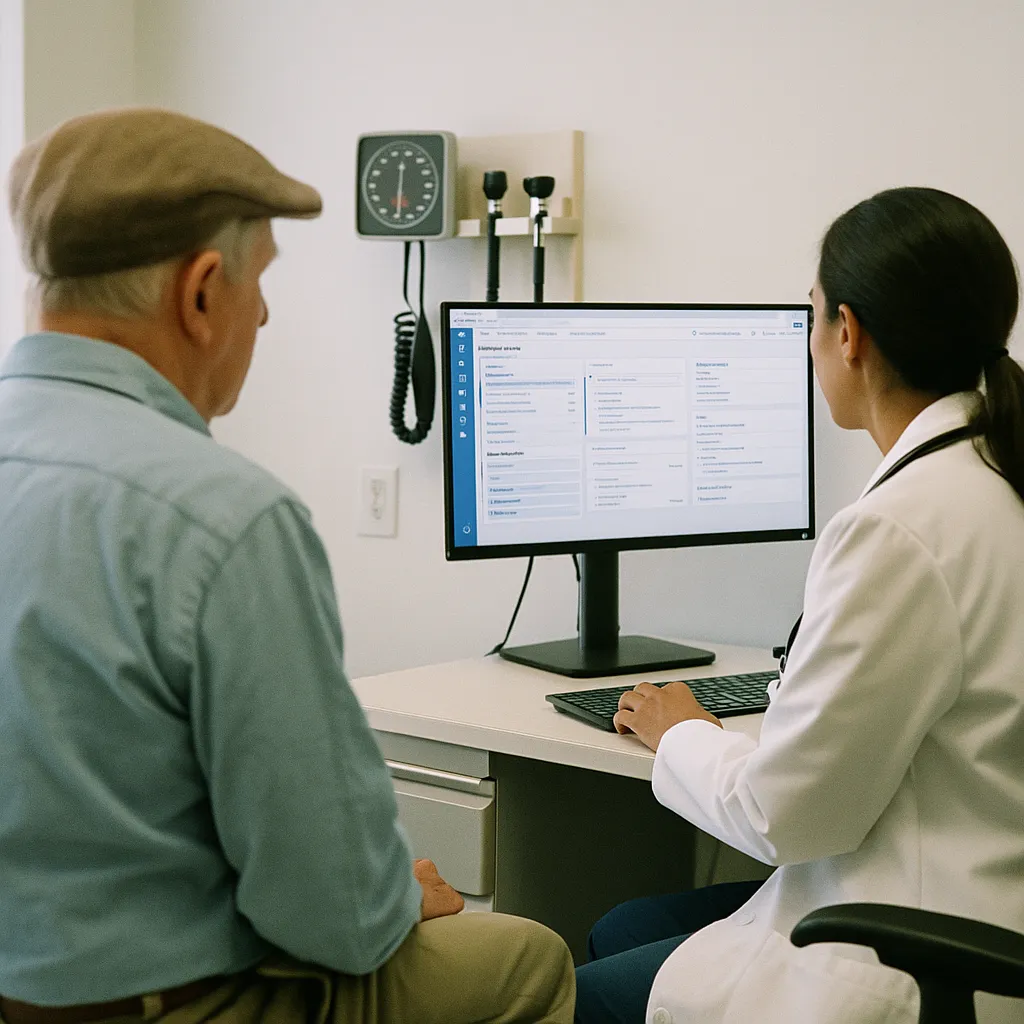
80% of U.S. physicians now use AI in clinical workflows — double the rate from three years ago — as ambient intelligence and agentic AI emerge as the next healthcare frontier.
The healthcare AI market has moved decisively from pilots to deployed systems, with 80% of U.S. physicians now using AI in clinical workflows — double the rate from three years ago — according to Philips' midyear healthcare AI trend report. The report identifies ambient intelligence and agentic AI as the next frontier, with early deployments already running at leading health systems.
Where Healthcare AI Actually Stands
The 80% physician adoption figure deserves context. Much of it reflects AI that is relatively invisible in daily practice — algorithm-generated flags in radiology reads, natural language processing that pulls structured data from clinical notes, scheduling optimization that clinicians interact with indirectly.
What's changed in 2026 is the depth of integration. The FDA has now cleared over 1,000 AI-powered tools for clinical use, and the pace of clearances is accelerating. More importantly, the tools are moving from single-function add-ons to AI that operates across the care workflow — from pre-visit triage through discharge planning.
Ambient Intelligence: AI That Watches Without Being Asked
Ambient intelligence — the term Philips uses for AI that passively monitors patients across care settings and surfaces alerts without requiring active clinician input — is emerging as the most consequential deployment category.
The practical form this takes in 2026:
- Continuous deterioration monitoring across ICU and general ward patients, using multimodal sensor data to flag emerging sepsis, respiratory decline, or cardiac events before conventional vital sign thresholds are crossed
- Ambient documentation that listens to patient-provider conversations and generates structured clinical notes in near real time, eliminating a significant portion of EHR documentation burden
- Predictive discharge planning that identifies patients at readmission risk while still admitted, enabling intervention before discharge rather than after
The value proposition for health systems is both clinical and financial. Earlier deterioration detection reduces ICU transfers and improves outcomes. Documentation AI has been shown in multiple health system deployments to recover 60–90 minutes per clinician per day that was previously consumed by note entry.
Agentic AI in Clinical Settings
The more consequential shift is the emergence of agentic clinical AI — systems capable of not just surfacing information but taking actions: ordering diagnostic tests, drafting care plans, generating referrals, and routing follow-up tasks.
Get this in your inbox.
Daily AI intelligence. Free. No spam.
According to Philips, agentic AI capable of ordering tests and drafting care plans is in early deployment at leading health systems as of mid-2026. This represents a materially different risk profile than diagnostic support AI that only presents information to clinicians.
The regulatory framework for autonomous clinical action is still forming. Most current deployments require physician co-signature or approval for agent-initiated orders — a human-in-the-loop architecture that preserves clinical judgment while reducing the cognitive load of routine decision execution. Full autonomy for clinical orders, even in narrow domains, remains a regulatory and liability question that no health system has resolved.
What's Holding Adoption Back
Philips' midyear assessment identifies three persistent barriers to broader healthcare AI deployment:
Interoperability. Most hospital AI tools still operate in data silos. An ambient monitoring system that doesn't talk to the EHR requires clinicians to context-switch between interfaces, reducing the efficiency gains the AI was designed to create. EHR integration remains the most common implementation bottleneck cited by health systems.
Validation in real populations. AI systems trained predominantly on data from academic medical centers underperform in community hospitals, rural facilities, and populations with different demographic profiles. Health systems are increasingly requiring prospective validation studies in their own patient populations before procurement — a standard that takes time and resources to meet.
Liability clarity. When an AI system misses a deteriorating patient, who is responsible? The hospital that deployed the tool? The vendor that built it? The clinician who was on shift? Legal frameworks for clinical AI liability are still being developed, and uncertainty is slowing deployment decisions at risk-averse health systems.
The Investment Implication
For health systems evaluating AI spending, the Philips data points to a market that has moved past the question of whether AI works in clinical settings. The question now is which AI works reliably enough, in your specific patient population, integrated into your existing workflows, to justify the integration cost.
The systems that will capture the most value from AI in 2026 and 2027 are those that treat AI deployment as an operational transformation project — redesigning workflows around AI capabilities — rather than a technology addition bolted onto existing processes.
What to Watch
The key indicator to track over the next 12 months is whether health systems begin disclosing AI-attributed clinical outcome improvements — reduced deterioration events, shorter LOS, fewer readmissions — at scale. Most current AI deployment claims are based on productivity metrics (time saved on documentation). Clinical outcome data, when it accumulates, will determine whether the long-term investment thesis for clinical AI holds.
Watch also for the first major liability case involving an AI-driven clinical action — or AI-missed alert. How courts and insurers respond will shape the agentic AI deployment timeline more than any technology development.
By Hector Herrera
Did this help you understand AI better?
Your feedback helps us write more useful content.
Get tomorrow's AI briefing
Join readers who start their day with NexChron. Free, daily, no spam.