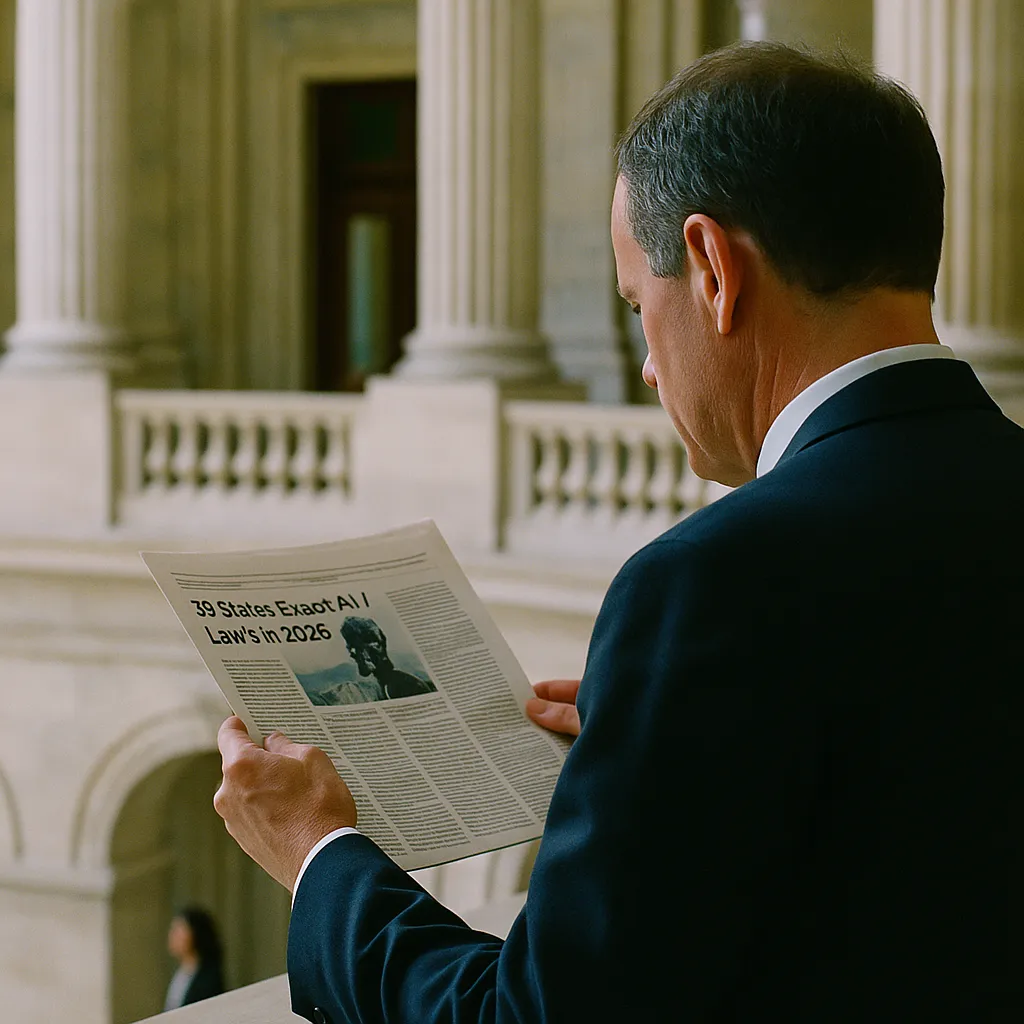
Thirty-eight states have enacted AI legislation in 2026, creating a compliance patchwork that is raising costs for national businesses and building its own case for federal preemption.
38 States Enact AI Laws in 2026 as Congress Remains Deadlocked on Federal Framework
By Hector Herrera | May 1, 2026 | Government
Thirty-eight states have enacted AI legislation in 2026, filling a vacuum left by a deadlocked Congress and creating a patchwork of compliance obligations that is raising costs for companies operating nationally. With Colorado's comprehensive AI Act taking effect June 30 and Texas's TRAIGA (Responsible AI Governance Act) already in force, the divergence between state regimes is accelerating — and legal experts warn the compliance complexity is now building its own case for federal preemption.
The State of State Action
NBC News reports that 38 states passed AI-related legislation in 2026, covering three main categories: deepfake regulation — particularly in electoral contexts — AI-generated medical and health information, and consumer transparency requirements for interactions with AI systems.
The legislative wave reflects a pattern that recurs in U.S. technology regulation: when Congress cannot act, states move. Data privacy followed this path before a patchwork of state laws (CCPA in California, then Virginia, Colorado, Connecticut, and others) created the compliance landscape that eventually forced federal attention. AI regulation is following the same trajectory, but faster.
What the Laws Actually Cover
The 38 enacted laws are not uniform. They address different aspects of AI deployment and impose materially different obligations:
Deepfakes and elections. The largest category of state AI laws targets AI-generated synthetic media in political contexts. Most require disclosure labels on AI-generated campaign content and impose penalties for undisclosed synthetic media in candidate advertising or voter suppression materials. The specific thresholds, disclosure formats, and penalty structures vary significantly by state.
AI-generated health information. Several states require that AI systems generating medical or health-related information disclose their AI nature and limit claims to what the available evidence supports. California and New York have enacted the most detailed requirements in this category.
Get this in your inbox.
Daily AI intelligence. Free. No spam.
Consumer transparency. A broader category requires businesses to disclose when consumers are interacting with an AI system rather than a human — a requirement that affects customer service chatbots, AI-generated product recommendations, and a wide range of consumer-facing AI applications.
The Two Laws to Know Now
Two statutes represent the leading edge of what comprehensive AI regulation looks like at the state level:
Colorado AI Act (effective June 30, 2026). Colorado's law is the most comprehensive enacted to date. It requires companies deploying "high-risk AI systems" — defined as those making or materially assisting consequential decisions in employment, housing, education, health care, financial services, and legal services — to conduct bias impact assessments, disclose AI use to affected consumers, and implement governance policies. The law applies to any company deploying high-risk AI to Colorado residents, regardless of where the company is headquartered.
Texas TRAIGA (already in force). Texas's Responsible AI Governance Act covers similar high-risk deployment categories with different definitions and enforcement mechanisms. Companies operating in both states face materially different compliance requirements for the same AI systems applied to the same types of decisions.
The Compliance Math for National Businesses
The cost problem is direct. A national business deploying AI in high-risk categories must now navigate:
- 38 different state disclosure requirements with varying formats and applicability thresholds
- Multiple overlapping definitions of "high-risk AI" that do not align across states
- Different enforcement agencies with different investigation authorities and penalty structures
- Ongoing legislative activity as state sessions continue adding requirements through 2026
Legal counsel specializing in AI compliance report that large enterprises are spending significantly more on state AI compliance than they were 18 months ago, and the number is still growing. Smaller companies face a proportionally harder choice: incur compliance costs that represent a larger share of their revenue, or restrict AI deployment to avoid the states with the most demanding requirements.
The Preemption Case
The divergence is building its own argument for federal action. Legal experts note that the compliance burden created by 38 non-uniform state regimes is now more disruptive to AI deployment than a single federal framework would be — even a relatively demanding one.
The challenge is political. Congress has been unable to pass comprehensive AI legislation because the coalitions required to advance either a permissive or a restrictive framework have not materialized. The business community, which would normally be a strong driver of federal preemption to simplify compliance, is divided: large technology companies generally want federal preemption on favorable terms, while some AI companies prefer the state-by-state approach where they can influence individual legislatures more directly.
What to Watch
June 30 is the next hard deadline — Colorado's AI Act takes effect, and companies that have not completed high-risk AI compliance assessments for Colorado are running out of time.
The larger question following June 30 is whether Colorado's framework becomes a de facto national standard. Companies may find it simpler to comply uniformly at Colorado's level than to maintain 38 different compliance configurations. That outcome — where the most demanding state law becomes the effective national baseline — has direct precedent in California's environmental regulations and data privacy rules.
Congressional action on a narrow AI-generated content disclosure bill, focused on elections, has more bipartisan support than comprehensive AI regulation and remains possible before the midterm election cycle focuses legislative attention elsewhere.
Did this help you understand AI better?
Your feedback helps us write more useful content.
Get tomorrow's AI briefing
Join readers who start their day with NexChron. Free, daily, no spam.