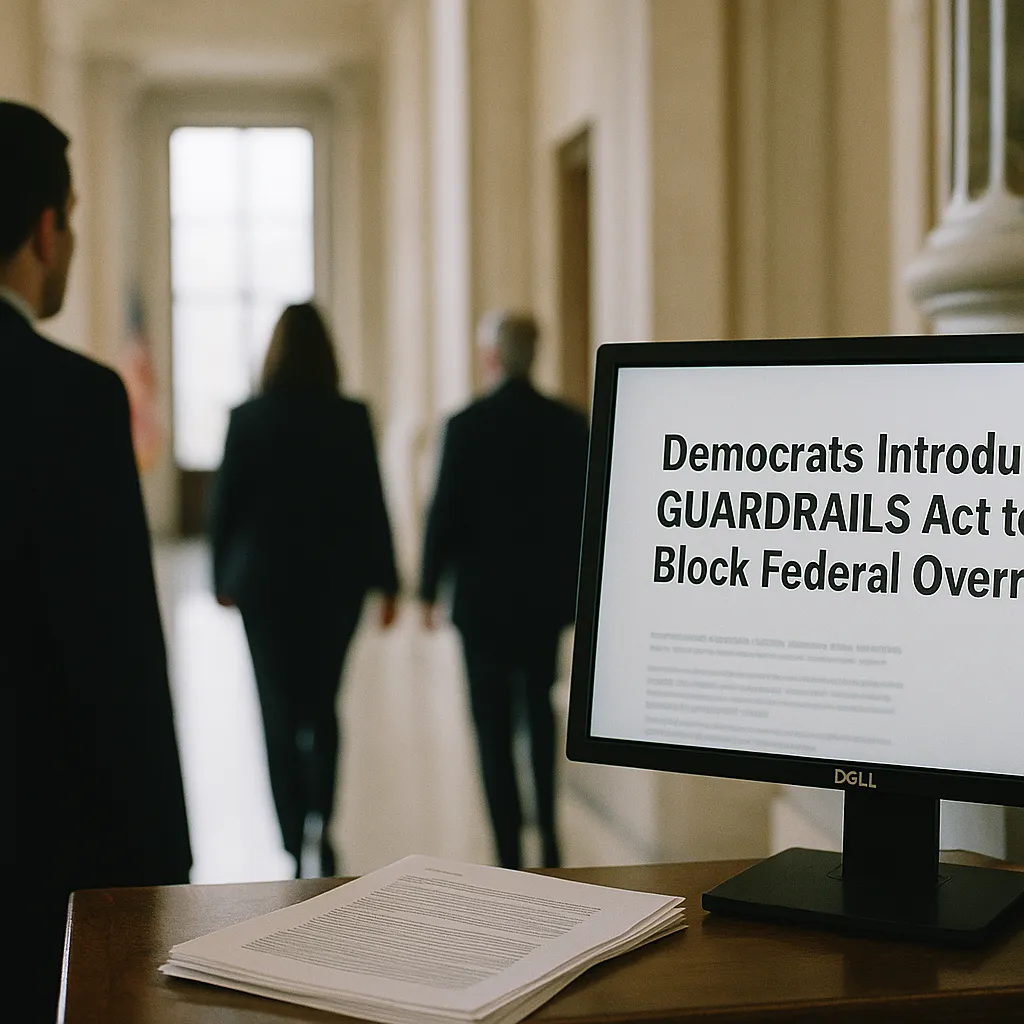
Rep. Don Beyer introduced the GUARDRAILS Act to repeal Trump's AI policy framework and block federal preemption of state AI laws — setting up the defining battle over who governs AI in America.
Democrats Introduce GUARDRAILS Act to Block Federal Override of State AI Laws
Rep. Don Beyer and Democratic colleagues have introduced the GUARDRAILS Act — legislation that would repeal the Trump Administration's national AI policy framework and block its most contentious provision: federal preemption of state AI laws that impose "undue burdens" on AI deployment, according to Consumer Finance Monitor's analysis of the framework. The bill sets up the defining legislative confrontation over who governs AI in America — fifty states or Washington.
Context
The Trump Administration released its National AI Policy Framework in March 2026, replacing the Biden-era AI executive orders that had established federal agency risk assessment requirements and voluntary commitments from AI companies. The new framework is built around acceleration and deregulation: reducing compliance friction, expanding government use of AI, and — most controversially — establishing federal standards that would preempt state AI regulations deemed to create "undue burdens" on interstate commerce in AI systems.
Preemption in this context means a state law would be legally unenforceable — superseded by the federal standard. If a state passed a law requiring companies to disclose when AI was used in a consequential decision affecting a resident, and the federal framework did not require that disclosure, the state law could be nullified.
This is not a hypothetical framework. Twenty-five states have enacted AI-specific laws in the past eighteen months. Colorado, Illinois, Texas, and New York have passed or are advancing laws covering AI in hiring, lending, healthcare decisions, and consumer disclosures. California has enacted multiple AI-related statutes. These laws were passed precisely because Congress hadn't acted, and they reflect constituent pressure on state legislators to provide protections that don't exist federally.
What the GUARDRAILS Act Does
The bill — whose name stands for Guardrails to Uphold Accountability, Restore Democratic Representation, Require Accountability, Implement Liability Safeguards — has two core provisions:
Repeal of the Trump AI framework — nullifying the March 2026 policy document and its implementing instructions to federal agencies, which had directed agencies to remove "unnecessary AI-related requirements."
Block on preemption authority — explicitly prohibiting the use of federal AI policy to override state AI laws. Under the GUARDRAILS Act, states would retain the authority to regulate AI within their jurisdictions regardless of whether federal standards exist.
Get this in your inbox.
Daily AI intelligence. Free. No spam.
The legislation does not establish new federal AI requirements. It is defensive in orientation: preserving the existing patchwork of state laws rather than creating a competing federal floor.
The Policy Stakes
For state regulators: The fight is existential. State AGs and legislators who have spent political capital passing AI laws are not going to quietly accept federal preemption. The GUARDRAILS Act gives them a legislative ally in Congress, even if passage is uncertain in the current House.
For AI companies: The industry is split. Large tech companies have generally preferred federal preemption — one compliance framework is cheaper than fifty. Smaller companies and civil society groups have argued that state laws are the only functioning AI accountability mechanism in the U.S. right now, and federal preemption would effectively mean no meaningful AI oversight.
For consumers: The practical impact of preemption depends entirely on what the federal framework requires. If federal standards are weaker than state laws — which is the stated design of the Trump framework — preemption removes protections that currently exist in those states. In practical terms: if Colorado requires that a consumer be told when an AI denied their credit application, and the federal standard doesn't, preemption means Colorado residents lose that right.
For the courts: Even if the GUARDRAILS Act doesn't pass — which is likely given the current congressional makeup — preemption challenges will land in federal courts. The legal question of whether a federal AI policy framework can preempt state laws without a statute explicitly authorizing that preemption is genuinely unsettled. Courts will decide if Congress doesn't.
The Political Arithmetic
The bill faces long odds in a Republican-controlled House where the majority has been broadly supportive of the administration's AI deregulation agenda. But the political dynamics are more complicated than a party-line count suggests.
Several Republican senators from states with active AI legislation have expressed discomfort with federal preemption — particularly on issues like AI in hiring and credit decisions that affect their constituents directly. And state attorneys general from both parties have signaled they will challenge preemption attempts in court, making the legal route a parallel track regardless of the GUARDRAILS Act's fate in Congress.
What to Watch
The immediate test is whether any Republican co-sponsors emerge — particularly those from states with enacted AI laws facing potential preemption. The secondary test is whether state AGs file preemptive legal challenges to the March 2026 framework before any enforcement action forces the issue. The first legal brief filed in a state-vs-federal AI jurisdiction fight will signal whether this is a slow-moving legislative battle or a fast-moving constitutional confrontation.
By Hector Herrera | NexChron | April 29, 2026
Did this help you understand AI better?
Your feedback helps us write more useful content.
Get tomorrow's AI briefing
Join readers who start their day with NexChron. Free, daily, no spam.