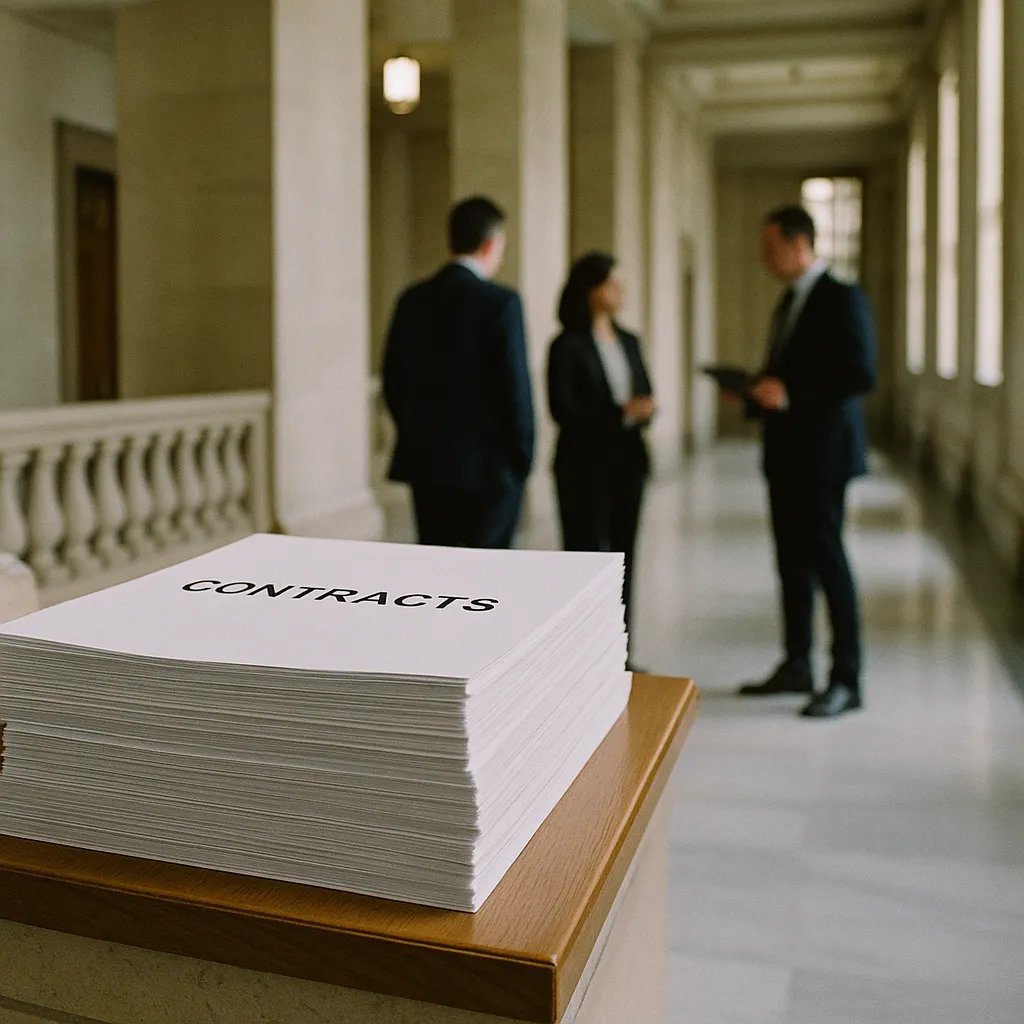
The General Services Administration issued AI procurement requirements for all new federal contracts effective October 19, 2026, bypassing standard rulemaking in an unusual move signaling urgency.
GSA Issues Sweeping AI Requirements for All New Federal Contracts
By Hector Herrera | October 4, 2026
The federal government's purchasing arm just made AI governance a requirement for every company trying to win new federal business. The General Services Administration issued an AI acquisition regulation deviation effective October 19, 2026, applying baseline AI requirements to all new federal procurement contracts — and it did so without the standard notice-and-comment rulemaking period.
The move is one of the broadest federal AI procurement mandates to date. It signals that AI oversight in government contracting has crossed from voluntary frameworks into hard contractual requirements — faster than the traditional regulatory timeline would normally allow.
What a Regulation Deviation Actually Means
A "regulation deviation" is a formal mechanism within the Federal Acquisition Regulation (FAR) system that allows an agency to implement rules without completing the full rulemaking process — which typically involves public comment periods lasting 60 to 90 days and can stretch across years. Agencies use deviations when they believe urgency justifies bypassing normal procedure.
The GSA's decision to use this mechanism rather than standard rulemaking is itself a signal. The agency concluded that waiting for a full public comment process would delay AI governance requirements on federal contracts for too long. Critics may argue that circumventing the standard process reduces transparency; proponents will note that without expedited action, the gap between AI's real-world deployment in federal agencies and any procurement-level accountability would keep widening.
Who This Affects
The regulation deviation applies to all new federal contracts — not retroactively to existing agreements. That means:
- Any technology vendor bidding on new federal work after October 19 must meet the AI requirements.
- Existing contractors on current contracts are not immediately affected, though renewal and modification of those contracts may trigger compliance reviews.
- The GSA sets baseline standards that other federal agencies reference; this deviation effectively establishes a floor for AI procurement across the entire federal government.
The practical reach is enormous. The federal government spends over $700 billion annually on contracts. Technology and IT services represent a large and growing share of that spending, and AI is now embedded in a wide range of federal IT tools — from customer-facing chatbots to back-office automation to cybersecurity monitoring.
Get this in your inbox.
Daily AI intelligence. Free. No spam.
What the Requirements Cover
The full text of the regulation deviation, as reported by FedScoop, establishes baseline requirements spanning risk classification, transparency obligations, and human oversight provisions. Key areas include:
- AI system identification. Contractors must identify AI components within the systems they're delivering.
- Risk classification. Systems are categorized by the level of risk they pose to government operations, civil liberties, or privacy — with higher-risk systems requiring additional safeguards.
- Human oversight requirements. High-stakes AI applications must include documented human review procedures before consequential decisions are made.
- Transparency provisions. Agencies must be informed when AI is making or influencing decisions within contract deliverables.
These requirements align with frameworks established in the Biden administration's 2023 Executive Order on AI, the Office of Management and Budget's AI guidance memoranda, and the National Institute of Standards and Technology's AI Risk Management Framework — but they now carry contractual teeth rather than advisory weight.
Why the Timing Matters
The October 19 effective date comes at a politically complicated moment. The Trump administration has generally favored AI deregulation in commercial contexts — including rolling back some provisions of the Biden-era AI EO — while simultaneously accelerating federal AI adoption through initiatives like the America.gov AI portal. Internal federal AI governance has continued moving toward accountability frameworks even as external regulatory posture has leaned deregulatory.
The GSA's action reflects a practical reality: federal agencies are already deploying AI-assisted systems, and contracting officers needed explicit contractual language to manage vendor accountability. The regulation deviation provides that language without waiting for a politically contentious rulemaking process.
What This Means for Federal Technology Vendors
Any company that derives revenue from federal contracts — from large defense primes to mid-size cloud providers to niche software vendors — must now assess whether their AI-embedded products comply with the new baseline.
The compliance burden is not trivial. Vendors must inventory AI components across their product portfolios, document risk classifications, build or demonstrate human oversight mechanisms, and update contract templates and representations. For companies that have been selling AI-enabled products into federal channels without systematic governance documentation, the work involved is significant.
Government-focused systems integrators — Leidos, SAIC, Booz Allen Hamilton, Accenture Federal Services — will likely move quickly to build compliance frameworks that their downstream vendor ecosystem can adopt. Smaller vendors without dedicated federal compliance teams face a steeper climb.
What to Watch
Contracting officers will need guidance on how to enforce the new requirements during proposal evaluation. Watch for GSA to publish implementing guidance in the days before October 19. Congressional scrutiny of the deviation mechanism is possible — particularly from members who favor formal notice-and-comment processes for significant regulatory actions.
The longer-term question is whether the deviation becomes the foundation for a permanent FAR clause. If it does, AI governance requirements move from agency-specific policies into the bedrock of federal procurement law — affecting every vendor in the federal market permanently.
Hector Herrera is the founder of NexChron and builds AI systems at Hex AI Systems.
Did this help you understand AI better?
Your feedback helps us write more useful content.
Get tomorrow's AI briefing
Join readers who start their day with NexChron. Free, daily, no spam.