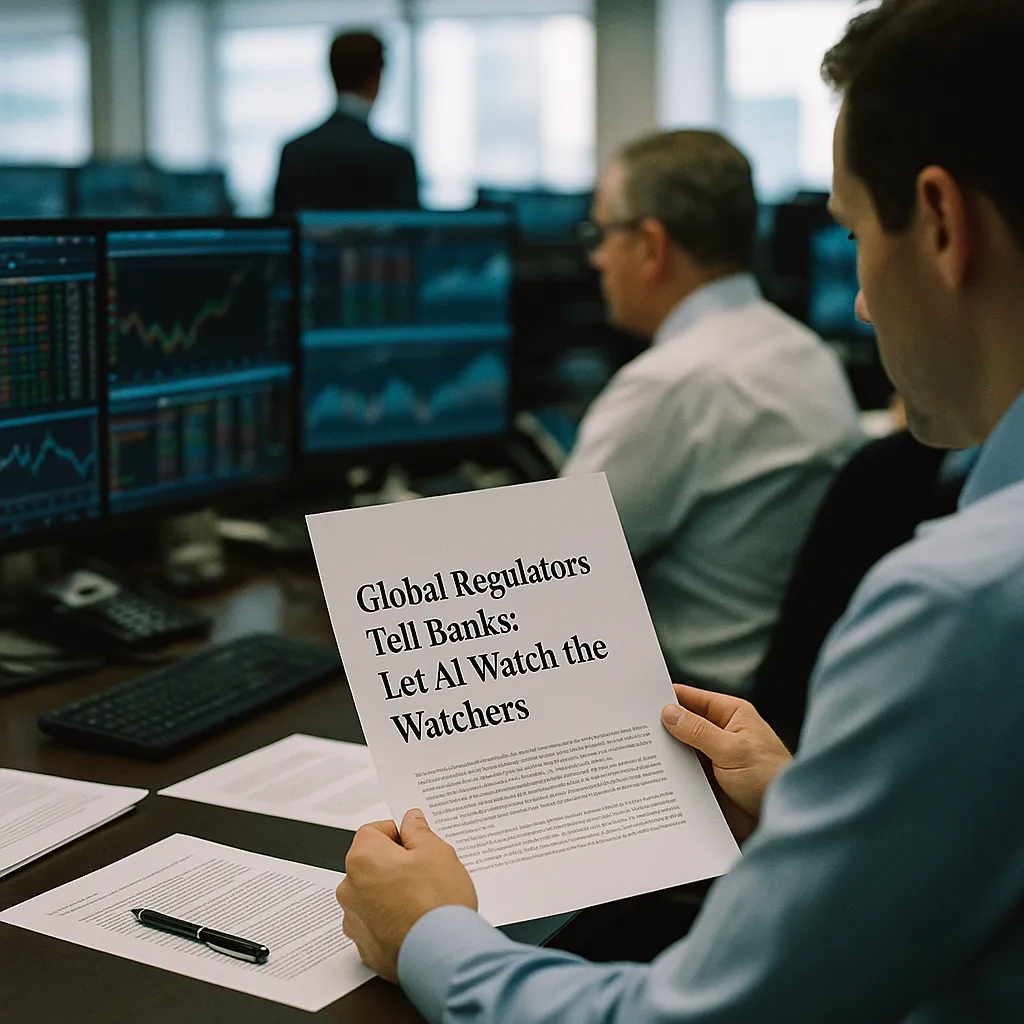
The FSB published 12 AI governance practices formally endorsing AI-monitors-AI oversight — the first global regulatory body to institutionalize it. Comment period closes July 22.
Global Regulators Tell Banks: Let AI Watch the Watchers
By Hector Herrera | June 13, 2026 | Finance · Government Policy
The Financial Stability Board published 12 formal sound practices for AI governance in financial services on June 10 — and embedded inside them is a principle that would have been unthinkable in traditional bank regulation: AI systems used by banks must themselves be monitored by AI, because continuous human review of every AI decision is no longer operationally feasible at scale. This is not a workaround. For the first time, a major global regulatory body has institutionalized the idea that human oversight requires AI assistance to function.
The FSB is the international body that coordinates financial regulation across G20 economies. Its guidance carries significant weight — while not binding law in any single country, FSB frameworks typically become the template that national regulators (the Fed, OCC, FCA, BaFin) translate into enforceable rules. The comment period for these practices closes July 22, 2026.
What the 12 Practices Actually Say
The FSB's framework covers the full lifecycle of AI in banking — from initial model development and validation through ongoing monitoring and incident response. The specific areas addressed include:
- Governance and accountability — boards must formally own AI risk, not delegate it entirely to technology teams
- Model risk management — AI models must be documented, validated, and subject to regular re-testing as market conditions change
- Third-party AI risk — vendors providing AI tools to banks are explicitly in scope; banks cannot outsource AI risk by outsourcing AI tools
- Human oversight supplemented by AI monitoring — the document formally accepts that at the volume and speed AI now operates, human-only review creates gaps; automated monitoring of AI behavior is a required control, not an optional enhancement
- Consumer protection — AI outputs affecting credit decisions, fraud flags, or account actions must be explainable and contestable
The acceptance of AI-monitors-AI as a formal governance principle is the most significant shift. It acknowledges what practitioners have known for years — that a trading floor deploying algorithmic models making thousands of decisions per second cannot have a human review each one in real time. The FSB is catching regulation up to operational reality.
The Timing Is Not Coincidental
This guidance arrives in the same week that U.S. banking regulators escalated their own AI scrutiny at domestic institutions, pressing banks on model explainability and third-party vendor risks. An American Banker survey published this month found 72% of U.S. banks lack a formal AI model kill-switch protocol — a basic safeguard that lets institutions halt a misbehaving model immediately. The FSB's framework would implicitly require exactly that kind of control.
Get this in your inbox.
Daily AI intelligence. Free. No spam.
Together, the FSB framework and the domestic regulatory pressure represent a synchronized global inflection point. Banks that have treated AI governance as a future compliance problem are now in the present-tense.
What This Means for Banks
For large institutions already operating AI at scale, the FSB practices largely describe what best-in-class shops are already doing — the governance burden is clarifying existing structures and documenting them for regulators. The real work is closing the gaps the framework exposes.
For mid-size and regional banks, the third-party risk provisions are the sharpest edge. If your bank uses a fintech's AI underwriting tool, an AI fraud-detection platform, or an automated customer service system, that vendor's AI practices are now your compliance surface. Banks will need to:
- Conduct AI-specific due diligence on existing vendor contracts
- Require contractual access to model documentation and testing results
- Build monitoring capabilities that can flag anomalous AI behavior from third-party systems
For fintechs selling AI tools into banks, the FSB framework is a customer requirement being formalized. Expect RFPs in the next 12-24 months to include detailed AI governance questionnaires as standard.
The Bigger Shift: From Oversight Theater to Systematic Controls
The most consequential idea in the FSB framework is the explicit rejection of "oversight theater" — the practice of claiming human review of AI systems that are, in practice, operating too fast and at too large a scale for meaningful human inspection at the individual-decision level.
What the FSB is requiring instead is systematic: governance structures, monitoring systems, and escalation paths that give human decision-makers visibility into AI behavior in aggregate, with automated tripwires that trigger human intervention when anomalies appear. Humans still make the calls — but AI is the instrument that makes those calls possible.
This matters beyond banking. The FSB framework is likely to become a reference point for regulators in insurance, asset management, and payment systems. The principle — that oversight of AI at scale requires AI tools — will spread.
What to Watch
The comment period closes July 22. Watch for pushback from industry associations on the third-party risk provisions — banks will argue that requiring AI governance audits of every vendor is operationally unworkable. The FSB's response will signal how hard national regulators are likely to push when they translate this framework into enforceable rules.
Source: ABA Banking Journal — Financial Stability Board Sound Practices for AI Adoption
Did this help you understand AI better?
Your feedback helps us write more useful content.
Get tomorrow's AI briefing
Join readers who start their day with NexChron. Free, daily, no spam.