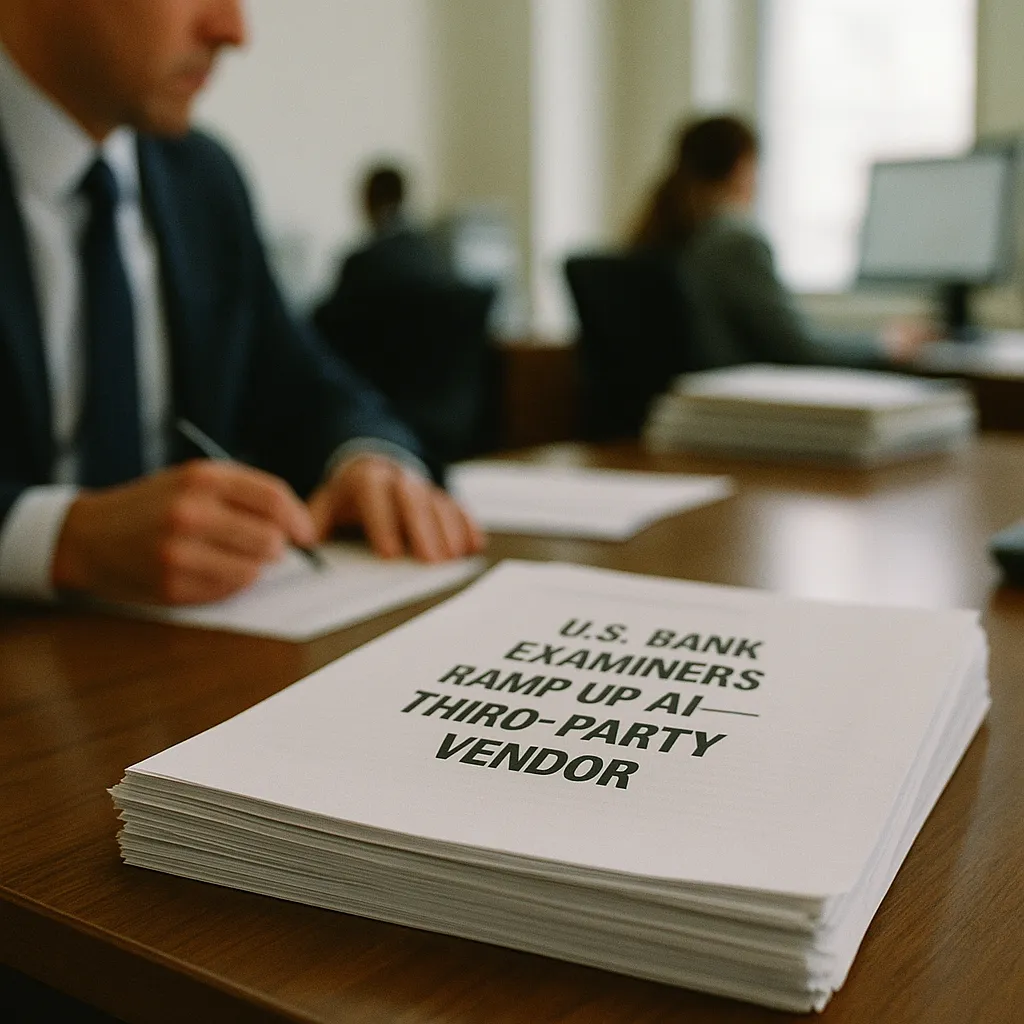
U.S. banking regulators are escalating AI examinations at financial institutions, pressing banks on vendor AI risk. A survey found 72% of banks lack a formal AI model kill-switch protocol.
U.S. Bank Examiners Ramp Up AI Pressure — Third-Party Vendors Now in the Crosshairs
By Hector Herrera | June 13, 2026 | Government · Government Policy
U.S. banking regulators are escalating their scrutiny of AI systems at financial institutions, pressing banks on model explainability, data governance, and — critically — the risks embedded in AI tools purchased from third-party vendors that sit outside traditional regulatory oversight. The escalation arrives in the same week as the Financial Stability Board's global AI governance framework, creating a simultaneous pressure point across the entire U.S. banking system. An American Banker survey found 72% of banks lack a formal AI model kill-switch protocol — a basic control that lets an institution halt a misbehaving model immediately.
The timing is deliberate. The OCC (Office of the Comptroller of the Currency), FDIC, and Federal Reserve — the three main bank regulators — are conducting AI-focused examinations alongside standard safety-and-soundness reviews. The message from examiners has shifted from "tell us what AI you're using" to "show us how you're controlling it."
What Examiners Are Actually Asking
Banks that have undergone recent AI-focused examination reviews report that examiners are pressing on several specific areas:
Model explainability: When an AI system denies a loan, flags a transaction as suspicious, or routes a customer inquiry, can the bank explain the decision to the examiner — and to the customer? Regulators are concerned that banks are deploying AI outputs they cannot meaningfully explain or defend, particularly in consumer-facing contexts governed by fair lending laws.
Data governance: What data is the AI trained on or using? Does it include protected class characteristics, directly or as a proxy? Is the training data current? Banks with AI models trained on pre-pandemic loan performance data, for example, face questions about whether those models are drawing on conditions that no longer exist.
Kill-switch protocols: The American Banker finding — that 72% of banks lack formal procedures for halting AI systems in an emergency — is precisely what regulators are probing. If a fraud detection model starts producing anomalous results, what is the documented procedure for shutting it off, who has the authority to trigger it, and how long does it take?
Get this in your inbox.
Daily AI intelligence. Free. No spam.
Third-party AI risk: This is the newest and sharpest edge of the current wave. Examiners are asking banks to produce documentation of AI governance practices at their AI vendors — companies that provide credit scoring tools, fraud detection platforms, customer service bots, and document processing systems. The position regulators are taking is that a bank cannot outsource its risk management obligations by outsourcing the AI.
Why Third-Party Risk Is Different This Time
Banks have been managing third-party vendor risk for decades. Standard practice involves due diligence, contractual requirements, and periodic reviews. But traditional vendor risk management was designed for systems that perform defined functions in defined ways. AI systems are different.
An AI fraud detection model does not simply apply a fixed ruleset. It infers patterns from data, and those patterns can shift as the underlying data changes. A vendor that provided a well-validated model in 2024 may be serving a materially different model in 2026 without the bank's knowledge, because the vendor has retrained it on new data or updated its architecture. Banks that never asked for re-validation rights in their vendor contracts did not anticipate this problem.
Examiners are now effectively requiring banks to rebuild their third-party AI framework from the ground up:
- Contract provisions that require vendors to notify banks of material model changes and provide re-validation data
- Audit rights — contractual access to model documentation, test results, and bias evaluations
- Sub-processor transparency — many fintech AI tools run on infrastructure from a third AI company (e.g., using OpenAI or Anthropic APIs under the hood). Banks are being asked to trace this dependency chain
- Incident response coordination — if a vendor's AI system produces a discriminatory lending outcome, who is responsible and what is the response protocol?
The Scale of the Exposure
Banks are not a monolith. The largest U.S. financial institutions — JPMorgan, Bank of America, Wells Fargo — have sophisticated AI governance programs that largely anticipate what examiners are looking for. The challenge for those banks is documentation and formalization.
The real exposure is at regional and community banks that have deployed AI tools from fintechs precisely because they lack the internal capacity to build those systems themselves. A community bank with $5 billion in assets that uses an AI-powered mortgage underwriting platform from a third-party vendor now faces examination questions that require AI-specific due diligence they may have never performed.
The FSB's global sound practices, published in the same week, draw a direct line under what "responsible AI use" looks like internationally. U.S. regulators are now enforcing a domestic version of that expectation — and enforcement is already happening through examination findings, not just guidance.
What to Watch
Watch for formal guidance from the OCC and FDIC on third-party AI risk management — likely in the form of updated third-party risk management bulletins that explicitly address AI tool characteristics. The CFPB (Consumer Financial Protection Bureau) has a separate track on AI in consumer-facing lending decisions that intersects with these examinations. If the examination findings result in Matters Requiring Attention (MRAs) or enforcement actions, those will be the signal that the compliance window is closing.
Source: Reuters via AOL — Exclusive: U.S. bank regulators ramp up AI scrutiny
Did this help you understand AI better?
Your feedback helps us write more useful content.
Get tomorrow's AI briefing
Join readers who start their day with NexChron. Free, daily, no spam.