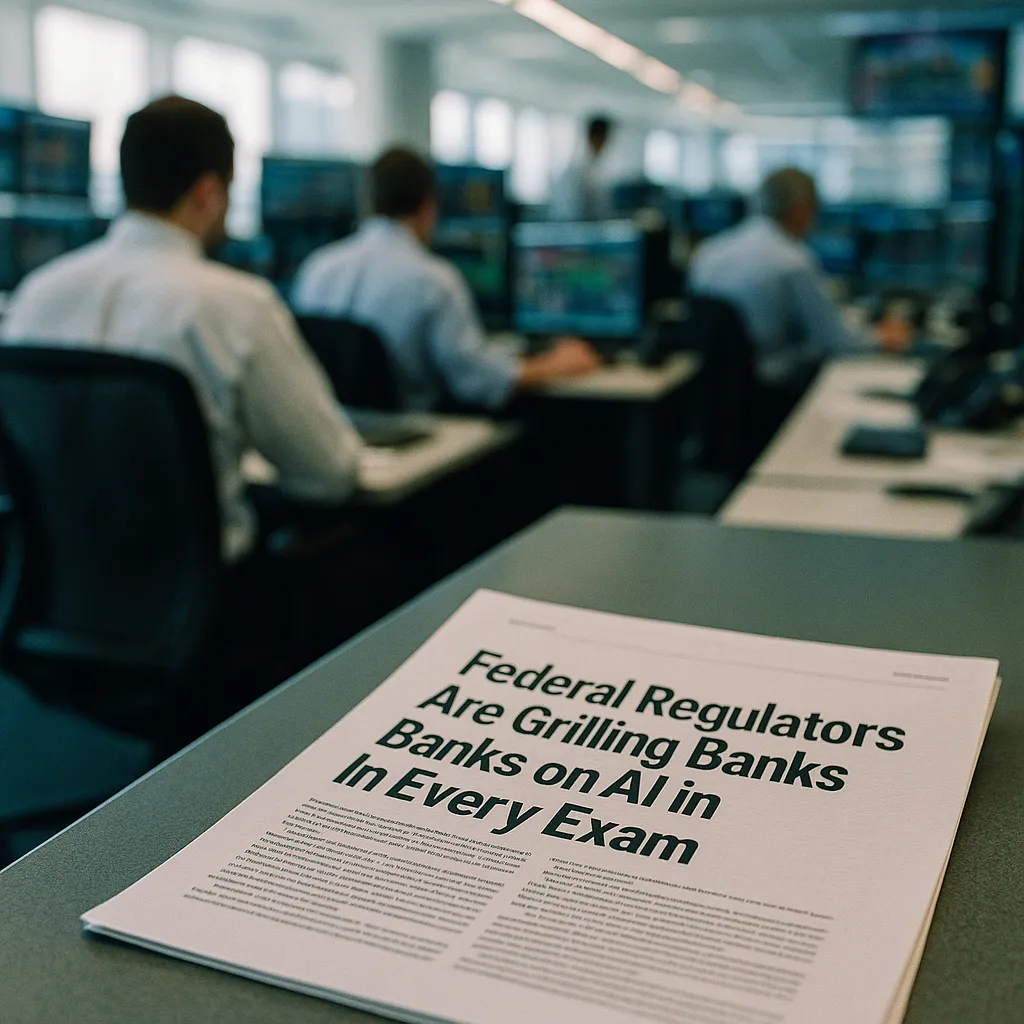
The Fed, OCC, and FDIC now probe AI governance in every exam cycle. A June 2026 survey found 72% of banks can't demonstrate AI failure controls on demand — and generative AI has outpaced the SR 26-2 guidance meant to govern it.
Federal Regulators Are Grilling Banks on AI in Every Exam — and Most Banks Are Failing
By Hector Herrera | June 14, 2026 | NexChron.com
The Federal Reserve, OCC, and FDIC are now scrutinizing AI governance in every federal bank examination cycle — not just during targeted technology reviews — and a June 2026 survey found 72% of banks are unprepared to demonstrate AI failure controls on demand. The shift marks a meaningful escalation: AI is no longer a specialty topic that bank examiners check occasionally. It is now baseline compliance terrain.
The core problem is a lag between how fast generative AI is spreading inside banks and how fast regulatory guidance has caught up. The result is a gap that examiners are increasingly treating as a safety finding — the kind that shows up in exam reports and can trigger formal corrective action.
What SR 26-2 Covers — and What It Doesn't
SR 26-2 is the Federal Reserve's model risk management guidance, first issued in 2011 and updated incrementally since. It defines how banks should validate, test, and govern quantitative models — the credit scoring engines, risk calculators, and trading algorithms that have always been at the heart of banking operations.
Generative AI does not fit cleanly into SR 26-2. The guidance was written for deterministic models with defined outputs. Large language models (LLMs) — the technology behind ChatGPT, Claude, and similar tools — are probabilistic, non-deterministic, and often opaque in how they reach conclusions. Asking an LLM to summarize a loan document is fundamentally different from running a credit scoring algorithm. The existing governance framework was not built for this.
That gap has become the focal point for examiners in 2026. According to TechTimes, regulators are specifically asking about two things:
- Kill-switch readiness: Can the bank immediately halt an AI system if it starts producing harmful outputs? Who has the authority, what's the process, how fast can it happen?
- Data containment: Is customer data being sent to third-party AI systems? What controls prevent sensitive data from leaking into model training pipelines?
Most banks cannot answer these questions with documentation on hand during an exam.
Get this in your inbox.
Daily AI intelligence. Free. No spam.
How AI Proliferated Faster Than Governance
The pattern at most large and mid-size banks looks similar. An employee team piloted a generative AI tool — often a Microsoft Copilot deployment or a custom LLM integration — in a business unit. It showed productivity gains. Other teams adopted it. Within 18 months, the tool was embedded in loan processing, customer service, compliance workflows, and internal knowledge management.
The problem: each of those deployments happened faster than the governance framework could track them. IT risk teams, model risk offices, and compliance departments often learned about these tools after deployment — sometimes much later. The survey showing 72% of banks unprepared is not a surprise to anyone who has spent time inside a large bank's technology organization in the past two years.
This is not unique to banking. What makes banking different is that federal regulators have both the authority and the institutional habit of using exam findings as enforcement levers. A safety finding on AI governance during an OCC exam is not a suggestion. It becomes a matter of record with corrective action timelines.
What Examiners Are Actually Looking For
Based on the current regulatory posture, examiners in 2026 are checking for four things:
- An AI inventory. Can the bank list every AI and machine-learning system it uses, including vendor-supplied tools embedded in third-party software?
- Model risk categorization. Has the bank applied its model risk framework — or a modified version of it — to generative AI tools? High-risk applications (customer-facing decisions, credit, fraud) should have the most rigorous validation.
- Kill-switch authority. Is there a documented procedure for suspending an AI system, with named individuals who can execute it without additional approvals?
- Third-party vendor oversight. If the bank uses an external AI vendor, does it have contractual access to audit that vendor's practices? Can it confirm customer data is not being used for model training?
Most banks have partial answers at best. The AI inventory is frequently incomplete because many tools were procured at the business unit level rather than through central IT. Model risk categorization for generative AI is almost universally in progress but not finished.
The Regulatory Gap Won't Close Itself
The regulators are aware that SR 26-2 needs to be updated. But guidance updates move slowly, and examiners have been instructed not to wait. The practical effect is that bank examiners are applying judgment — and that judgment is not always consistent across regional Fed banks, OCC districts, and FDIC regions.
Banks are being held to a standard that has not been formally written down. That is uncomfortable, but it is also the reality of operating in a sector where regulators have a mandate to ensure safety and soundness before the rule book catches up to the technology.
The banks best positioned right now are those that extended their existing model risk governance frameworks to cover generative AI proactively — even imperfectly — rather than waiting for updated guidance. They have documented processes, named owners, and audit trails. That evidence of intent matters in an exam even when the governance is still maturing.
What to Watch
The OCC has signaled it will publish updated AI model risk guidance before the end of 2026. The Fed is conducting a separate review of SR 26-2 applicability to generative AI. In the meantime, expect exam findings on AI governance to increase in frequency and formality — and expect the banks that ignored this through 2025 to spend 2026 and 2027 in remediation mode.
Sources: TechTimes
Did this help you understand AI better?
Your feedback helps us write more useful content.
Get tomorrow's AI briefing
Join readers who start their day with NexChron. Free, daily, no spam.