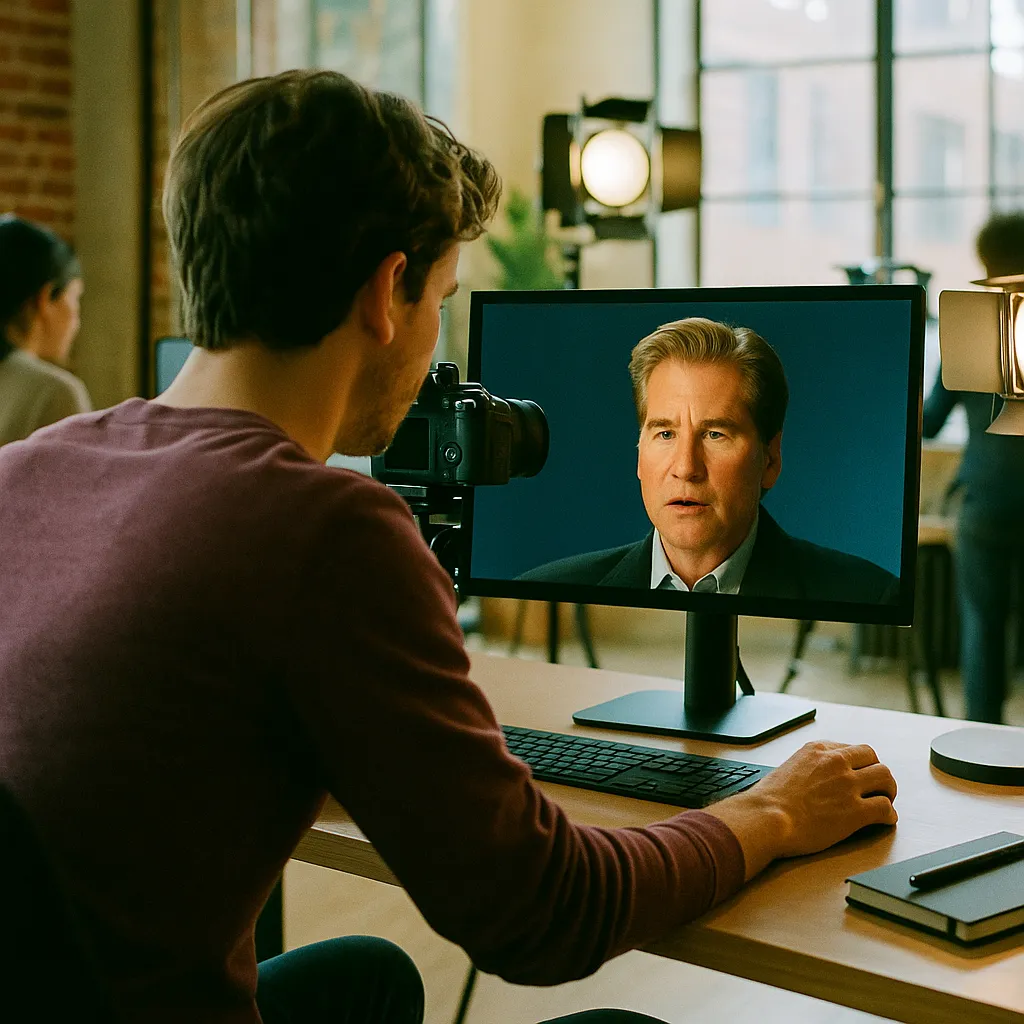
A posthumous AI-reconstructed Val Kilmer performance is forcing the Academy to apply — and publicly define — its rule barring performances fully generated by artificial intelligence.
Val Kilmer's AI-Generated Posthumous Performance Is Testing Oscar's New AI Rules
By Hector Herrera | May 18, 2026
A posthumous AI-generated performance from the late Val Kilmer is forcing the Academy of Motion Picture Arts and Sciences to publicly apply a rule it adopted just months ago — and the application is already exposing how difficult the line between AI assistance and AI generation actually is. Variety reports that a new film featuring Kilmer's AI-reconstructed performance is prompting scrutiny under the Academy's rule that acting performances "fully generated by artificial intelligence" are ineligible for awards. The problem is that nobody has yet established what "fully generated" means — or who gets to decide.
This is not a peripheral edge case in the ongoing debate about AI in the creative industries. It is exactly the test case that reveals whether the creative community's policy responses to AI can hold when they encounter a compelling, commercially released piece of work with a human name attached.
What Val Kilmer's AI Performance Actually Is
Kilmer, who died in April 2025, had previously consented to voice reconstruction work. The production company used AI voice synthesis and digital likeness technology to construct a performance for the new film — one that draws on footage, recordings, and possibly performance data captured before his death.
The technical reality of such a reconstruction sits in a continuum rather than at a clear endpoint:
- Voice synthesis — AI models trained on recordings of Kilmer's voice, generating new speech he never actually delivered
- Digital likeness — visual compositing of his image, potentially augmented by AI-generated expressions or movements
- Performance direction — human creative choices about what the character says, how they move, what emotions they convey
The human creative labor in the film is real. Directors, writers, producers, and visual effects artists made thousands of decisions to shape the final performance. But the voice and face delivering those creative decisions belong to a man who is no longer alive — reconstituted by AI from the data his living presence left behind.
The Academy's rule targets "fully generated" performances. If any meaningful human performance element remains, the eligibility question becomes genuinely ambiguous. That ambiguity is the problem.
Get this in your inbox.
Daily AI intelligence. Free. No spam.
Why the Industry Needed This Test Case
The Academy adopted its AI eligibility rules following sustained pressure from actors and writers who had fought through the 2023 strikes partly over AI protections. NexChron's May 10 coverage of the Oscars AI ineligibility rule detailed how the policy was written broadly to signal the Academy's commitment to human artistry — while leaving implementation specifics undefined.
Every policy in this space faces the same structuring problem: AI is not a binary. It is a spectrum of assistance, augmentation, generation, and replacement that does not map cleanly onto categories like "AI performance" versus "human performance." The Kilmer case sits near one end of that spectrum — a performance where no living human is performing — but it is constructed from the artifacts of a real human who did perform, and assembled by human creatives who are making real artistic decisions.
The Cannes 2026 AI authorship debates that NexChron covered in May showed the same definitional problem from the filmmaking side: at what point does AI-assisted filmmaking become AI-generated filmmaking? The Kilmer case is the acting equivalent of that question.
The Specific Stakes for the Academy
If the Academy rules the performance eligible, it sets a precedent that AI reconstruction of deceased performers does not disqualify a film from awards consideration — a significant signal to studios with vaults full of footage of legendary actors.
If the Academy rules it ineligible, it must explain where exactly the line sits, and that explanation will immediately be tested by the next production that is slightly more human-involved in its reconstruction.
If the Academy declines to issue a pre-release ruling and waits for a potential awards submission to trigger formal review, it punts the definitional work until the moment it is most publicly contested.
None of these outcomes is clean. The Kilmer case is useful precisely because it does not have an obvious answer — it requires the industry to do the definitional work it has been avoiding.
The Consent Question Running Underneath
There is a separate issue the Variety coverage raises that the awards eligibility debate can obscure: Kilmer consented to some form of AI reconstruction during his lifetime. Whether that consent covers the specific use made of his likeness in this particular film is a matter for his estate and the production company's agreement. But the consent question matters for how the creative community evaluates the ethics of the performance independent of its awards eligibility.
The Screen Actors Guild negotiated AI likeness protections in the 2023 contract. Those protections cover living members. For deceased performers — especially those who gave partial consent to reconstruction — the legal and ethical framework is still being written.
What to Watch
Watch how the Academy's Governors formally respond to the Kilmer situation, and whether they issue updated guidance that defines the human involvement threshold for eligibility. Separately, watch whether studios with IP interests in other deceased performers' likenesses — from legacy Hollywood figures to more recently deceased actors — use this moment to test the boundaries. The commercial incentive to use AI-reconstructed performances of beloved actors is substantial, and the Kilmer film will tell the industry how much legal and reputational risk is actually attached to doing so.
Source: Variety, May 2026
Did this help you understand AI better?
Your feedback helps us write more useful content.
Get tomorrow's AI briefing
Join readers who start their day with NexChron. Free, daily, no spam.