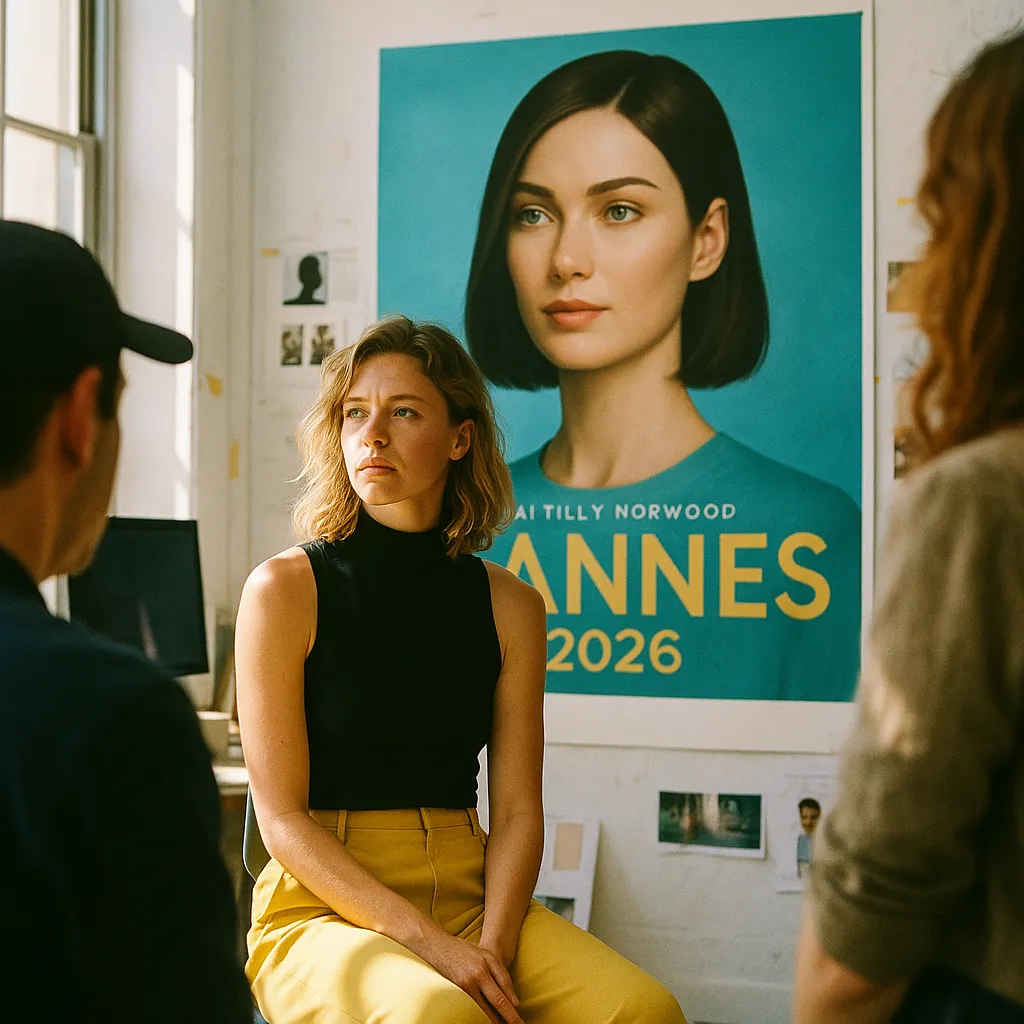
A fully AI-generated actress named Tilly Norwood appeared at the 79th Cannes Film Festival, triggering immediate guild backlash and prompting the Academy to require acting nominations be demonstrably performed by humans.
Cannes 2026: AI 'Actress' Tilly Norwood Sparks Industry Backlash as Oscars Draw New Lines
By Hector Herrera | May 21, 2026 | Creative
The 79th Cannes Film Festival became the site of the film industry's most direct confrontation with AI performance when a fully synthetic actress named Tilly Norwood — generated entirely by AI with no human actor behind the role — appeared in a competing film and drew immediate condemnation from actors, guilds, and industry leaders. The Academy of Motion Picture Arts and Sciences responded within days by announcing that acting nominations will require performances "demonstrably performed by humans with their consent."
Two things are true simultaneously: the technology is already here, and the industry has no framework for it. Tilly Norwood is not a hypothetical. The question of what film and television do with synthetic performers has moved from speculative to immediate.
Who — or what — Tilly Norwood is
According to AP reporting, Tilly Norwood is a fully AI-generated actress presented at Cannes in a screened film. The character has no human source behind it — no motion capture actor, no voice performer, no underlying human whose likeness was adapted. The entire performance was synthesized: appearance, movement, voice, emotional expression.
This is categorically different from previous AI controversies in film. De-aging visual effects (used on Harrison Ford in Indiana Jones and the Dial of Destiny, for instance) modify a human performance. Digital recreations of deceased actors have used underlying human footage as source material. CGI characters like Gollum or Thanos are built over motion-capture performances from human actors. Tilly Norwood has none of that. There is no human in the performance chain.
The Oscars response
The Academy of Motion Picture Arts and Sciences announced its new acting eligibility standard in direct response to the Cannes controversy. The key provisions:
Get this in your inbox.
Daily AI intelligence. Free. No spam.
- Acting nominations require performances "demonstrably performed by humans with their consent." This closes the door on synthetic performers like Norwood and on AI recreations of deceased actors without estate-level consent agreements.
- The "with their consent" clause directly addresses a scenario already happening in practice: living actors' AI replicas deployed in productions without renegotiated consent from the actors themselves.
- AI tools neither help nor harm eligibility for other nomination categories — including cinematography, editing, production design, visual effects, and original score. The Academy is drawing a sharp line around performance specifically, not AI use in production broadly.
The clarity on non-performance categories is notable. It removes a source of ambiguity that had filmmakers uncertain whether using AI editing tools or AI-generated set extensions would disqualify their work from awards consideration.
What the industry is arguing about
The Tilly Norwood case has split the industry into roughly three camps that are not going to converge easily.
The guild position is categorical: synthetic performers threaten actors' livelihoods and must be prohibited in union productions. SAG-AFTRA negotiated AI performance protections in its 2023 contract after a 118-day strike. A synthetic performer that requires no actor, no residuals, and no consent is the scenario those protections were designed against.
The filmmaker position treats AI performance tools as production tools, no different from VFX, CGI characters, or digital doubles — creative instruments that skilled directors use to tell stories. The question under this framing is attribution and compensation, not prohibition.
The platform position — streamers and studios operating at scale — is largely unstated but structurally clear. AI-generated characters reduce production costs, require no scheduling, no travel, no onset medical, and no renegotiation. The economic incentive to deploy synthetic performers in secondary and background roles is significant.
What makes the debate difficult to resolve is that union jurisdiction and guild agreements only bind signatories. Productions that opt out of SAG-AFTRA agreements — common in low-budget, international, and streaming contexts — face no contractual barrier to synthetic performers.
The broader precedent
Cannes has a particular authority in shaping film industry norms. The festival's decisions on screening and competition eligibility have historically tracked what the broader industry eventually standardizes. When Cannes decided in 2023 to require disclosure of AI use in competing films, other major festivals followed.
The Tilly Norwood case is different in scale. Previous AI controversies at Cannes centered on tools: AI-generated imagery, AI editing assistance, AI scriptwriting. This is a tool that replaces a human role entirely. The festival's decision on how to handle the Norwood film — whether to disqualify it, screen it with disclosure, or screen it without condition — will establish a precedent that every festival, awards body, and union contract will reference.
What to watch
SAG-AFTRA's next contract negotiations, expected in 2026, will almost certainly produce explicit synthetic performance clauses with financial penalties for use in covered productions. The more important battleground may be international co-productions and streaming-first projects, where union jurisdiction is contested. Watch for streaming platforms' policy announcements on synthetic performers — if Netflix, Amazon, or Apple announce internal bans, that shifts market norms regardless of what contracts say. If they stay silent, the silence is its own answer.
Did this help you understand AI better?
Your feedback helps us write more useful content.
Get tomorrow's AI briefing
Join readers who start their day with NexChron. Free, daily, no spam.