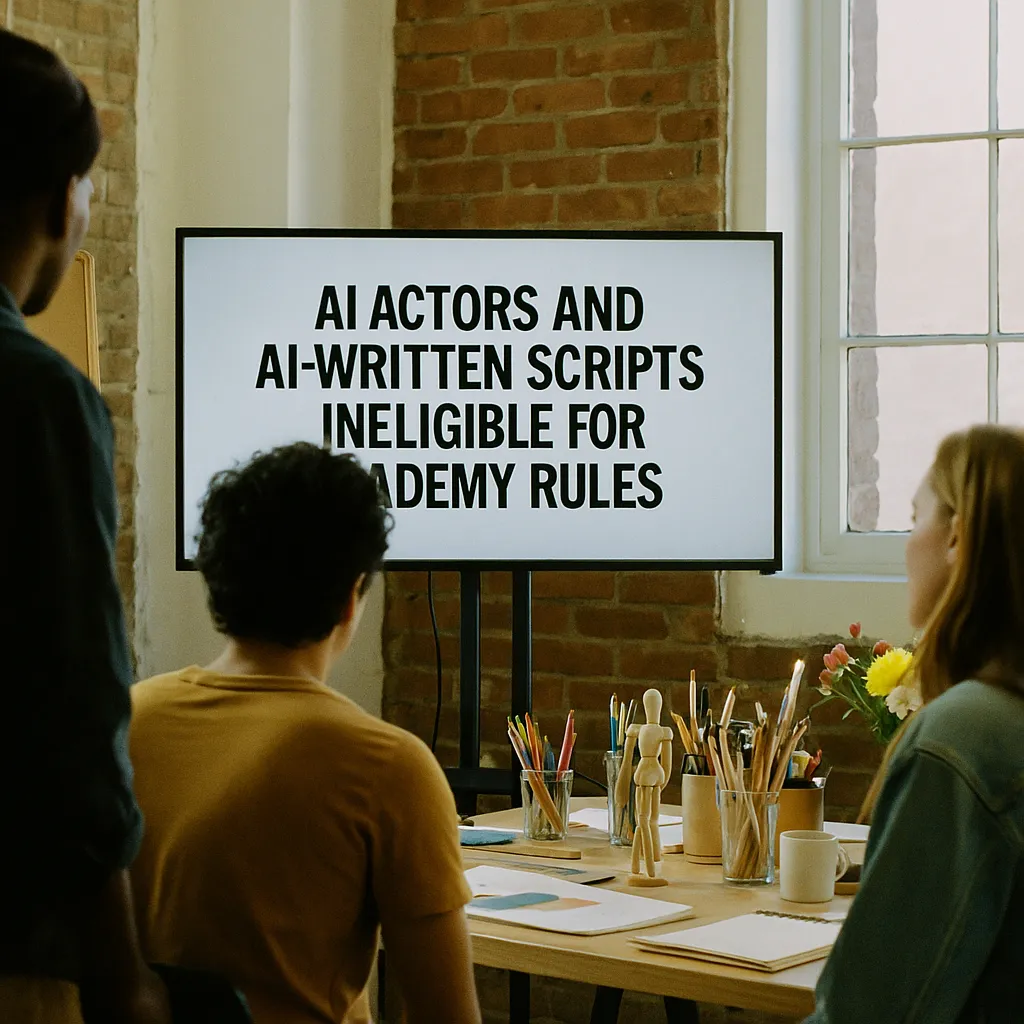
The Academy of Motion Picture Arts and Sciences has ruled that AI-generated performances and AI-primary screenplays are ineligible for Oscar consideration.
Academy Rules AI Actors and AI-Written Scripts Ineligible for Oscar Consideration
By Hector Herrera | May 10, 2026 | Creative
The Academy of Motion Picture Arts and Sciences has drawn a formal line between human and machine creative authorship: AI-generated performances will not be considered for acting awards, and screenplays must be primarily human-authored to qualify for Oscar eligibility. The ruling, announced in early May 2026, gives the film industry's most prestigious institution its clearest position yet on AI-generated creative work.
What the Academy Actually Ruled
The Academy's new eligibility criteria establish two specific exclusions:
On acting: A performance generated or significantly constituted by AI — meaning a digital actor whose movements, voice, and expression were produced by generative models rather than a human performer — is not eligible for Academy Award consideration in any acting category.
On writing: A screenplay must be primarily authored by a human to qualify for Best Original Screenplay or Best Adapted Screenplay consideration. AI-assisted writing — where a human writer used AI tools in their process — is not automatically disqualified, but AI-primary generation is.
The Academy has not published a detailed technical definition of where the line falls between "AI-assisted" and "AI-generated." That ambiguity is intentional and will likely generate ongoing interpretation as productions increasingly blend human and AI creative work.
The Context Behind the Ruling
This did not happen in isolation. The Academy's move follows the Cannes Film Festival's earlier policy statement requiring festival submissions to disclose AI use and affirm human creative primacy. Cannes drew the line at eligibility for the Palme d'Or and other main competition awards.
The Screen Actors Guild–American Federation of Television and Radio Artists (SAG-AFTRA) has been pushing studios toward explicit contractual protections against digital replicas of actors being used without consent or compensation — protections won in the 2023 strike and now being stress-tested as AI image and voice synthesis technology has advanced significantly since that agreement was negotiated.
Get this in your inbox.
Daily AI intelligence. Free. No spam.
The Writers Guild of America (WGA) negotiated AI provisions in its 2023 agreement that require writers to disclose AI use and bar studios from using AI-generated material to fulfill human writer minimums. The Academy's ruling aligns with that framework by placing the eligibility determination at the output end rather than the process end.
Why the Academy's Position Carries Weight
Oscar eligibility is not a legal standard. But it functions as a de facto industry benchmark because of the commercial and reputational stakes attached to Academy recognition.
A film that cannot qualify for acting or writing awards because of AI authorship faces a specific competitive disadvantage in the prestige market — the segment of the film industry where awards drive theatrical longevity, streaming licensing value, and the ability to attach top talent to future productions.
Studios making decisions about how much AI to embed in production pipelines will now weigh Oscar eligibility as a variable. A film that is 60% AI-generated in its script and uses a digital lead performance might generate lower production costs but forfeits access to the awards circuit that justifies prestige-market budgets.
This creates a market signal that existing contracts do not fully generate on their own. The WGA and SAG-AFTRA agreements govern employment and compensation; the Academy's ruling governs recognition. Together, they create reinforcing incentives to maintain human authorship as the primary creative layer.
What Is Not Settled
The ruling leaves significant questions open:
-
Digital voice and likeness of living actors. If a studio licenses an actor's voice and likeness for an AI-generated performance, and the human actor approved and directed elements of the characterization, is that human or AI performance? The Academy has not answered this.
-
AI-assisted performances. Actors are already using AI-powered performance capture, real-time facial replacement, and de-aging tools. Where does the line fall between enhancement and generation?
-
International productions. Oscar eligibility rules apply to Academy members and submissions, not to global production decisions. Studios operating primarily outside the U.S. awards market have less direct incentive to align with these standards.
These gaps will be tested in the 2026-27 production cycle, which is already underway with projects that incorporate various levels of AI-generated content.
What to Watch
Watch for the Directors Guild of America and the Producers Guild to issue their own guidance, which typically follows Academy eligibility changes. Also watch for the Academy to publish more specific technical standards for what constitutes "AI-generated" performance — the current language is general enough that productions will test its edges, and the Academy will need to respond with specificity.
Sources: Film Information
Did this help you understand AI better?
Your feedback helps us write more useful content.
Get tomorrow's AI briefing
Join readers who start their day with NexChron. Free, daily, no spam.