Disney has struck a multiyear agreement with Adobe to co-develop custom generative AI models trained on its proprietary content libraries — marking a sharp reversal from the studio's previous anti-AI stance.
Disney has struck a multiyear agreement with Adobe to co-develop custom generative AI models trained on Disney's proprietary content libraries — covering feature animation, theme park design, ESPN sports production, and marketing — in one of the most consequential studio AI commitments since generative technology emerged as a commercial force. The deal marks a sharp reversal for a company that previously aligned with Hollywood's anti-AI coalition and represents a broader conclusion among major studios that generative AI adoption is now strategically unavoidable.
The scale of the commitment distinguishes this from the exploratory AI partnerships studios have been announcing over the past two years. Disney is not licensing a third-party tool. It is co-developing models trained on its own intellectual property, with Adobe providing the generative AI infrastructure and Disney providing both the content and the production workflow context. The result will be proprietary models rather than Disney-tuned versions of publicly available ones.
What the Deal Covers
The agreement spans four distinct content operations:
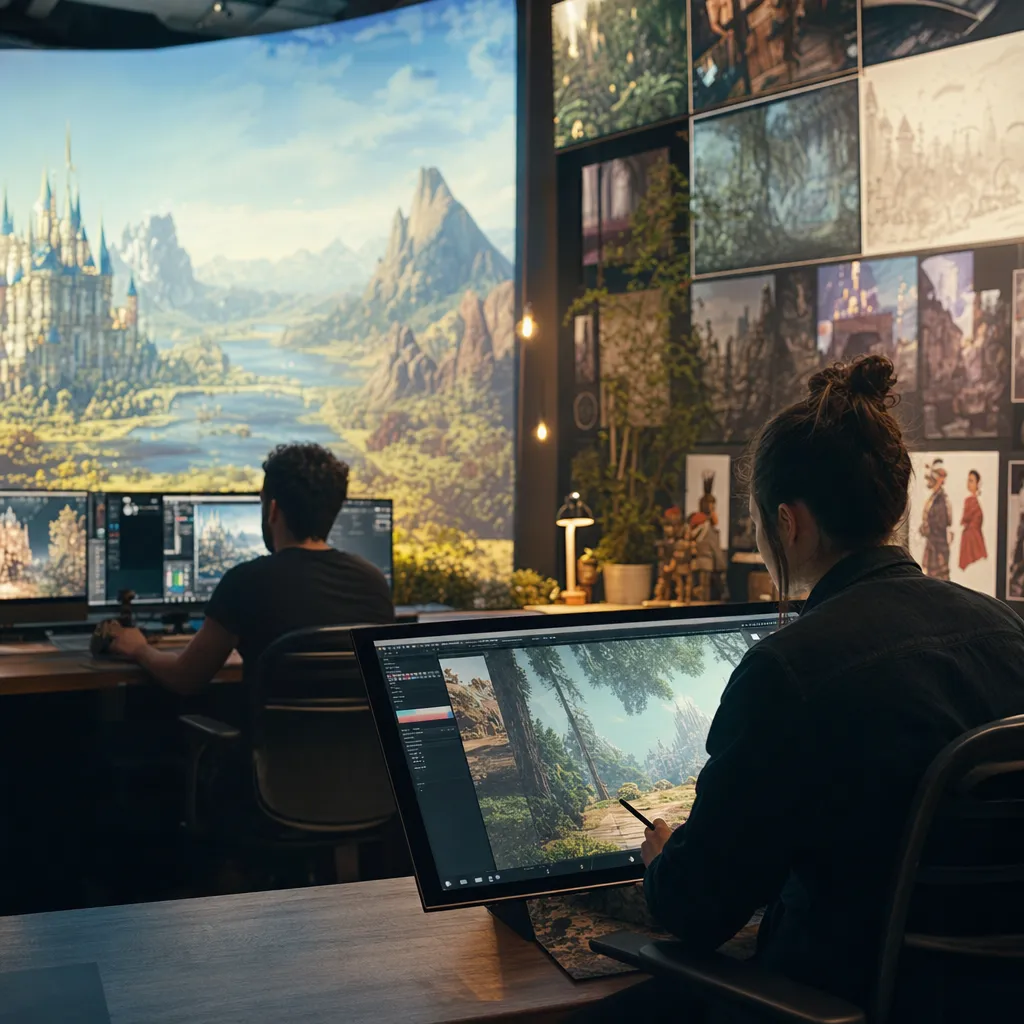
Feature animation. Disney's animation division — responsible for Pixar, Walt Disney Animation Studios, and their associated visual development processes — will develop AI tools trained on the company's character design, visual style, and production asset libraries. The goal is accelerating pre-production: concept visualization, storyboard iteration, and asset generation that currently requires weeks of animator time per project.
Theme park design. Walt Disney Imagineering, the division responsible for designing and building Disney parks globally, will use custom AI models to accelerate experience design, attraction concept development, and the generation of visual reference material. This application has received less attention than film industry AI use cases but represents a substantial design and construction operation with concept-to-execution timelines measured in years — timelines where AI-accelerated iteration has significant value.
ESPN sports production. ESPN will apply generative AI to sports production workflows — highlights generation, graphics, and real-time content assembly around live events. Sports is one of the fastest-moving segments of the media industry for AI-assisted production, with high demand for personalized clips, instant recaps, and multilingual content generation that scales far beyond what human production teams can produce.
Get this in your inbox.
Daily AI intelligence. Free. No spam.
Marketing. Disney's marketing operations — spanning theatrical releases, streaming promotions, parks advertising, and merchandise — will use custom models to generate and iterate on campaign creative. Marketing is typically where entertainment companies deploy AI first, because the content cycle is fast and the tolerance for iteration is high. The scale of Disney's global marketing activity makes this one of the highest-volume applications in the deal.
The Reversal
Disney's decision requires context. The company was among the studios that expressed concern about generative AI's impact on the creative workforce during the 2023 WGA and SAG-AFTRA strikes. Disney's CEO Bob Iger emphasized then that the company took seriously the concerns of the guilds about AI displacement.
The resolution of those strikes — with AI provisions that required disclosure of AI use in productions and established minimum standards for how AI-generated content is credited — created a governance framework that made studio AI adoption more legible. Studios that had been reluctant to move publicly on AI found that the post-strike framework gave them clear rules to operate within rather than a regulatory vacuum.
The more direct driver is competitive pressure. Studios and streaming services that have moved aggressively on generative AI — including smaller production houses and international competitors — are producing more content at lower cost. Disney's scale of content output and the speed requirements of streaming mean the economic case for AI-assisted production is compelling regardless of earlier public commitments.
Why This Structure
The joint development model — Adobe building the generative infrastructure, Disney providing proprietary content — is strategically significant. Disney's value is not just in its IP catalog; it is in the specific visual language, character design systems, and narrative conventions that have made its content identifiable across generations. A model trained on Disney's internal production assets will be more capable in Disney-specific applications than any general-purpose generative model, while remaining within Disney's control rather than flowing into Adobe's broader commercial products.
Adobe's Firefly platform, which forms part of the underlying infrastructure, was built with intellectual property rights compliance as a core design principle. This matters to Disney: the company cannot use generative tools that might expose it to copyright claims from third-party training data embedded in model outputs. Firefly's IP-safe architecture was likely a deciding factor in Adobe's selection over competitors.
The Industry Signal
Disney's move will almost certainly accelerate comparable deals from Universal, Sony, and Warner Bros. Discovery, all of which have been monitoring Disney's AI strategy closely. The question is no longer whether major studios adopt generative AI — it is whether they do so with control over their own models or on platforms controlled by technology companies.
Disney's answer — co-development of proprietary models on proprietary content — is the strongest possible version of the first option. It preserves creative control, maintains IP ownership, and avoids the dependency risk of building core workflows on a third-party tool that could change its terms, pricing, or capabilities. Studios that move more slowly and license rather than co-develop may find themselves at a structural disadvantage as custom models increasingly outperform general ones for domain-specific production tasks.
What to Watch
The first evidence of this partnership will likely appear in marketing and ESPN production — high-volume, fast-cycle applications where generative AI ROI is easiest to measure and where Disney can iterate quickly. Feature animation applications take longer to develop and have higher quality thresholds. The production credits of Disney's 2027 and 2028 theatrical releases will be the clearest signal of how deeply generative AI has moved into the core production pipeline.
Did this help you understand AI better?
Your feedback helps us write more useful content.
Get tomorrow's AI briefing
Join readers who start their day with NexChron. Free, daily, no spam.