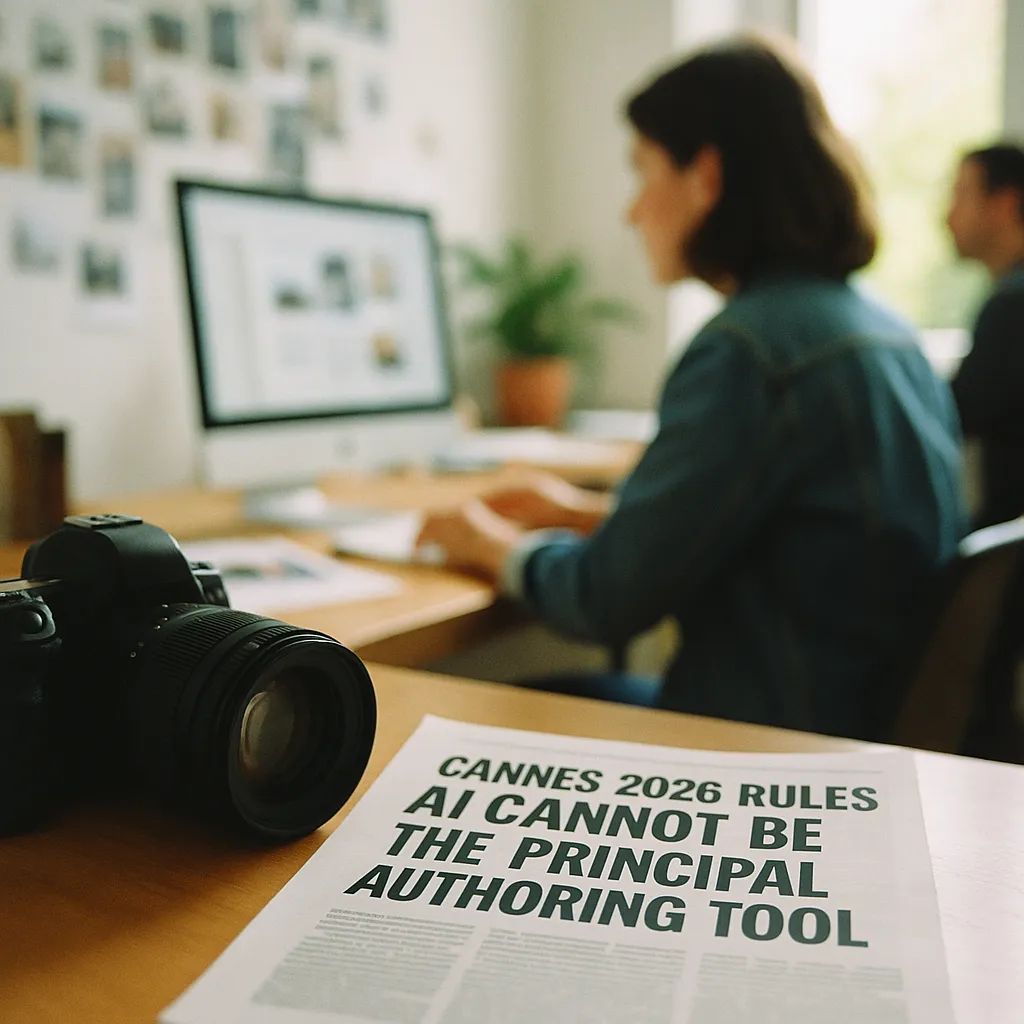
The 79th Cannes Film Festival has barred films where generative AI served as the principal authoring tool from competing for the Palme d'Or — the most consequential AI content policy from a major cultural institution to date.
Cannes 2026 Bans Films Where AI Was the Principal Author From Palme d'Or Competition
The 79th Cannes Film Festival, opening May 12, has adopted a rule barring any film where generative AI served as the "principal authoring tool" from competing for the Palme d'Or. It is the most consequential AI content policy decision by a major cultural institution to date — drawing a line that the film industry, streaming platforms, and guilds have spent two years arguing about without resolution.
The Rule and What It Means
Cannes' policy permits AI as a production tool — for visual effects, color grading, sound design, translation, or any role that augments human creative decisions. What it prohibits is AI as the primary author: generating the screenplay, directing the visual composition, or serving as the originating creative intelligence of a film.
The distinction matters because it's the first institutional definition of "AI authorship" from a tier-one cultural body. Where guilds have focused on payment and credit, and studios have focused on liability, Cannes is making an aesthetic and ethical judgment: a film is a human work, or it isn't eligible for its highest honor.
FSU's head of animation noted that the rule will face immediate practical testing, as several submitted films used AI tools extensively in both principal photography planning and script generation.
Why Cannes, and Why Now
Cannes carries global prestige that transcends box office. A Palme d'Or shapes careers, distribution deals, and the canon of what counts as serious cinema. By attaching eligibility conditions to AI use, Cannes is asserting that authorship is a value the festival will police — not just a contractual question for studios.
The timing is driven by the volume. In the 79th edition's submission pool, festival programmers reportedly encountered films that were difficult to categorize under existing norms — where AI had generated not just individual assets but the compositional logic of the work itself. The rule responds to what already arrived at the gate, not a hypothetical future scenario.
Get this in your inbox.
Daily AI intelligence. Free. No spam.
The Boundary Problem
The policy's strength is also its challenge: "principal authoring tool" is a judgment call. A human director who used AI to generate 60% of the screenplay, then rewrote it, may argue human authorship dominated. A director who used AI to generate shot compositions from text descriptions may argue the camera work was still human-executed.
Cannes hasn't published a threshold or audit process. That gap will produce the festival's first test cases immediately, as filmmakers whose submissions are borderline challenge the determination. Expect public disputes before the opening ceremony.
What This Means for the Industry
For studios and streamers: Any prestige film strategy that relies on Cannes validation now has a constraint. Studios developing AI-intensive productions will need to document the human authorship case if they want festival viability — which means Cannes eligibility will become a consideration in production planning.
For directors: The rule is a protection for filmmakers who want to work in ways that AI cannot replicate. It also creates a market signal: human-authored films are differentiated at the top of the prestige ladder, at least at Cannes.
For AI tool vendors: Companies like Runway, Pika, and Adobe Firefly are now navigating a new dynamic. Their tools must be positioned as production augmentation, not principal authorship — or their clients face festival disqualification. Marketing language will shift accordingly.
For other festivals: Sundance, TIFF, Venice, and Berlin will face immediate pressure to define their own positions. Cannes has set the benchmark; silence from peers will read as endorsement or evasion.
Precedent Beyond Film
The "principal authoring" frame is exportable. Literary prizes, music awards, and visual art competitions are watching. If Cannes' rule holds through the 79th edition without major backlash or legal challenge, expect similar eligibility language to appear in prize rules across creative disciplines by the end of 2026.
What to Watch
Whether Cannes disqualifies any submitted film before or during the festival will determine how serious the rule is in practice. A high-profile disqualification would make the policy concrete and consequential. No disqualifications would raise questions about whether the rule is enforceable or merely symbolic.
By Hector Herrera
Did this help you understand AI better?
Your feedback helps us write more useful content.
Get tomorrow's AI briefing
Join readers who start their day with NexChron. Free, daily, no spam.