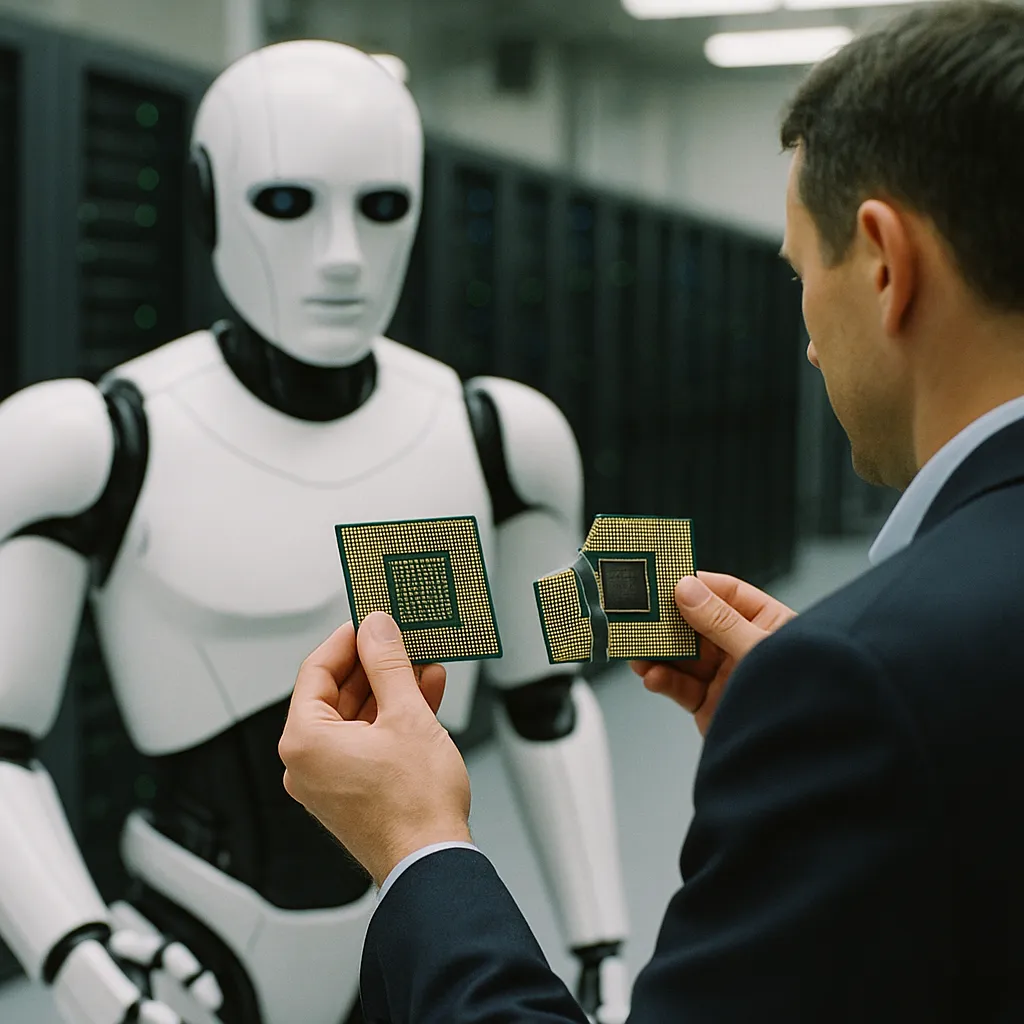
Tesla halved the memory on its Optimus robot chips — AI5 from 144GB to 72GB, AI6 from 216GB to 144GB — to secure enough DRAM supply for mass production. Musk says bandwidth, not capacity, is the real performance lever.
Tesla cut the memory on its next-generation Optimus robot chips by half — not because of a design flaw, but because volume production demands more DRAM than the world currently supplies. The tradeoff reveals how hardware supply chains, not software ambition, are now the binding constraint on humanoid robot scale-up.
Elon Musk disclosed the change on social media, per Benzinga, noting that Tesla's AI5 chip had its LPDDR5 memory cut from 144GB to 72GB, and the follow-on AI6 chip from 216GB to 144GB LPDDR6. The culprit: insufficient DRAM supply to build Optimus at scale.
The Tradeoff Musk Is Making
Musk's argument is that memory bandwidth — not total memory capacity — is the bottleneck for inference performance in Optimus's onboard AI. Bandwidth determines how fast data moves between memory and the processor; capacity determines how much data can be held at once. For the real-time perception and motor-control tasks Optimus runs, bandwidth matters more.
Get this in your inbox.
Daily AI intelligence. Free. No spam.
If that holds, cutting capacity in half costs relatively little in robot performance while potentially unlocking the supply volume needed for mass production. The memory supplier implicated is Micron — a detail significant for investors and supply chain analysts watching DRAM allocation across AI applications.
Why This Matters Beyond Tesla
The episode illustrates a pressure that will define humanoid robotics in 2026 and beyond: every major AI hardware program is competing for the same DRAM.
Data center GPU clusters, consumer AI devices, autonomous vehicles, and now humanoid robots all demand high-bandwidth memory. Foundry capacity for advanced LPDDR5 and LPDDR6 is finite. Tesla is, in effect, choosing to ship more robots at slightly lower spec rather than fewer robots at full spec — a classic volume-over-perfection manufacturing call.
For businesses watching the humanoid robotics space, the signal is clear: production volumes will scale faster than chip specs improve. Companies planning deployments in warehousing, manufacturing, or logistics should expect first-generation Optimus units to reflect these constrained specs, with higher-memory variants following as supply loosens.
What to Watch
Whether the memory reduction materially affects Optimus task performance in real-world trials will become clear as Tesla begins broader deployments. Watch for independent benchmarks comparing AI5 and AI6 inference speeds — and for Micron or Samsung supply announcements that might shift the DRAM calculus before AI6 enters production.
Did this help you understand AI better?
Your feedback helps us write more useful content.
Get tomorrow's AI briefing
Join readers who start their day with NexChron. Free, daily, no spam.