The World Meteorological Organization has trained national weather services in 15 countries to run AI-enhanced forecasting models — a move that could cut crop losses by up to 20% in regions where climate volatility is highest.
WMO Expands AI Weather Forecasting to 15 Nations to Shield Farmers from Climate Shocks
The World Meteorological Organization has trained national weather services in 15 countries to run AI-enhanced forecasting models — a move that could cut crop losses by up to 20% in regions where climate volatility is highest and weather infrastructure is thinnest.
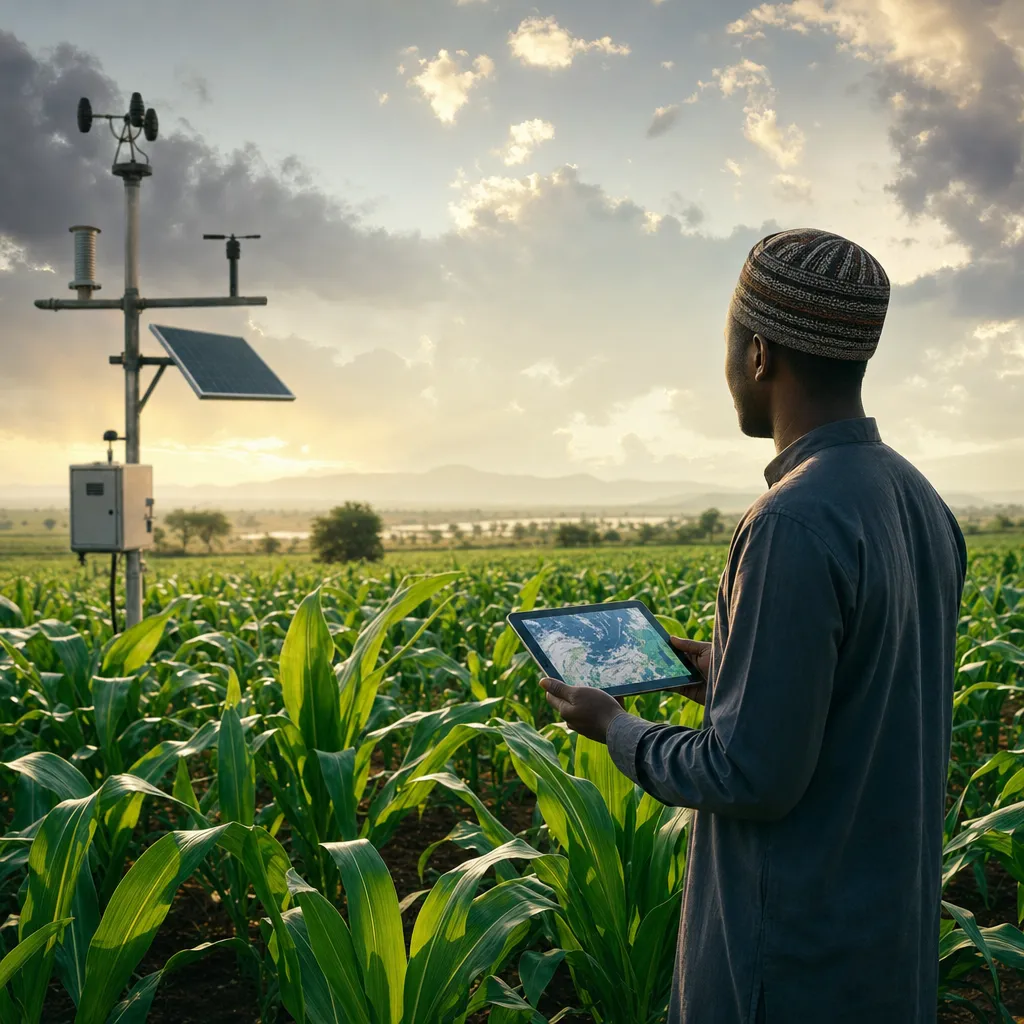
The AIM for Scale program just completed its latest expansion, bringing meteorologists in Africa, Asia, the Middle East, and Latin America up to speed on AI-assisted sub-seasonal forecasting. These aren't places with abundant agricultural technology. They're places where knowing whether it will rain next month can mean the difference between a harvest and a failed crop.
What AIM for Scale Does
Standard numerical weather models break down beyond about 10 days. The atmosphere is too chaotic for deterministic predictions at longer ranges. AI models trained on decades of historical climate data and satellite observations can generate probabilistic forecasts at the 30-60 day range — the sub-seasonal window that matters most for agricultural planning.
AIM for Scale does two things: it provides access to AI-enhanced modeling systems, and it trains local forecasters to operate them. That second part matters. A forecast that sits inside a meteorological agency's servers and never reaches a farmer is worthless. Building local capacity means national weather services can run models, interpret outputs, and push guidance to agricultural extension networks themselves — without depending on a Geneva server.
The 15 participating countries span regions the WMO identifies as most vulnerable: sub-Saharan Africa, South and Southeast Asia, the Middle East and North Africa, and the Andean region. The common thread is high agricultural dependence combined with thin weather infrastructure.
The 20% Crop Loss Reduction
The WMO projects that accurate AI-assisted sub-seasonal forecasts can reduce crop losses by up to 20% in the target regions. That figure comes from modeling how weather-informed decisions affect yield outcomes — specifically, how farmers respond when they receive probabilistic drought or rainfall outlooks 30-60 days in advance.
Get this in your inbox.
Daily AI intelligence. Free. No spam.
The mechanism is straightforward: a farmer who knows with reasonable confidence that rainfall will fall below average in the next six weeks can switch to drought-resistant varieties, reduce fertilizer input (which is wasted on a failed crop), bring forward irrigation schedules, or sell grain futures at a more favorable price. Each of those adjustments has economic value. Stacked together, the WMO's modeling suggests they add up to a meaningful reduction in total crop loss.
That's a projection, not a guarantee. Actual impact depends on whether the forecast reaches farmers fast enough to act on, whether agricultural extension services can translate meteorological language into actionable guidance, and whether local farming practices are flexible enough to respond. The WMO acknowledges these last-mile challenges — the program's next phase will specifically address distribution gaps.
Why This Matters Now
The timing is not accidental. 2026 has been the third consecutive year of above-average agricultural weather disruption globally. The relationship between climate volatility and food security is sharpening: the regions most exposed to yield shocks are also the ones least equipped to absorb them.
Precision agriculture — soil sensors, satellite imagery, smart irrigation — has spread rapidly in high-income farming markets. But those tools sit on top of an infrastructure layer that developing-economy agriculture often lacks: reliable, locally-interpreted, forward-looking weather intelligence.
AI forecasting closes that foundational gap at scale and at low cost. The WMO's approach — training local forecasters rather than delivering centralized forecasts — is designed for durability. National weather services that can run models themselves are not dependent on external data pipelines that break during the crises they're meant to predict.
The Technology Behind It
The WMO is not building its own AI weather models from scratch. Tools like Google DeepMind's GraphCast and NVIDIA's FourCastNet have demonstrated that AI weather models can match or exceed traditional numerical models at a fraction of the computational cost. What was expensive specialized research three years ago is becoming deployable infrastructure.
AIM for Scale trains forecasters to interpret and deploy these models in operational settings — a skill set that blends meteorology, data science, and decision support. The goal is for participating national weather services to run sub-seasonal AI forecasts as a routine operational product, not a research experiment.
What to Watch
The bottleneck is no longer the model — it's distribution. Getting probabilistic 45-day drought outlooks from a national meteorological agency into the hands of smallholder farmers in time to change planting decisions requires agricultural extension systems, mobile alert infrastructure, and local language translation.
Watch for outcome data from the first full growing season where AI sub-seasonal forecasts are operational in all 15 countries. If crop loss reductions approach the WMO's projections, expect a significant expansion — both in participating nations and in the range of AI weather products being pushed to agricultural users.
Did this help you understand AI better?
Your feedback helps us write more useful content.
Get tomorrow's AI briefing
Join readers who start their day with NexChron. Free, daily, no spam.