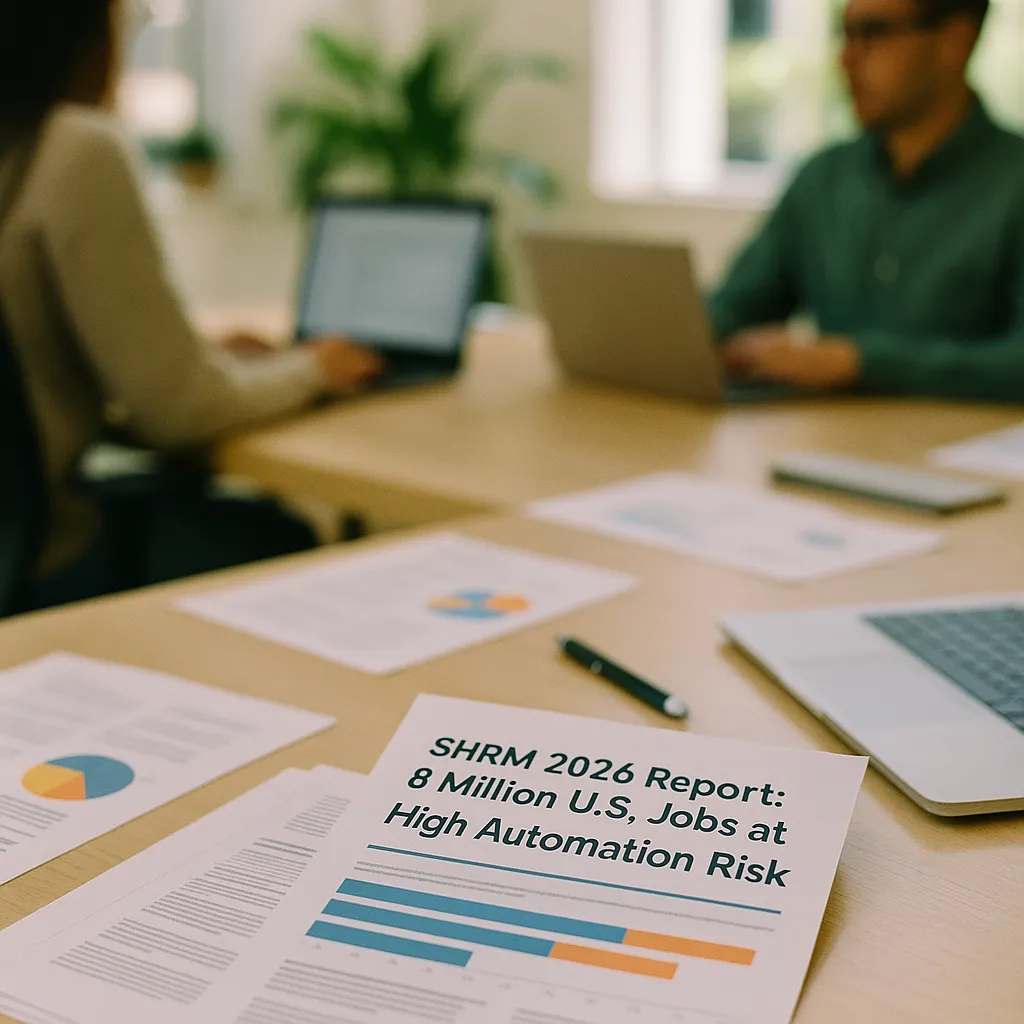
SHRM's 2026 report identifies 7.9 million U.S. jobs at high automation risk, with nearly 80% of working women in roles significantly exposed to AI displacement — versus 58% of men.
SHRM 2026 Report: 8 Million U.S. Jobs at High Automation Risk, Women Disproportionately Exposed
Nearly 8 million U.S. jobs are at high near-term risk of automation, and women hold a disproportionate share of them. That is the central finding of SHRM's 2026 full-year automation and AI displacement report, which identifies 7.9 million positions — roughly 5% of total U.S. employment — in roles where AI automation is likely to eliminate or fundamentally restructure the work within the next few years. The report's harder number is this: nearly 80% of working women hold jobs significantly exposed to AI automation, compared to 58% of working men.
The gender gap is not a fringe finding. It is the report's lead conclusion, and SHRM is explicit that it reframes the automation conversation from a productivity issue to a workforce equity crisis that employers, policymakers, and educational institutions are not yet treating with appropriate urgency.
The Numbers Behind the Gap
SHRM's methodology distinguishes between two categories of AI exposure:
High-risk roles: Jobs where AI is likely to fully automate or eliminate the majority of current tasks within the near-term horizon. SHRM identifies 7.9 million such positions.
AI-reliant roles: Jobs where workers already use AI tools extensively and where that reliance is deepening. SHRM puts this category at 32.6 million workers — about 20% of the U.S. workforce.
The distinction matters because AI-reliant roles are not automatically at risk. A knowledge worker who uses AI to draft documents, analyze data, and research problems may be more productive, more valuable, and more securely employed than before AI. But a customer service representative, medical billing coder, or administrative coordinator whose role consists primarily of tasks AI can now replicate is in a different position entirely.
The gender gap emerges from occupational concentration. Women in the U.S. workforce are heavily concentrated in administrative support, healthcare support, customer service, and data entry roles — the categories where generative AI and automation are replacing tasks fastest. Men are more concentrated in skilled trades, construction, and technical roles where physical manipulation, variable environments, and hands-on judgment remain harder for current AI systems to replicate.
Get this in your inbox.
Daily AI intelligence. Free. No spam.
The specific roles SHRM flags as highest-risk include:
- Medical billing and coding coordinators
- Administrative and executive assistants
- Data entry and records management clerks
- Customer service representatives
- Insurance claims processors
- Retail cashiers and sales support
Women hold the majority of jobs in every one of these categories.
Why "Reskilling" Framing Falls Short
SHRM's report is careful to note what it is not saying. This is not a prediction that 8 million women will be unemployed by a specific date. Automation timelines are uncertain, adoption is uneven across employers, and many roles will be restructured rather than eliminated outright — with workers who adapt retaining employment in changed forms.
What the report argues is that the current employer and policy response is calibrated for a different problem. Most corporate reskilling programs are designed around upskilling workers who are already digitally literate into higher-value AI-adjacent roles — essentially, programs for workers who already have a foundation to build on. The workers in high-displacement roles often lack that foundation, and the economic incentive for employers to invest in their upskilling is lower precisely because their current roles are the ones being automated away.
SHRM's specific recommendations to employers:
- Treat AI reskilling investment as a workforce equity commitment, not just a productivity play
- Map existing workforce demographics against AI displacement risk by role and create explicit intervention plans for high-risk cohorts
- Prioritize transition pathways into roles that are AI-augmented rather than AI-replaced — healthcare clinical roles, technical support, skilled trades — not just into AI engineering
- Measure reskilling program outcomes by gender, race, and income level, not just aggregate participation
The report notes that sectors seeing the fastest AI adoption — financial services, insurance, healthcare administration — are also sectors where women represent 60–70% of frontline administrative and support staff. That overlap is not coincidental. It reflects both the demographic composition of care and administrative work and the pattern by which AI deployment choices are made: productivity optimization by management teams that are less demographically diverse than the workers whose jobs are being automated.
Policy Context
The SHRM report arrives as Congressional debate over AI workforce transition policy remains stalled. Proposals for federal AI transition assistance — modeled loosely on Trade Adjustment Assistance programs for workers displaced by offshoring — have been introduced in both chambers but have not advanced. State-level workforce development programs are filling some of the gap, but funding and scale are inconsistent.
The Biden-era National AI Workforce Strategy committed to tracking displacement by demographic group. The current administration has not prioritized that framework. SHRM is explicitly positioning this report as a briefing document for both Congress and state legislatures, with the gender gap data designed to create political pressure for action ahead of the 2026 midterm cycle.
What to Watch
The follow-on question SHRM's data raises is whether employer voluntary action or legislative mandate will drive meaningful reskilling investment. The answer will likely depend on what happens in the labor market over the next 12 to 18 months — whether the predicted displacement accelerates visibly enough to create political pressure for structured intervention, or whether the transition proceeds gradually enough that piecemeal employer programs remain the primary response.
Did this help you understand AI better?
Your feedback helps us write more useful content.
Get tomorrow's AI briefing
Join readers who start their day with NexChron. Free, daily, no spam.