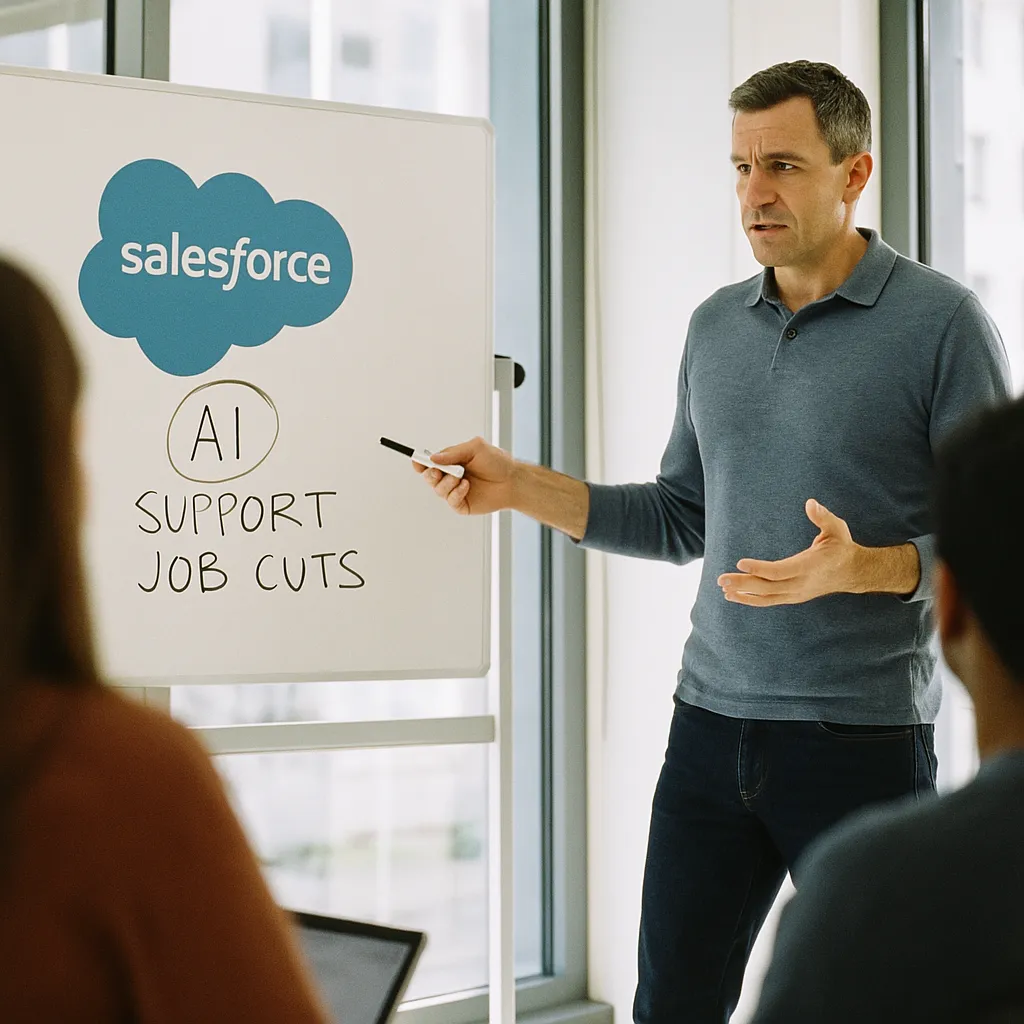
AI displacement became the top-cited reason for U.S. job cuts in 2026, with 116,175 positions attributed to AI automation through August, per Challenger, Gray & Christmas.
AI Is Now the Leading Stated Cause of U.S. Layoffs — 116,175 Cuts Through August
Artificial intelligence displacement became the leading stated reason for U.S. job cuts in 2026, with 116,175 positions attributed to AI automation through August, according to data from outplacement firm Challenger, Gray & Christmas. That represents approximately 22% of the national layoff total — a total that is itself down 41% year-over-year — meaning AI is responsible for a growing share of a shrinking number of overall job cuts.
The headline number masks a more specific problem: the workers most exposed are entry-level and early-career employees in cognitive-task roles, and the compression of that entry-level pipeline is becoming a structural problem for the next generation of the U.S. workforce.
The Numbers Behind the Threshold
116,175 job cuts attributed to AI through August 2026 is significant for two reasons.
First, it marks the first time Challenger, Gray & Christmas — which has tracked stated reasons for U.S. layoff announcements since the 1990s — has recorded AI as the single leading stated cause. Previous years showed technology as a factor in layoffs alongside restructuring, cost reduction, and market conditions. 2026 is the year it became the dominant stated justification.
Second, the national layoff total is down 41% year-over-year, to approximately 528,000 through August. Fewer total layoffs combined with a higher AI-attributed share means AI automation is increasingly the reason cuts happen, not background noise accompanying other business decisions.
The largest contributors by announced volume:
- Amazon: 30,000+ positions eliminated since late 2025 as fulfillment automation and AI-powered customer service reduced headcount requirements in both operations and support
- Salesforce: 4,000 customer support roles cut after AI agents handled 50% of all incoming customer queries without human escalation — a threshold that directly mapped to a headcount reduction of similar scale
- Dow Chemical: 4,500 positions automated across manufacturing operations and administrative functions
These are not pilots or experiments. They are permanent restructurings of large organizations' human capital footprints.
The Entry-Level Pipeline Is Contracting
The 116,175 figure tracks announced layoffs. The harder-to-measure damage is in hiring — specifically, the collapse of entry-level hiring in AI-exposed fields.
Research cited by Challenger, Gray & Christmas documents a 13% employment decline for college graduates aged 22–25 in AI-exposed occupational categories. That decline is compressing the entry-level career pipeline for the second consecutive year.
Get this in your inbox.
Daily AI intelligence. Free. No spam.
Why entry-level roles are disproportionately affected:
The tasks most easily automated by current AI systems — document processing, data entry, first-pass analysis, standard customer interactions, code review, content summarization — are precisely the tasks that entry-level roles historically contained. Junior analysts, entry-level customer service representatives, first-year associates in legal and financial services, junior data analysts: these positions existed in large part because the volume of routine cognitive work exceeded what senior employees could handle.
When AI handles the routine work at scale, organizations need fewer junior employees. The ones they do hire are expected to operate at a higher functional level immediately — which narrows the field of viable candidates and removes the traditional on-ramp of spending two years building foundational skills before advancing.
The Salesforce case is the clearest illustration of how AI automation translates to headcount reduction. The company announced the 4,000 cuts after its AI agents reached 50% query resolution without human assistance — meaning half of all incoming customer service contacts were fully resolved by AI without escalation.
That threshold changes the staffing math in a straightforward way: if you have 8,000 customer service representatives handling a given daily contact volume, and AI is handling half of it, you need approximately 4,000 representatives, not 8,000. The employees eliminated weren't underperforming. The volume of work they were hired to do no longer exists at the same scale.
This pattern — AI reaching a specific automation rate that directly maps to a headcount reduction — will repeat across industries. When AI handles 40% of first-level IT help desk tickets, you need 40% fewer first-level agents. When AI handles 60% of initial document review in legal discovery, junior associate headcount requirements contract proportionally. The Salesforce case is a template.
What the 41% Decline in Total Layoffs Actually Means
The overall decline in U.S. layoffs is real and should not be dismissed. Many companies that cut aggressively in 2023 and 2024 have stabilized. AI automation is not producing mass unemployment at the scale some 2022 forecasts projected — at least not in aggregate numbers.
But the composition of who is losing jobs and who is struggling to find work has shifted materially. The labor market is bifurcating:
- Strong demand for workers who can direct, evaluate, and build AI systems — prompt engineers, AI product managers, ML infrastructure engineers, AI governance specialists
- Contracting demand for workers whose primary value was executing routine cognitive tasks that AI now handles at lower cost
Mid-career workers in roles with high AI automation exposure face elevated displacement risk. Entry-level workers face a structurally tighter market. Workers without post-secondary education or technical credentials who previously filled administrative and data-processing roles face the narrowest path forward.
Retraining programs exist but operate at far smaller scale than the disruption warrants. No federal AI workforce legislation has passed. State-level initiatives are nascent and underfunded relative to the scope of the transition.
What to Watch
Q3 2026 corporate earnings — reporting in October — will provide the next major data point. Companies with recent AI investments will quantify automation ROI, and some will announce additional headcount reductions tied to demonstrated automation rates. The Salesforce 50% query-resolution threshold is a benchmark other executives will reference when explaining to analysts why staffing levels have changed.
Watch also for congressional action on retraining and workforce transition funding. Two bills — the AI Workforce Development Act and an expansion of Trade Adjustment Assistance (TAA) to cover AI displacement — have been in committee. 116,175 is a concrete number. Advocates will use it.
By Hector Herrera
Did this help you understand AI better?
Your feedback helps us write more useful content.
Get tomorrow's AI briefing
Join readers who start their day with NexChron. Free, daily, no spam.