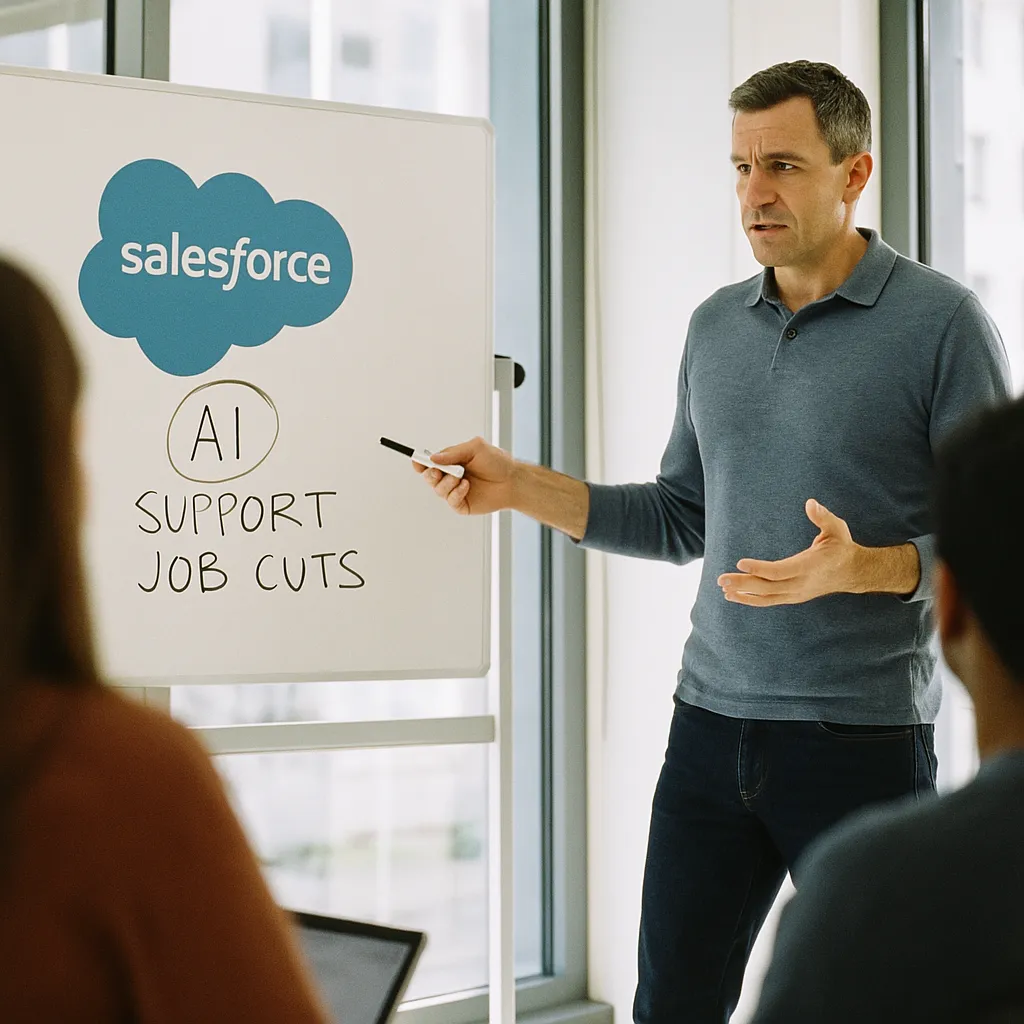
Salesforce eliminated 4,000 customer support roles after AI agents resolved approximately half of all customer service queries — one of the clearest documented cases of white-collar AI displacement in 2026.
Salesforce Cuts 4,000 Support Roles After AI Agents Take Over Half of Customer Service
By Hector Herrera | September 12, 2026
Salesforce eliminated 4,000 customer support roles after AI-driven agents took over approximately half of all customer service queries handled by the company. The cuts represent one of the clearest documented examples of white-collar AI displacement in 2026 — not a layoff attributed to market conditions or restructuring, but a direct substitution of AI agents for human support workers at scale.
The number to hold: half of all customer service queries, now resolved without a human in the loop. Salesforce builds the CRM and service software used by hundreds of thousands of companies. When it uses its own tools to eliminate 4,000 of its own jobs, it is also demonstrating what those tools can do to the companies that buy them.
Context: This Is Not an Isolated Event
Salesforce's cuts are part of a pattern that has accelerated through 2026. Amazon has cut more than 30,000 roles since late 2025, with AI cited explicitly as a factor in a significant portion of those decisions. Across industries, AI is now the third-leading cause of layoff plans at 16 percent of surveyed companies, behind only economic conditions and business restructuring, according to Digital Examiner's analysis of employer data.
One in six employers now expects AI to reduce headcount this year — not in five years, this year.
The macro projection that gets cited most frequently comes from SHRM (the Society for Human Resource Management): 92 million jobs displaced by 2030, offset by an estimated 170 million new roles created by AI-enabled industries. The net number sounds reassuring until you recognize that displaced and created are not the same people in the same places with the same skills.
Get this in your inbox.
Daily AI intelligence. Free. No spam.
Why Customer Service Was First
Customer service represents one of the most AI-susceptible job categories because the work is structured, repetitive, and already heavily mediated by software. A customer service agent typically:
- Retrieves account information from a CRM
- Applies a decision tree to categorize the problem
- Routes to a solution from a knowledge base
- Escalates edge cases to a specialist
Each of those steps maps directly to what an AI agent with CRM integration, retrieval tools, and a policy knowledge base can now do — faster, at any hour, at a fraction of the per-query cost.
The 50 percent query resolution rate that Salesforce is reporting is also not a ceiling. As AI agents handle more queries, they generate training data that improves their resolution rates. The trajectory goes up, not sideways.
The Broader Implication: What Salesforce Sells
This is where the story becomes more than a company-specific layoff. Salesforce's flagship product is Agentforce — its AI agent platform built directly into the Salesforce CRM ecosystem. When Salesforce publicly reports that AI agents now handle half of its own customer service volume, it is simultaneously:
- Validating Agentforce to its customers — the vendor is running the experiment on itself
- Setting an expectation for enterprise buyers — if Salesforce achieved 50% AI resolution, what should your company expect?
- Accelerating adoption timelines — skeptical enterprise buyers move faster when the vendor demonstrates results with their own headcount on the line
Every Salesforce customer that reads this story now has a business case template for their own board: if the company that built the tool cut 4,000 jobs with it, the ROI conversation at your company has a reference point.
What Displaced Workers Face
The jobs being eliminated are not entry-level software engineering roles. They are support positions — often held by workers without four-year degrees, in cities where those jobs represent genuine middle-income employment. SHRM's 92 million displacement projection is not primarily about software engineers who can retrain in six months. It is about workers in support, administrative, and routine cognitive roles where retraining pathways are longer, less funded, and less certain.
The skills gap is real. The World Economic Forum and multiple workforce studies published through 2026 document that AI literacy training and reskilling programs exist — but are not reaching displaced workers at the speed or scale the transition requires. The gap between "jobs created by AI" and "displaced workers who can fill those jobs" is a policy problem, not just a market adjustment.
What to Watch
Watch Salesforce's Agentforce sales pipeline over the next two quarters. If enterprise buyers accelerate Agentforce deployments in response to the company's own results, we will see similar displacement announcements from major Salesforce customers in financial services, healthcare administration, and retail — the three sectors with the largest customer service workforces on the Salesforce platform. Also watch whether the SHRM 92-million-jobs figure becomes a legislative trigger point in the AI governance bills moving through Congress and state legislatures this fall.
Source: Digital Examiner, AI Job Displacement 2026
Did this help you understand AI better?
Your feedback helps us write more useful content.
Get tomorrow's AI briefing
Join readers who start their day with NexChron. Free, daily, no spam.