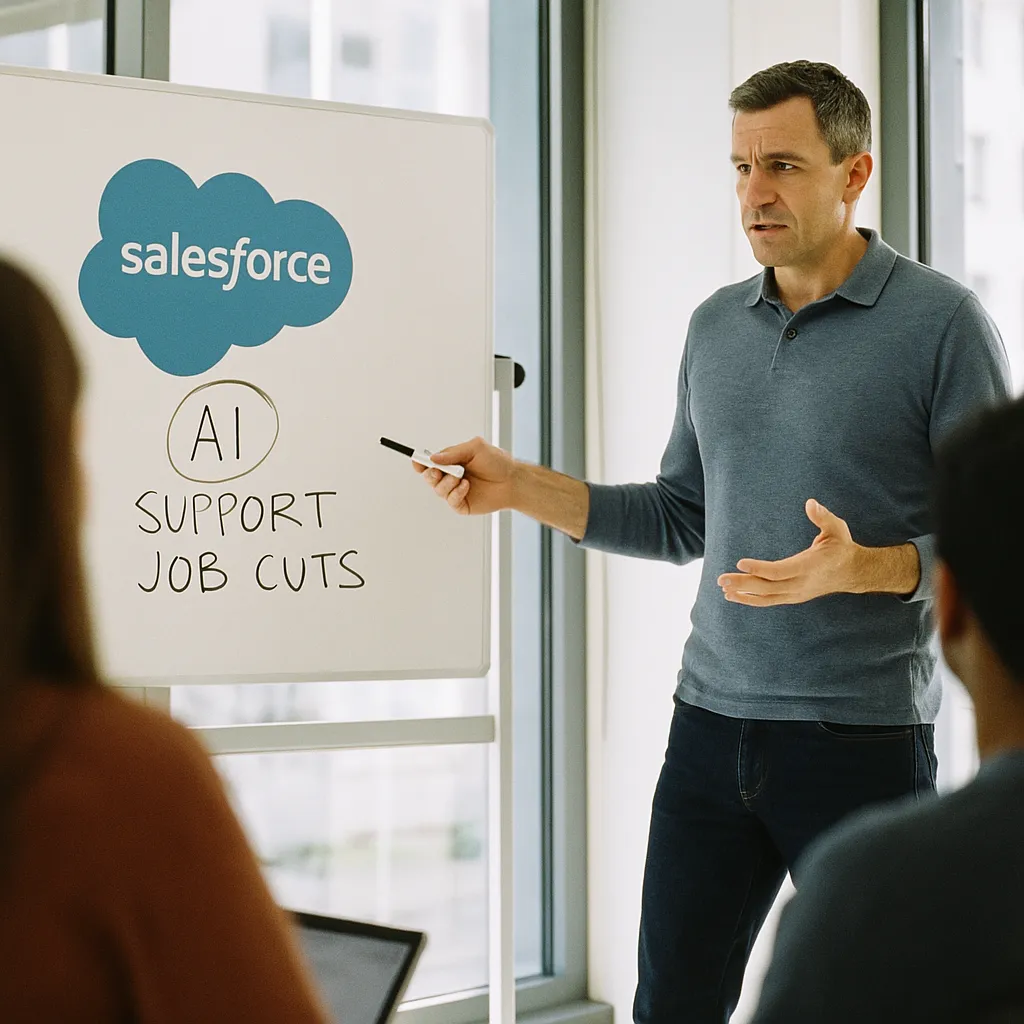
AI-attributed layoffs reached 210,000 US workers through mid-September 2026, with 49% of major employers explicitly citing AI automation in their official rationale — and the pace is accelerating.
AI Cited in 49% of Major US Layoff Announcements Through September 2026 as Displacement Reaches 210,000 Workers
By Hector Herrera | September 28, 2026 | Work
More than 210,000 US workers have been laid off in events where employers explicitly cited artificial intelligence as a contributing factor, with 49% of the 383 major layoff announcements tracked through mid-September 2026 naming AI in their official rationale. The pace is accelerating: SHRM documented 116,175 AI-attributed separations through August, meaning roughly 94,000 additional workers entered that count in roughly six weeks — suggesting Q3 is tracking as the highest quarter of AI-driven displacement on record.
The Data Behind the Number
TechJack Solutions' AI Job Displacement Tracker — which monitors public layoff notices, WARN Act filings, and employer press releases — reached the 210,000 figure by mid-September. The methodology counts only events where the employer's own documentation references AI, automation, or machine learning as a factor, which means the true count is almost certainly higher: most employers do not publicly attribute layoffs to specific causes.
Key data points from the tracker:
- 383 major layoff announcements through September that name AI in the official rationale
- 49% of all major layoff events in the period cite AI, automation, or machine learning
- 210,000 workers in events with explicit AI attribution — up from 116,175 through August
- Entry-level workers aged 22–25 in AI-exposed occupations now sit 19% below where employment would be if it had tracked peers in less-exposed roles
That last number — the 19% employment gap for young workers in AI-exposed occupations — is the most structurally significant figure in the dataset. It is not measuring layoffs; it is measuring the cumulative divergence in employment trajectories between workers in roles AI is actively displacing and those in roles it is not.
What "AI-Exposed Occupation" Actually Means
An AI-exposed occupation, in the research literature, is one where a substantial share of tasks can be performed by currently available AI systems — not hypothetically, but with tools commercially deployed today. This includes roles in financial analysis, customer support, content moderation, basic legal research, data entry, software QA, marketing copy, and a broad category of white-collar entry-level work that has historically served as the on-ramp for new graduates.
Get this in your inbox.
Daily AI intelligence. Free. No spam.
The 19% employment gap in this category is significant because entry-level roles are not just jobs — they are the training ground for mid-career competence. A worker who cannot get an entry-level analyst position does not simply find a different first job; they fall off a career development path that typically takes five to eight years to travel. The productivity and earnings consequences compound over a decade.
Who Is Being Cut — and Why Now
The current wave of AI-attributed layoffs is concentrated in:
- Software development and QA — where AI coding assistants and automated testing have reduced the number of junior engineers required per project
- Financial services back-office — where AI agents handle document review, reconciliation, and reporting that previously required analyst pools
- Customer operations — where generative AI handles first and second-tier support at a fraction of the headcount cost
- Media and content — where AI-generated drafts have reduced the number of copywriters and content coordinators required
The acceleration in Q3 is at least partly a timing effect: many enterprises began deploying AI tools in 2024–2025 and are now in the phase where they are right-sizing headcount to reflect what those tools have actually absorbed. The lag between deploying a technology and adjusting staffing levels typically runs 12–18 months — which means we are now in the first major wave of realized, post-deployment workforce adjustments.
The Entry-Level Career Pipeline Problem
The 19% employment gap among 22-to-25-year-olds in AI-exposed occupations is the number that should be in every CEO's and policy-maker's peripheral vision. Here is why:
Organizations build institutional knowledge through junior employees who learn on the job, accumulate tacit knowledge over years, and eventually become the senior leaders who make consequential decisions. If AI eliminates the entry-level pipeline, organizations will eventually face a competence cliff as their current experienced cohort ages out and there is no trained successor generation below it.
This is not a ten-year problem — it is a five-year problem for any organization that has significantly reduced entry-level hiring in the last two years. The professionals who would have been mid-level managers in 2030–2032 are not being trained today.
What Companies and Workers Are Doing About It
The responses so far are heterogeneous. Some companies are redirecting entry-level hires toward AI operations roles — managing, evaluating, and correcting AI outputs — rather than eliminating the positions entirely. Goldman Sachs, JPMorgan, and several major law firms have been explicit about creating "AI associate" pathways. Others have simply reduced headcount with no announced retraining commitment.
For workers, the challenge is reorientation toward tasks AI cannot yet perform reliably: complex judgment calls, client relationship management, novel problem framing, and cross-domain synthesis. The difficulty is that these skills are typically developed through years of lower-level work — the same work AI is now displacing.
What to Watch
Q4 layoff filings will confirm whether the Q3 acceleration represents a new baseline or a temporary surge. Policy response is the other signal: the SHRM study released this summer drew attention in the Senate HELP Committee, and there are early indications of proposed amendments to WARN Act reporting requirements that would require employers to classify automation-related separations explicitly. If that amendment advances, the reported numbers will rise sharply as employers who currently obscure AI attribution are forced to disclose it.
Did this help you understand AI better?
Your feedback helps us write more useful content.
Get tomorrow's AI briefing
Join readers who start their day with NexChron. Free, daily, no spam.