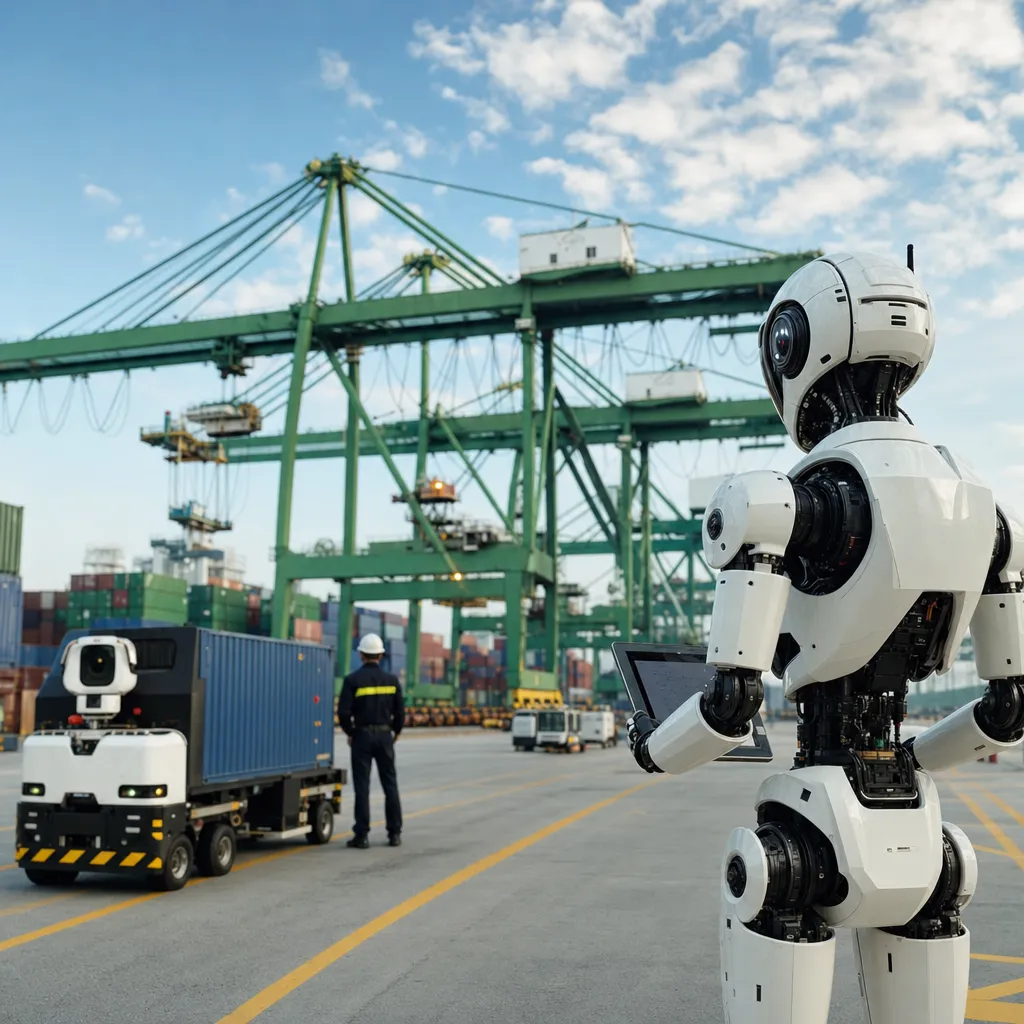
PSA Singapore broke ground on Tuas Port Phase Two, adding 21 mega-berths and deploying close to 1,000 AI-enabled intelligent guided vehicles that independently optimize routes in real time.
Singapore Just Broke Ground on the Port That Will Handle 65 Million Containers a Year — With Nearly 1,000 AI-Guided Robots
PSA Singapore has broken ground on Phase Two of Tuas Port, adding 21 mega-berths and deploying close to 1,000 AI-enabled intelligent guided vehicles to what is already the world's largest fully automated container terminal. The expansion will add 8.6 kilometers of quay line and push Tuas Port's total annual capacity to 65 million twenty-foot equivalent units (TEUs) — roughly double Singapore's current throughput — when fully built out. For global trade, this is not an incremental upgrade. It is the most ambitious automated port construction project in the world.
What Makes Tuas Different
Port automation is not new. Dozens of container terminals around the world use automated stacking cranes, automated guided vehicles (AGVs), and remote-controlled ship-to-shore cranes. What sets Tuas apart is the scale, the degree of integration, and specifically the AI layer governing its vehicle fleet.
The intelligent guided vehicles (IGVs) deployed at Tuas are meaningfully different from earlier automated guided vehicles. Traditional AGVs follow fixed magnetic track routes laid in the ground — they move only where the tracks tell them to go. Tuas's IGVs independently calculate and optimize their own routes in real time, responding dynamically to shifting traffic, vessel priorities, container assignments, and operational conditions across the terminal.
That distinction matters enormously at scale. A terminal handling 65 million TEUs annually involves constant, simultaneous movement of thousands of containers across dozens of berths. A fixed-route system requires human operators to redesign paths when conditions change. An AI-navigated system adapts on its own.
The Numbers
- Phase Two quay addition: 8.6 kilometers
- New berths: 21 mega-berths (sized for the largest container ships afloat)
- IGVs in Phase Two: approaching 1,000 vehicles
- Total Tuas capacity at full build-out: 65 million TEUs per year
- Singapore's current annual throughput: approximately 37-38 million TEUs
- Operator: PSA International, the state-owned port operator majority-owned by Temasek Holdings
Phase One of Tuas Port has been operational since 2021. Phase Two represents the expansion that transforms it from a large automated terminal into something with no peer anywhere in the world.
Why Singapore Is Doing This
Singapore's economy is built on trade. The country handles about 12% of global container transshipment — cargo that arrives from one ship and transfers to another bound for a different destination — which makes port efficiency a direct national economic priority, not just a logistics business line.
Three forces are driving the Phase Two investment:
Ship size inflation. Container ships have grown dramatically over the past two decades. The largest vessels afloat today, the ultra-large container vessels (ULCVs), carry over 24,000 TEUs per ship. Existing berth infrastructure at many global ports, including earlier Singapore facilities, cannot accommodate them efficiently. Tuas's mega-berths are engineered specifically for this generation and the next.
Get this in your inbox.
Daily AI intelligence. Free. No spam.
Labor economics and reliability. A human-staffed port of equivalent scale would require thousands of workers on rotating shifts, with all the variability in throughput, injury risk, and labor cost that entails. An automated terminal with AI-navigated vehicles operates 24 hours a day, 365 days a year, at consistent throughput rates. PSA has redeployed workers toward higher-skill roles in monitoring, maintenance, and systems management rather than eliminating them entirely — but the headcount profile of a fully automated terminal is fundamentally different from a manual one.
Regional competition. Malaysia's Port Klang and Johor's emerging logistics corridors, China's expansion of automated capacity at Ningbo, Shanghai, and Tianjin, and the UAE's modernization of Jebel Ali all mean Singapore cannot hold its transshipment position on legacy infrastructure. Tuas Phase Two is a 20-year infrastructure bet.
What This Looks Like in Practice
At full operation, Tuas Phase One and Two together will function as a single integrated AI-managed system. When a mega-vessel arrives, its cargo manifest is processed before the ship enters the berth. Container movements are pre-planned. IGVs are pre-assigned. Cranes are sequenced.
As containers move through the terminal, the AI continuously re-optimizes. If an IGV breaks down, its assignments redistribute automatically. If a vessel's departure is delayed, container prioritization shifts without human intervention. The system operates closer to a real-time logistics coordination platform than to a traditional port management system.
PSA has not published detailed specifications of the AI architecture — whether it uses reinforcement learning, constraint optimization, or a combination — but the independent route-calculation capability of the IGVs implies edge computing on each vehicle combined with central fleet coordination.
Impact on Global Shipping
Tuas Phase Two will affect global container shipping in ways that extend well beyond Singapore's borders.
Shipping lines will route more of their largest vessels through Singapore, knowing they can call on berths built for ULCVs with AI-managed dwell times that minimize the hours a vessel sits idle.
Regional ports that compete with Singapore for transshipment volumes — particularly in Malaysia, Indonesia, and Sri Lanka — will face pressure to accelerate their own automation investments or cede market share.
Port technology vendors — companies like Kalmar, ZPMC, Konecranes, and the IGV systems integrators working with PSA — will use Tuas as a commercial reference for their most advanced automated terminal offerings.
Insurers and financiers of shipping infrastructure globally will increasingly price the risk difference between automated and manual terminals, as automated facilities demonstrate lower incident rates and more predictable throughput.
What to Watch
Phase Two is a multi-year construction project. The near-term milestones to track are the first IGV deployments under Phase Two operations, the integration of Phase One and Phase Two AI fleet management into a unified system, and how PSA handles the operational handoff from construction to live cargo handling. Watch also whether competing port authorities — particularly Klang and Port of Tanjung Pelepas in Malaysia — announce accelerated automation programs in direct response.
By Hector Herrera
Did this help you understand AI better?
Your feedback helps us write more useful content.
Get tomorrow's AI briefing
Join readers who start their day with NexChron. Free, daily, no spam.