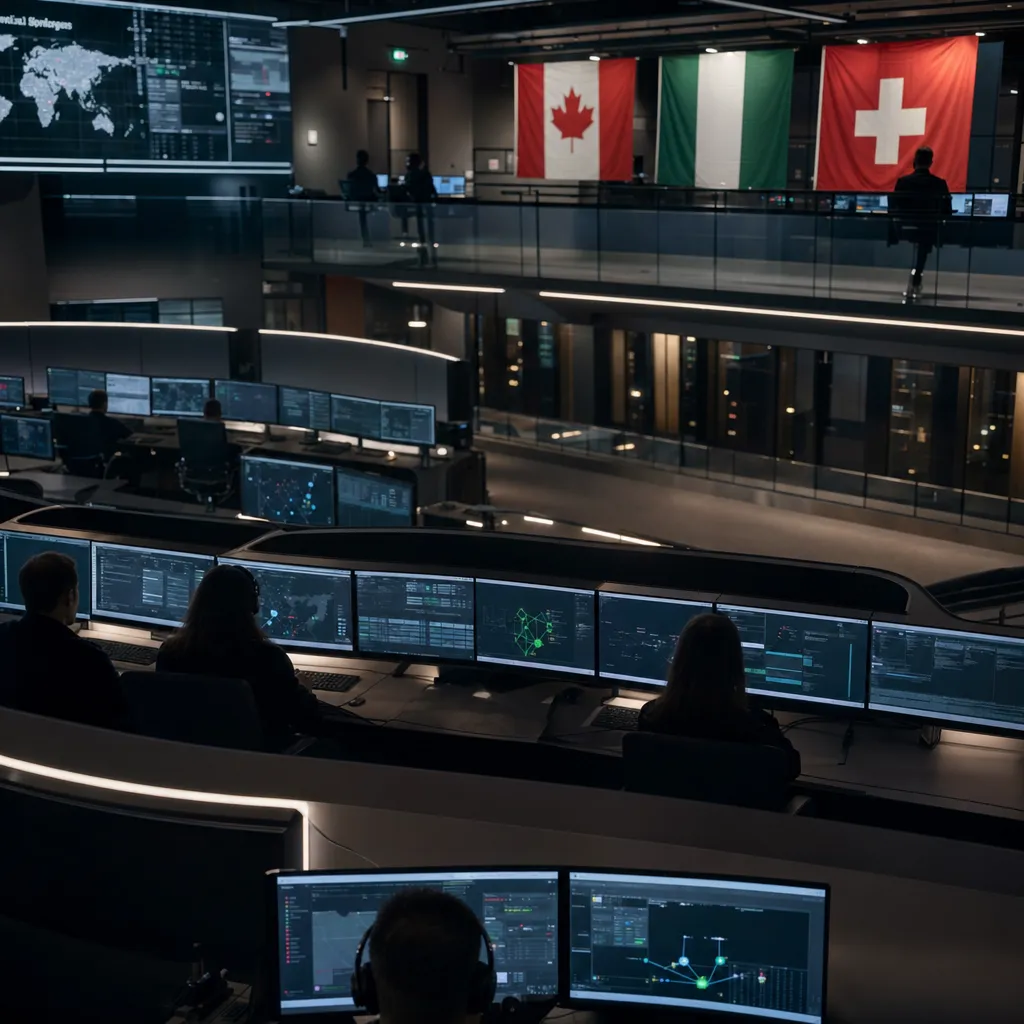
Cyber agencies from Canada, Italy, and Switzerland issued coordinated warnings that autonomous AI agents are actively automating attacks on critical infrastructure — with Switzerland confirming its first AI-agent attacks, every one resulting in full system compromise.
Canada, Italy, and Switzerland Issue Coordinated Warning: AI Agents Are Now Automating Attacks on Critical Infrastructure
Cybersecurity agencies from Canada, Italy, and Switzerland issued coordinated warnings this week that autonomous AI agents are actively being used to automate every phase of cyberattacks against critical infrastructure — from initial reconnaissance through exploitation and lateral movement. Switzerland's National Cyber Security Centre (NCSC) confirmed the country's first documented AI-agent attacks on domestic organizations, with every confirmed incident resulting in fully compromised IT systems.
This is not a theoretical warning. It is a report of attacks already underway.
What "AI-Agent Attacks" Actually Means
Traditional cyberattacks require human operators to make decisions at key points: choosing targets, selecting exploits, deciding whether to persist or extract data. AI agents remove those human bottlenecks. An autonomous attack agent can scan thousands of targets for vulnerabilities, identify the most promising, select an appropriate exploit, execute it, assess the result, and move laterally to the next system — all without waiting for a human operator to approve each step.
The practical effect is speed and scale. What previously required a team of experienced attackers working over days now takes hours. What previously targeted one organization can now target hundreds simultaneously.
The agencies specifically cited AI agents being used for:
- Automated reconnaissance — mapping target networks and identifying vulnerable entry points
- Vulnerability discovery — scanning for known and zero-day weaknesses across public-facing systems
- Exploitation — selecting and launching appropriate attack tools without operator intervention
- Lateral movement — traversing from initial compromise to higher-value systems inside the network
Switzerland's Confirmed Cases
The Swiss NCSC's confirmation of domestic AI-agent attacks is the most specific data point in the joint warning. Across at least two critical sectors — which the NCSC declined to name publicly — every confirmed AI-agent attack resulted in a fully compromised IT environment. That 100% success rate among confirmed cases reflects a capability gap: defenders built for human-paced attacks are not responding fast enough to agent-driven intrusions.
Get this in your inbox.
Daily AI intelligence. Free. No spam.
The NCSC also noted that the number of publicly accessible offensive AI agents has nearly doubled since October 2026 — a growth rate that suggests rapid proliferation, likely from both criminal actors and state-sponsored groups adapting commercial AI tooling.
The Three-Agency Coordination
The coordinated nature of the warning carries its own signal. Canada's Canadian Centre for Cyber Security (CCCS), Italy's National Cybersecurity Agency (ACN), and Switzerland's NCSC do not typically issue joint advisories. The decision to coordinate suggests the agencies are observing overlapping attack infrastructure — the same AI-agent tools or threat actors hitting targets in all three countries — and want to signal to other Western governments that this is a cross-border pattern, not isolated incidents.
The advisory stops short of attributing attacks to specific nation-states, which is consistent with early-stage intelligence where tooling is shared or rented across multiple actor groups.
Which Infrastructure Is at Risk
The agencies highlighted critical infrastructure broadly, but the sectors historically most targeted by nation-state and criminal actors — and most exposed to AI-accelerated attacks — are:
- Energy and utilities (power grids, water treatment, pipelines)
- Healthcare (hospital networks, medical device infrastructure)
- Financial services (banking systems, payment infrastructure)
- Transportation (rail signaling, air traffic management, logistics networks)
- Telecommunications (backbone networks, emergency communications)
AI-agent attacks are particularly effective against organizations with large attack surfaces, aging operational technology (OT) systems, and IT/OT network boundaries that were designed before AI-native threats existed.
What Organizations Should Do
The joint advisory recommends a set of defensive measures that have been standard cybersecurity guidance for years but are now urgent given the pace of AI-driven attacks:
- Patch management velocity — the window between vulnerability disclosure and exploitation is now measured in hours, not days
- Network segmentation — limit lateral movement by separating IT and OT environments with zero-trust access controls
- Behavioral anomaly detection — signature-based defenses will not catch AI agents using novel exploit chains; monitor for behavioral patterns
- Incident response speed — build automated containment capabilities that can match the speed of automated attacks
- Third-party risk — AI-agent attacks often enter through vendor or supply-chain access; audit external access privileges
What to Watch
Whether additional Western cyber agencies — particularly CISA in the United States and the UK's NCSC — issue matching advisories in the coming weeks will indicate how broadly this threat pattern has been observed. If the US and UK join the coordination, it signals the intelligence picture is clearer than the current advisory language suggests.
Source: CybersecAsia, November 2026
Did this help you understand AI better?
Your feedback helps us write more useful content.
Get tomorrow's AI briefing
Join readers who start their day with NexChron. Free, daily, no spam.