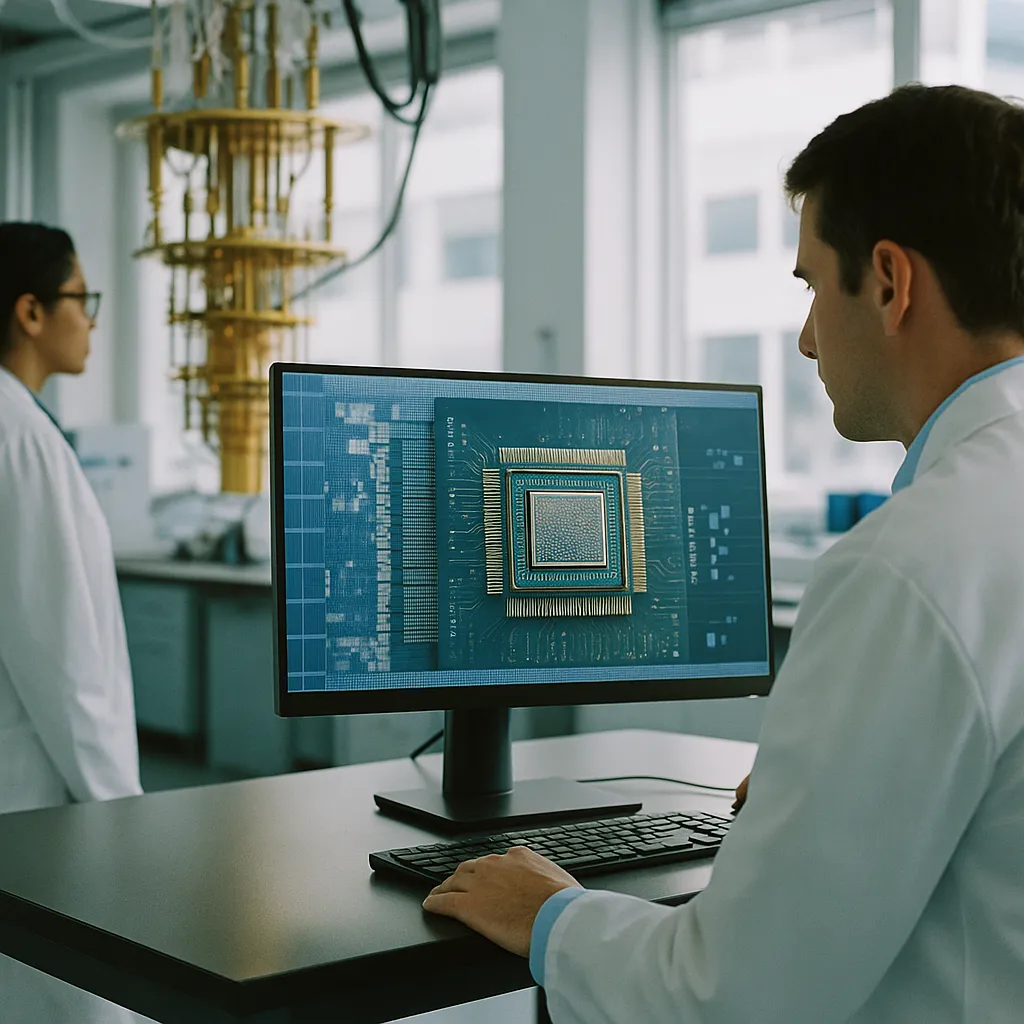
NVIDIA's open Ising model family delivers error-correction decoding that is 2.5x faster and 3x more accurate than traditional methods, removing the calibration and decoding bottlenecks blocking practical quantum computing.
NVIDIA Built Open AI Models to Solve Quantum Computing's Hardest Engineering Problem
By Hector Herrera | April 23, 2026 | Science
NVIDIA has released the Ising model family — a set of open AI models purpose-built to solve the calibration and error-correction problems that have kept quantum computers from scaling past the research lab. The models deliver error-correction decoding that is 2.5 times faster and 3 times more accurate than traditional methods, and they are immediately available to any quantum hardware developer.
This is not AI accelerating quantum research at the margins. This is AI solving the specific operational problem that was preventing quantum computers from being reliably useful.
The Problem Ising Solves
Quantum computers operate using quantum bits, or qubits (pronounced "cue-bits"), which can represent multiple states simultaneously rather than being strictly 0 or 1 like classical bits. That property is what gives quantum computers the potential to solve certain classes of problems exponentially faster than any classical computer.
The fundamental catch: qubits are extraordinarily fragile. Physical noise — temperature fluctuations, electromagnetic interference, even minor vibrations — introduces errors into quantum calculations at rates far higher than classical computing allows. Managing those errors is the central engineering problem of the field.
Two tasks have historically consumed most of the expert engineering time required to run a quantum processor:
Calibration: Each quantum processor must be individually tuned to minimize error rates. Qubits behave differently based on physical position, manufacturing variation, and operating conditions. Calibrating a processor means characterizing each qubit individually and adjusting operating parameters — a process that must be repeated regularly as the processor drifts over time. On current hardware, this requires ongoing expert tuning; it is not a one-time setup.
Error correction decoding: Even after calibration, quantum computations produce errors that must be detected and corrected in real time. Quantum error correction (QEC) schemes encode logical qubits — the qubits doing the computation — across multiple physical qubits, and continuously monitor for deviations that signal errors. Decoding those error signals fast enough to keep pace with an active computation has been a hard problem: traditional decoder algorithms were either too slow or too inaccurate.
According to NVIDIA, the Ising models address both. The calibration models significantly reduce the expert time required to bring a new quantum processor into an operational state. The decoding models are 2.5x faster than traditional decoder algorithms and 3x more accurate. At the scale where error correction matters — running algorithms that require thousands of quantum gate operations — that improvement in decoder accuracy is the difference between a computation that succeeds and one that produces noise.
Get this in your inbox.
Daily AI intelligence. Free. No spam.
Why Open Models Are the Right Call
NVIDIA released Ising as open models — weights and code available immediately, no licensing restrictions. This is a deliberate strategy, and it reflects where quantum computing is in its development arc.
The quantum hardware ecosystem is genuinely fragmented. IBM, Google, IonQ, Quantinuum, PsiQuantum, and a dozen other companies are building quantum processors using fundamentally different physical approaches: superconducting qubits, trapped ions, photonic systems, neutral atoms. Each approach has different error profiles, different calibration requirements, and different error correction characteristics.
A proprietary tool tied to specific hardware would serve one slice of this market. Open models serve all of it — and establish NVIDIA's GPU hardware as the compute layer for quantum error correction across every platform. The Ising models run inference on GPUs; the quantum processors need classical computers to do the decoding fast enough. NVIDIA is making itself the obvious choice for that classical compute layer by removing the barrier to adoption.
For the quantum hardware ecosystem, open models also mean that calibration and decoding improvements compound across organizations rather than staying siloed inside individual research programs. A calibration improvement discovered at IBM's quantum facilities can benefit IonQ's researchers, and vice versa, if they are all building on the same open model infrastructure.
Where Quantum Computing Actually Stands in 2026
The Ising announcement is significant, and it is worth being precise about the distance between where quantum computing stands today and where it needs to be.
Current quantum processors — including IBM's systems above 1,000 qubits and Google's hardware — are in what researchers call the NISQ era: Noisy Intermediate-Scale Quantum. These systems can perform certain computations that are difficult for classical computers, and researchers have demonstrated quantum advantage on specific narrow problems. But they have not demonstrated fault-tolerant quantum computation — the threshold where a quantum computer reliably and repeatedly outperforms classical computers on problems of genuine commercial or scientific importance.
The path to fault-tolerant quantum computing requires:
- Error correction good enough to produce reliable logical qubits from noisy physical qubits — Ising directly advances this
- Fast enough classical control systems to decode errors in real time — Ising directly advances this
- Sufficient scale — enough physical qubits to encode enough logical qubits for practical algorithms — this remains a hardware challenge
NVIDIA's contribution removes two of the three bottlenecks. The scale problem — manufacturing quantum processors with thousands or millions of reliable physical qubits — is still the hard constraint. But removing the calibration and decoding bottlenecks means the engineering effort that was being consumed by those problems can now be redirected toward scale.
NVIDIA's Strategic Position
NVIDIA's move is not altruistic. It is a long-term bet that quantum error correction will require GPU compute at scale — and that establishing Ising as the industry-standard decoding infrastructure now positions NVIDIA as a necessary component of the quantum computing stack as hardware matures.
This is the same strategic logic NVIDIA applied to AI more broadly: make GPUs the default compute substrate for a new workload category before the workload category has reached scale. By the time quantum hardware catches up to the error correction requirements that make Ising genuinely useful at commercial scale, NVIDIA's GPU infrastructure will already be embedded in the calibration and decoding pipelines of every major quantum hardware vendor.
It is a patient strategy. It is also the right strategy for a company with GPU manufacturing dominance looking for the next durable compute workload.
What to Watch
Watch for adoption announcements from IBM Quantum, Quantinuum, and IonQ over the next six months. Their willingness to integrate Ising models — and the degree to which they announce performance improvements attributable to NVIDIA's tools — will be the real test of whether this ecosystem play is working.
Fault-tolerant quantum computing is still years away. The Ising announcement does not change that timeline fundamentally. But it removes two real engineering bottlenecks, and that matters. The distance just got measurably shorter.
Hector Herrera is the founder of Hex AI Systems and editor of NexChron.
Did this help you understand AI better?
Your feedback helps us write more useful content.
Get tomorrow's AI briefing
Join readers who start their day with NexChron. Free, daily, no spam.