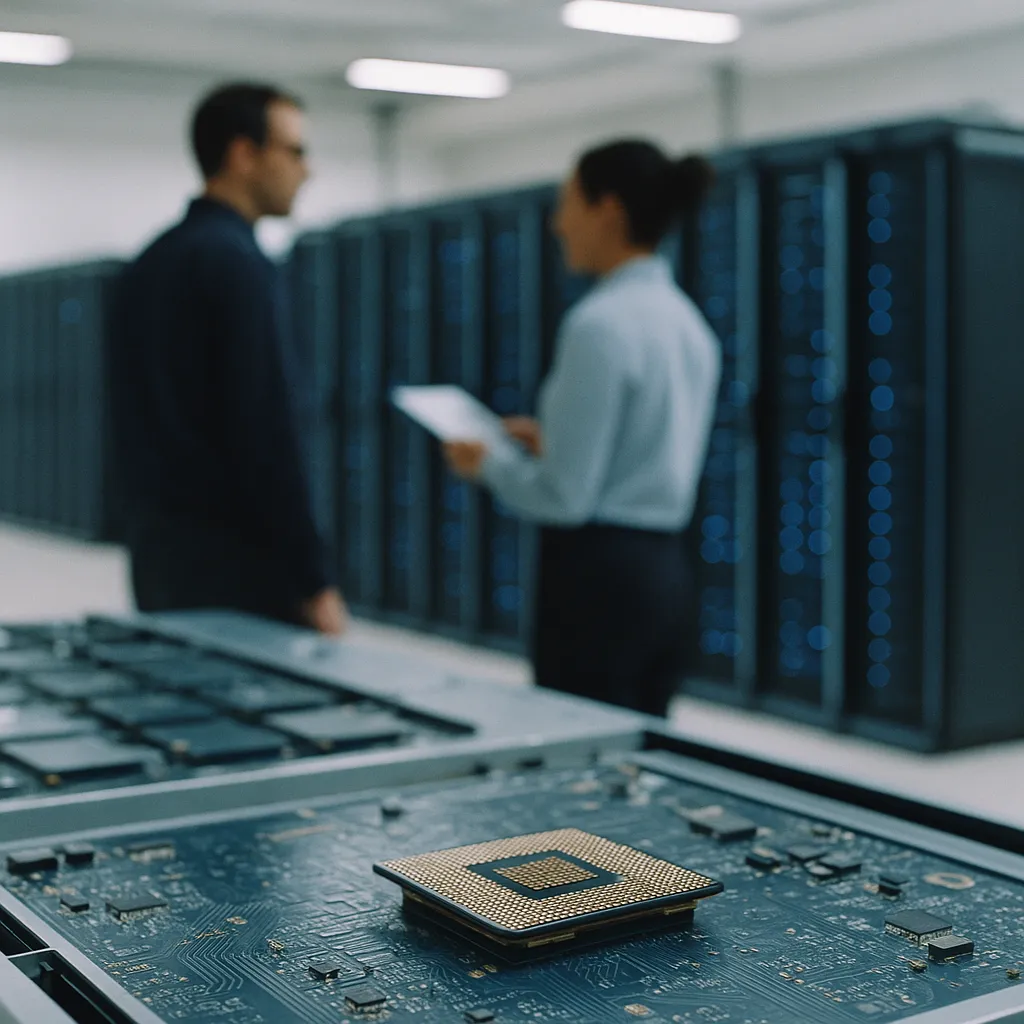
Google launched a fridge-sized satellite carrying four Tensor Processing Units aboard a SpaceX Falcon 9 today, becoming the first company to test AI compute in orbit.
Google put four of its AI chips into orbit today aboard a SpaceX Falcon 9, becoming the first company to test machine-learning compute in space. If the experiment works, it validates a long-term plan to replace land-based data centers with satellite clusters that generate solar power at eight times Earth's efficiency — and beam AI responses directly back to the ground.
The launch, called Project Suncatcher, marks the first time Tensor Processing Units (TPUs) — Google's custom chips designed to run AI workloads — have operated in a space environment. The satellite is roughly the size of a household refrigerator.
What's on the Satellite
The spacecraft carries four TPUs running Gemini AI models in 15-minute operational bursts. After each burst, the hardware enters a cooling cycle — heat dissipation in the vacuum of space works differently than in an air-conditioned data center, and managing that thermal load is one of the core engineering problems Project Suncatcher is designed to solve.
The experiment doesn't yet beam AI responses to Earth. This mission is a validation test: Can consumer-grade AI silicon survive orbital conditions — radiation, temperature swings, microvibration — and still perform?
Why Space for AI Compute
The economics of orbital solar are compelling on paper. Solar panels in low Earth orbit receive direct, unfiltered sunlight with no atmospheric absorption, no weather, and no day-night cycle (depending on orbital path). Google's internal figures, reported by NPR, put orbital solar generation at eight times the output of equivalent panels on Earth's surface.
Get this in your inbox.
Daily AI intelligence. Free. No spam.
Data centers are now one of the fastest-growing sources of electricity demand globally. The AI boom has pushed hyperscalers — Google, Microsoft, Amazon — into multi-year power purchase agreements and grid expansion fights with local utilities. An orbital compute layer that generates its own power would sidestep that bottleneck entirely.
The Long-Term Blueprint
Google's published roadmap for Project Suncatcher describes a phased architecture:
- Phase 1 (current): Single-satellite validation of TPU function in orbit
- Phase 2: Multi-satellite cluster with inter-satellite laser communication links
- Phase 3: 81-satellite arrays forming 1-kilometer compute grids capable of sustained AI inference, with downlink to terrestrial receivers
The 1km array concept is ambitious. For comparison, the International Space Station is roughly 109 meters end-to-end. An 81-satellite formation flying in coordinated proximity represents a significant orbital operations challenge, separate from the compute engineering.
What This Means
For the AI industry, this is primarily a watch-and-wait moment. The satellite either works or it doesn't. If TPUs survive and perform through the first operational cycles, Google will have proof-of-concept data that no competitor has. If the thermal or radiation environment degrades performance, the engineering team learns what needs to change before scaling.
For the energy and data center industries, this signals that at least one major hyperscaler is hedging against the long-term unsustainability of terrestrial power demand. Google spent over $10 billion on data center infrastructure in Q1 2026 alone — any technology that changes the marginal cost of compute at scale is worth serious R&D investment.
For consumers, the near-term impact is zero. Orbital AI compute at commercial scale is at minimum a decade away. What changes today is the knowledge that it's being tested.
What to Watch
Mission telemetry results should be public within 90 days based on Google's stated timeline. The key metric: sustained TPU performance across multiple 15-minute cycles without thermal degradation. A successful run would almost certainly accelerate Phase 2 funding and draw competitors — Microsoft and Amazon have both filed related patents — into active programs.
Did this help you understand AI better?
Your feedback helps us write more useful content.
Get tomorrow's AI briefing
Join readers who start their day with NexChron. Free, daily, no spam.