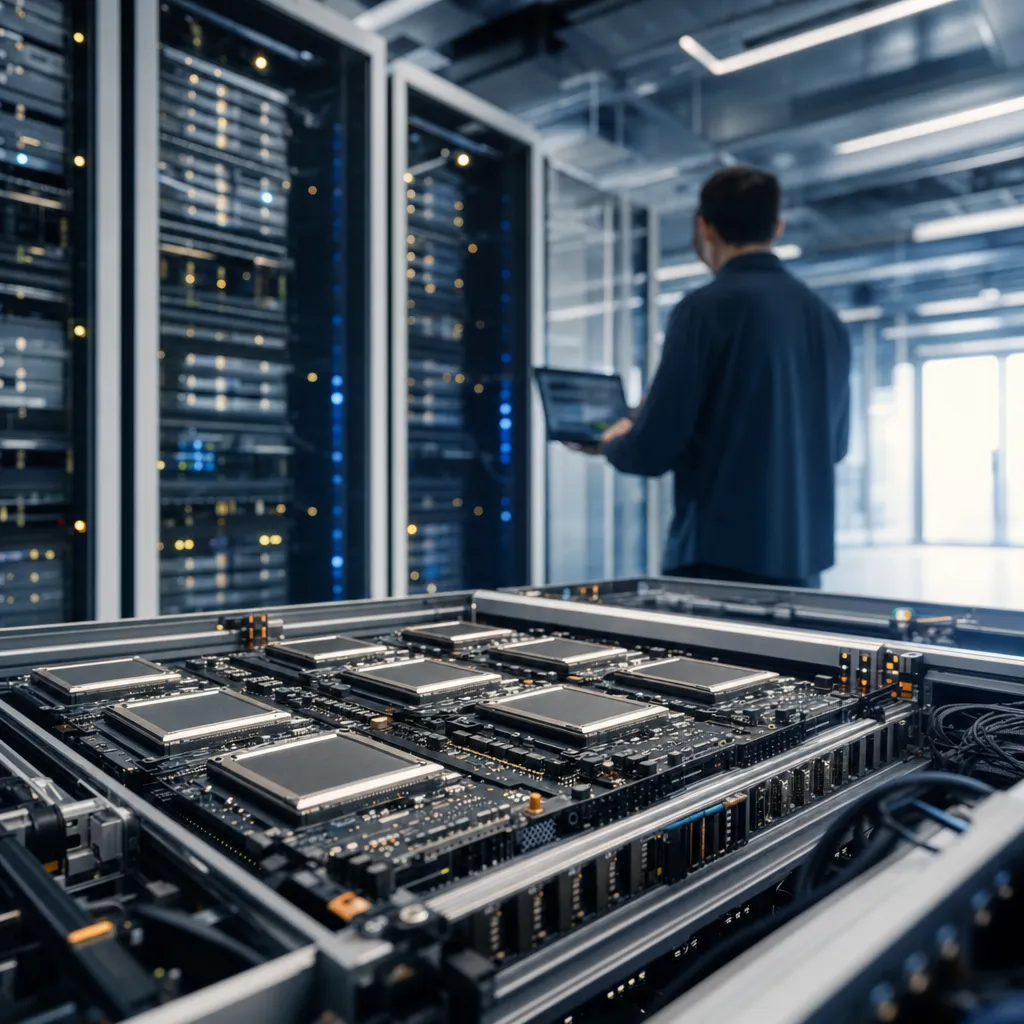
AMD's MI455X achieved 21,333 tokens per second on DeepSeek-R1 inference in MLPerf benchmarks — up to 30% faster than Nvidia's Vera Rubin chip, the strongest challenge to Nvidia's AI hardware dominance yet.
AMD's MI455X GPU outperformed Nvidia's Vera Rubin chip by up to 30% on the industry's most watched LLM inference benchmark, a result that marks the most significant competitive crack in Nvidia's AI hardware dominance in years. The benchmark — MLPerf Offline on DeepSeek-R1 — has become the de facto measuring stick for large-scale inference workloads, and AMD now leads it.
The result was published in the November 2026 MLPerf Inference benchmark round. AMD's MI455X achieved 21,333 tokens per second on DeepSeek-R1 inference under identical testing conditions, according to benchmarks reported by Rio Rundown, which AMD states is up to 30% higher than Nvidia's Vera Rubin GPU under the same workload. MLPerf is an industry consortium — not a vendor-run test — that uses standardized hardware submissions reviewed by external participants.
What MLPerf Measures and Why This Round Matters
MLPerf Inference measures how fast an accelerator can process a fixed set of AI workloads at production quality. The Offline scenario measures peak throughput when queries are batched — the relevant test for data center inference, where operators want to maximize tokens delivered per second per dollar of hardware cost.
DeepSeek-R1 is a 671-billion-parameter mixture-of-experts model (a type of neural network that activates only a subset of its parameters per query, allowing large capability at lower compute cost) released earlier in 2026. It has become the benchmark of choice for evaluating inference at scale because it reflects real-world LLM serving demands: large model, long context windows, complex reasoning outputs.
Nvidia has dominated MLPerf since the benchmark's inception. The H100 and H200 GPUs set the pace in prior rounds; Vera Rubin — Nvidia's current-generation flagship — was expected to extend that lead. AMD's result challenges that assumption directly.
Get this in your inbox.
Daily AI intelligence. Free. No spam.
The MI455X: What Changed
AMD's MI300 architecture, which preceded the MI455X, closed the gap with Nvidia's H100-class hardware but did not overtake it. The MI455X represents AMD's next-generation push with:
- Higher memory bandwidth — a critical bottleneck for LLM inference, which is memory-bound rather than compute-bound at typical production batch sizes
- ROCm 7 software stack improvements — AMD's CUDA-equivalent software layer has historically been a friction point for adoption; recent versions have narrowed the developer experience gap significantly
- Deeper integration with open-weight model optimizations — AMD has invested specifically in kernels tuned for DeepSeek-class mixture-of-experts architectures
The 30% performance lead is not across all workloads. MLPerf covers multiple tasks; AMD's advantage appears concentrated in the DeepSeek-R1 Offline scenario. Training benchmarks, real-time (server scenario) performance, and other model families may show different results.
What This Means for the AI Hardware Market
For cloud buyers: Hyperscalers and enterprises procuring inference infrastructure now have a credible alternative to Nvidia at the top of the performance stack for specific workloads. This matters for price negotiations even if buyers stay with Nvidia — competitive benchmarks give procurement teams leverage.
For AMD: A benchmark win doesn't translate directly to market share. Nvidia's moat includes CUDA's ecosystem lock-in (millions of developers have written CUDA-dependent code), the full NVLink/NVSwitch interconnect stack for training clusters, and enterprise software partnerships that go deep into the ML ops toolchain. AMD needs sustained performance parity across workloads and quarters, not a single benchmark victory.
For the industry: The result accelerates the possibility of a genuinely competitive AI chip market. Qualcomm, Intel, and a wave of custom silicon startups (Groq, Tenstorrent, Cerebras) have argued for years that Nvidia's dominance is a temporary moat. AMD's MLPerf win is the strongest empirical data point yet for that thesis.
For DeepSeek-class models: The fact that an open-weight, freely available model is now the benchmark that shapes hardware procurement decisions is itself significant. The inference efficiency of open-weight models is now shaping multi-billion-dollar hardware roadmaps.
What to Watch
Watch for Nvidia's formal MLPerf submission response and any public rebuttal of AMD's methodology claims. The more consequential test will be Q1 2027 procurement decisions at the major hyperscalers — Microsoft Azure, Google Cloud, and Amazon Web Services. If any of them announce MI455X deployments at scale, the narrative shifts from benchmark result to market reality.
Did this help you understand AI better?
Your feedback helps us write more useful content.
Get tomorrow's AI briefing
Join readers who start their day with NexChron. Free, daily, no spam.