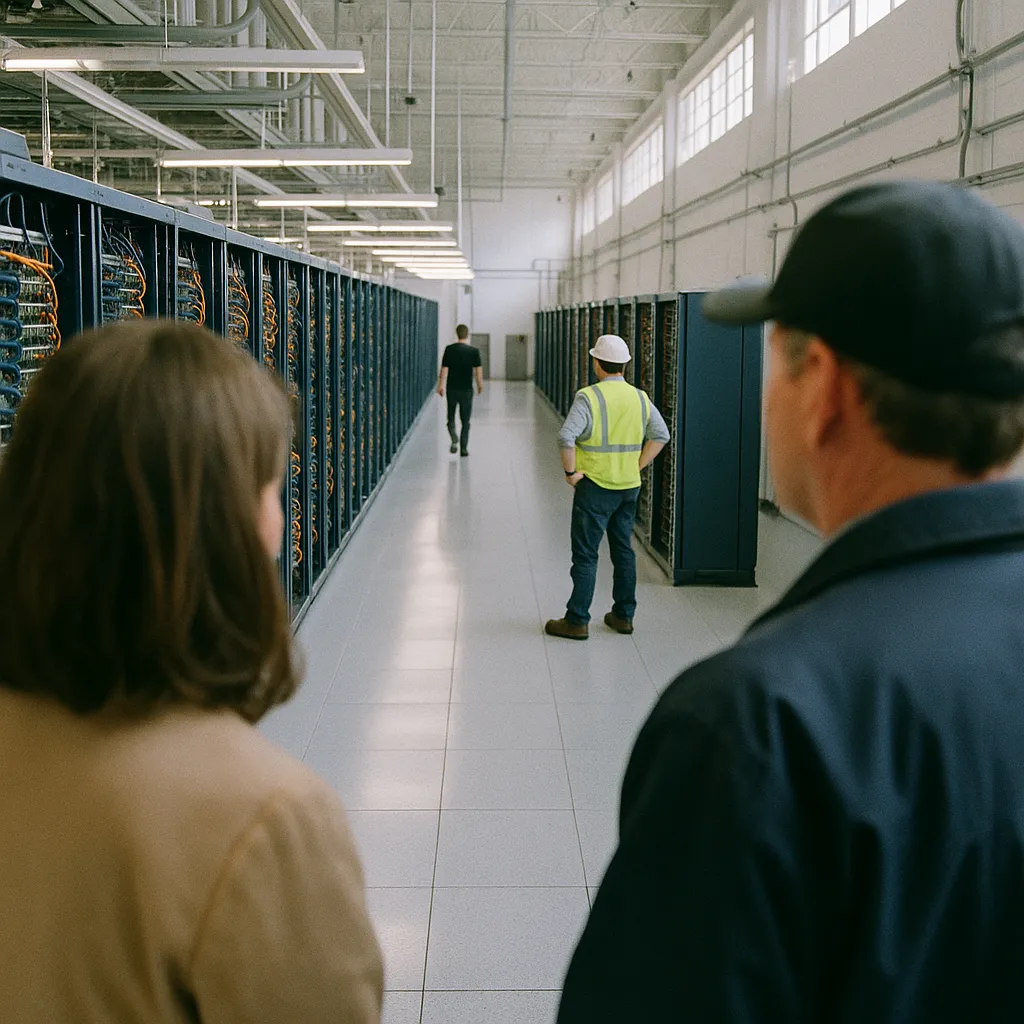
Community opposition to AI data center construction is spreading nationwide, driven by concerns over water use, grid strain, and industrial noise — and now it's reaching governors' desks.
Community Opposition to AI Data Centers Is Reaching Governors' Desks — Maine's Just Became a Veto
By Hector Herrera | May 10, 2026 | Real Estate
Maine's governor vetoed legislation this week that would have banned new hyperscaler AI data center construction in the state — a sign that the political fight over where AI infrastructure gets built has moved from city council chambers to executive offices. The veto stops one bill, but it doesn't stop the underlying opposition, which is spreading across the country as communities confront what a $7 trillion global data center buildout actually looks like on the ground.
Context
AI data centers are not like traditional data centers. They consume dramatically more power, water, and physical space. A hyperscale AI training facility can draw 500 megawatts or more — enough to power a mid-sized city — and require millions of gallons of water per day for cooling. They operate 24 hours a day, generating persistent industrial-level noise and heat. And they're being sited in suburban and rural communities that have little regulatory framework to evaluate or manage them.
CNBC's reporting documents how community opposition is now appearing in states from Virginia to Texas to the Pacific Northwest, with residents raising concerns that go well beyond the data center itself: power grid strain that raises utility bills for existing customers, water consumption in drought-stressed regions, industrial facility noise in residential corridors, and property tax displacement as hyperscalers negotiate abatements that shift the local tax burden.
The Maine Veto
Maine's legislature passed a bill that would have imposed a moratorium on new hyperscaler data center construction while the state developed a regulatory framework to evaluate their environmental and grid impacts. The governor vetoed it, citing economic development concerns — data centers represent significant construction employment and long-term property tax revenue.
The veto illustrates the political bind that state and local governments face. The economic case for hosting data centers is real: construction jobs, permanent technical jobs, property tax revenue (where abatements aren't negotiated), and the signaling value of being an AI infrastructure hub. The community case against them is also real: the benefits are concentrated and the costs — grid strain, water use, noise, industrial character — are diffuse and borne by existing residents.
Maine's governor chose the economic argument. That will not be the last such choice, and not every governor will make the same call.
Get this in your inbox.
Daily AI intelligence. Free. No spam.
What Communities Are Actually Fighting Over
The opposition to AI data centers is not monolithic. Redfin data from earlier this month found that 47% of Americans surveyed said they would oppose a data center being built in their neighborhood. The specific concerns break into several categories:
Grid and utility costs: Large data centers add significant load to regional grids. In areas with constrained transmission capacity, that load can require expensive grid upgrades — the cost of which is typically socialized across all ratepayers. Existing utility customers effectively subsidize the infrastructure that serves new hyperscaler tenants.
Water consumption: Cooling a major AI facility requires substantial water. In western states already under drought stress, new data centers are competing for the same aquifers that agriculture and municipalities depend on.
Industrial noise: The cooling systems for large data centers — massive banks of fans and chillers — generate continuous low-frequency noise that travels significant distances. Residential neighbors within half a mile often report sleep disruption.
Property tax dynamics: Many hyperscalers negotiate multi-year tax abatements as conditions of site selection. Those abatements reduce the local fiscal benefit while the infrastructure costs (roads, utilities, emergency services) remain.
The Scale of What's Coming
Global spending on AI data centers is projected to exceed $7 trillion by 2030, according to industry analysis cited by CNBC. That investment has to land somewhere — in physical buildings, on physical land, connected to physical power grids. The siting and permitting process for that infrastructure is now one of the largest land-use policy battles in the country.
Hyperscalers — Amazon, Microsoft, Google, Meta — have been moving quickly to lock up sites before local opposition can organize. That strategy is increasingly running into organized resistance, and into state legislatures that are starting to write rules.
Virginia, which hosts the largest concentration of data centers in the world in Loudoun County, has been struggling with grid capacity issues for years and has enacted stricter siting rules. Texas has seen significant opposition in rural counties where data centers are being proposed near agricultural land. Idaho and Georgia are seeing similar fights.
What to Watch
The Maine veto is a setback for the regulatory approach, but the underlying dynamic is not going away. Watch for:
- State-level framework legislation that stops short of outright bans but requires environmental impact assessments, water use disclosure, and grid impact studies before permits are issued
- FERC intervention — the Federal Energy Regulatory Commission is already examining how large data center loads affect grid reliability and cost allocation; federal rules could override state-by-state inconsistency
- Hyperscaler site selection shifts — if opposition in established markets becomes too costly, companies will accelerate development in states with fewer regulatory tools and more desperate economic development appetites
The $7 trillion doesn't disappear because Maine said no. It goes somewhere. The question is where, and under what terms.
Source: CNBC — AI Data Center Construction Public Opposition
Did this help you understand AI better?
Your feedback helps us write more useful content.
Get tomorrow's AI briefing
Join readers who start their day with NexChron. Free, daily, no spam.