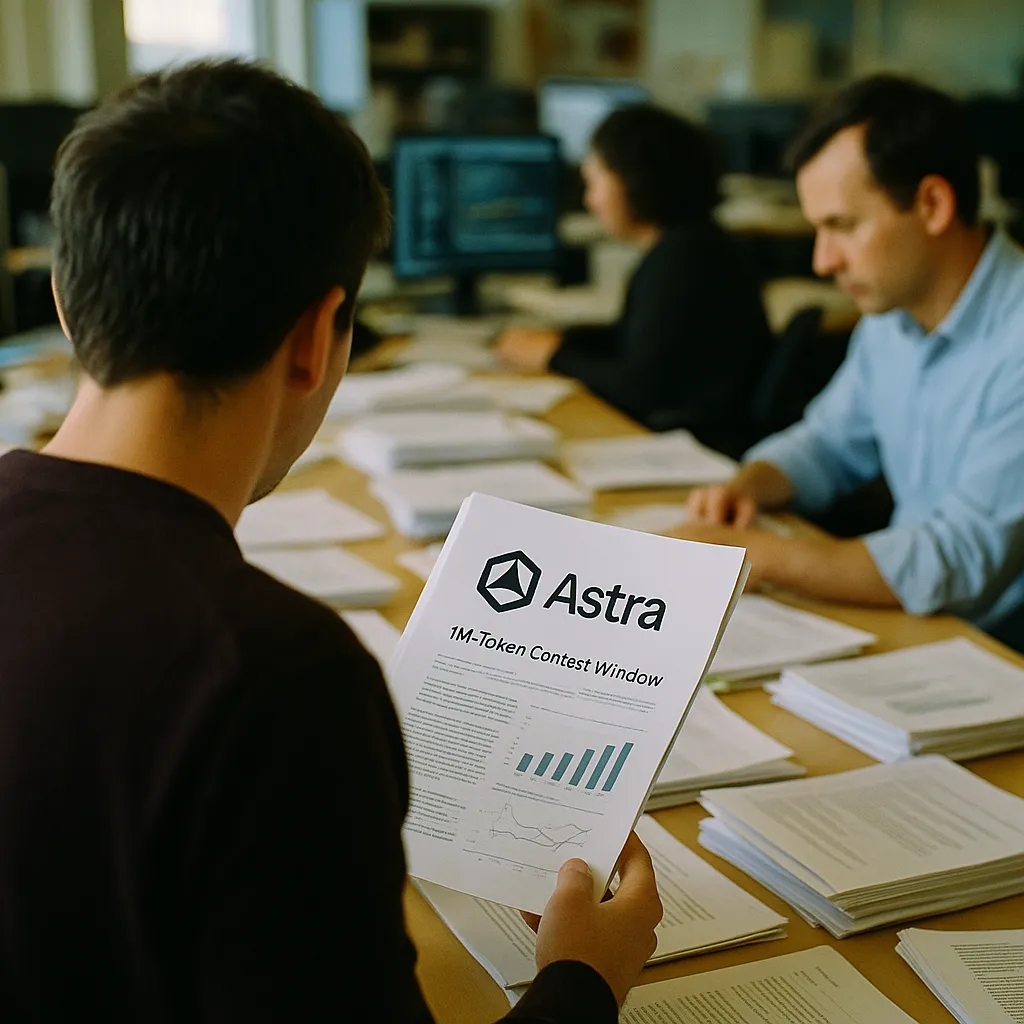
OpenAI shipped GPT-6 Astra with a 1.05-million-token context window and opened its Agents API to public beta on September 10 — a dual release targeting enterprise agentic deployments ahead of DevDay.
OpenAI Launches GPT-6 Astra with 1M-Token Context Window and Opens Agents API to Public Beta
By Hector Herrera | September 12, 2026
OpenAI shipped GPT-6 Astra — model ID gpt-6-astra — on September 10, giving developers a 1.05-million-token context window and standard API pricing of $10 per million input tokens and $50 per million output tokens. The same day, the company opened its Agents API to public beta, exposing the managed Codex harness so developers can build agentic pipelines without writing their own session management or orchestration layers.
Both releases arrive roughly three weeks before OpenAI's DevDay event on September 29 in San Francisco — a timing that signals these are the opening bids in a broader enterprise push, not a quiet infrastructure update.
What GPT-6 Astra Actually Offers
The 1.05-million-token context window is the headline number, but the practical implication matters more: a model can now hold an entire codebase, a year's worth of financial reports, or a patient's longitudinal health record inside a single prompt. That removes the retrieval-augmented generation (RAG) workarounds developers have relied on when documents exceed earlier context limits.
Key specs:
- Context window: 1.05 million tokens
- Pricing: $10/million input tokens, $50/million output tokens
- Model ID:
gpt-6-astra
At $50 per million output tokens, GPT-6 Astra is priced significantly above GPT-4o ($15/million output) and Anthropic's Claude 3.5 Sonnet ($15/million output). OpenAI is pricing the model for enterprise workloads where long-context processing justifies the cost premium — not for consumer applications.
Get this in your inbox.
Daily AI intelligence. Free. No spam.
The Agents API: What Changes for Developers
The Agents API entering public beta is arguably the more consequential release for the near term. OpenAI's managed Codex harness — previously available only in limited preview — now handles the stateful infrastructure that autonomous agent workflows require: session management, tool call routing, conversation memory, and retry logic.
Before this, developers building multi-step AI pipelines had to wire these components themselves, which meant significant engineering overhead and inconsistent behavior across complex task chains. The public beta means any developer with an OpenAI API key can now access that managed layer directly.
What it enables:
- Agents that complete multi-step tasks across multiple tool calls without losing context
- Automated code execution, file analysis, and web browsing pipelines without custom orchestration
- Enterprise deployments where persistent, auditable agent sessions are a compliance requirement
Why It Matters for Enterprise AI Adoption
The combination of a long-context model and a managed agents layer is a deliberate product architecture choice. Enterprise buyers have consistently named two friction points in deploying AI at scale: models that lose track of large documents, and agent pipelines that require too much internal engineering to maintain. OpenAI is removing both blockers simultaneously.
The competitive context: Anthropic's Claude 3.5 models support a 200,000-token context window. Google's Gemini 1.5 Pro extended to 1 million tokens earlier this year. GPT-6 Astra's 1.05 million tokens keeps OpenAI roughly at parity on context length while the Agents API gives it a managed infrastructure advantage over competitors who offer raw API access without opinionated orchestration.
This also sets the stage for DevDay on September 29. The public beta is almost certainly not the final form — DevDay will likely announce pricing tiers, enterprise agreements, and additional tooling built on top of the Agents API framework.
What to Watch
Watch whether enterprise buyers' adoption timelines compress ahead of DevDay. If OpenAI announces volume pricing or dedicated enterprise tiers for GPT-6 Astra at the September 29 event, the model's high output cost becomes negotiable at scale — which could accelerate displacement of earlier GPT-4 class deployments across large organizations.
Source: TechStartups, September 11, 2026
Did this help you understand AI better?
Your feedback helps us write more useful content.
Get tomorrow's AI briefing
Join readers who start their day with NexChron. Free, daily, no spam.