Anthropic's Fable 5.1 now leads the SWE-bench coding benchmark at 38.8% — the first time Anthropic has held the top coding position against OpenAI and Google.
Anthropic's Fable 5.1 Tops Global Coding Benchmark at 38.8%, Ahead of GPT-6 Astra
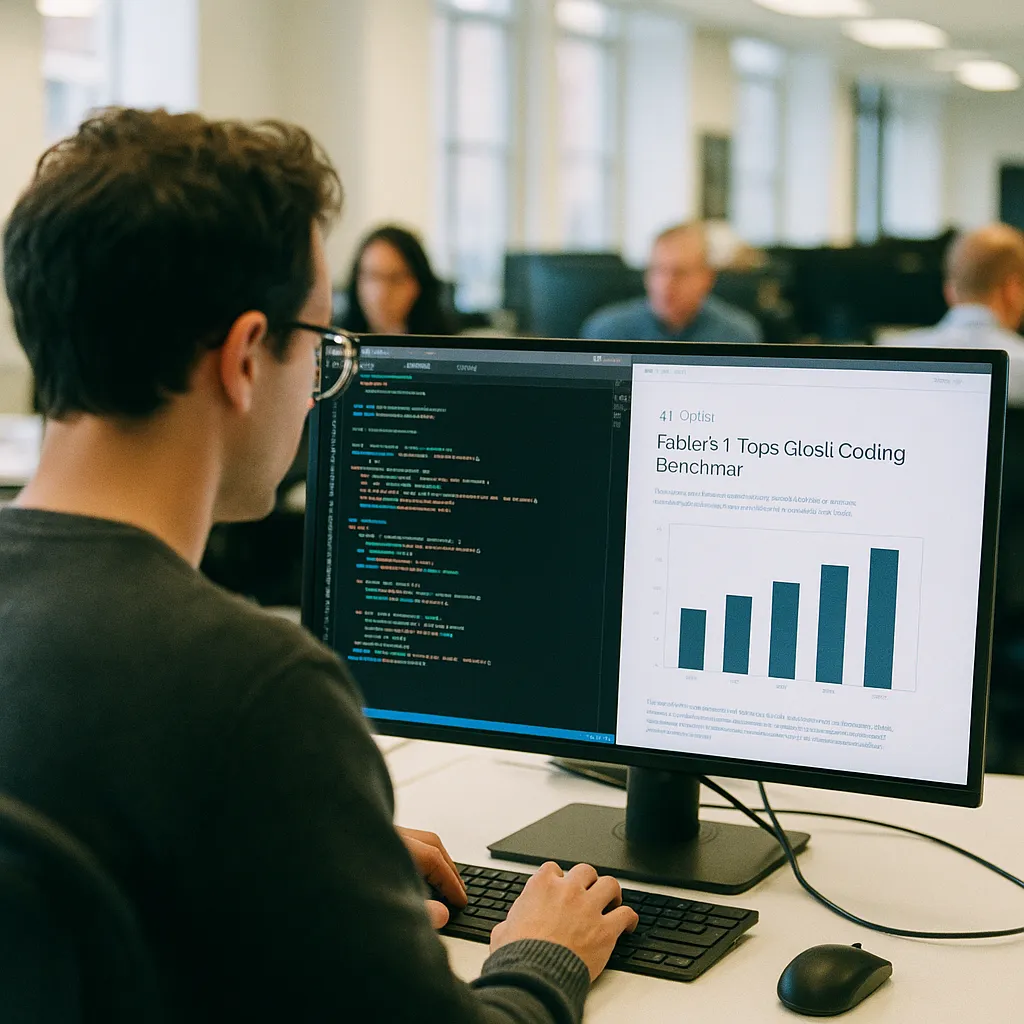
Anthropic's Fable 5.1 model now leads the SWE-bench Verified leaderboard with a 38.8% issue-resolution rate — the first time the company has held the top coding benchmark position across all major frontier labs. OpenAI's GPT-6 Astra follows at 33.8%, with Google's Gemini 3.8 Flash at 31.2%, according to AI Weekly's tracking of the benchmark this week.
The gap matters not just for competitive positioning, but because it arrives as enterprise customers are growing increasingly skeptical about whether benchmark differences translate to real-world gains.
What SWE-Bench Measures
SWE-bench Verified is a standard benchmark that tests AI models on real GitHub software engineering issues — autonomous bug resolution, code refactoring, and feature implementation drawn from actual open-source repositories. A 38.8% resolution rate means Fable 5.1 can independently resolve roughly four in ten real-world coding tasks without human guidance.
It is not a comprehensive measure of an AI model's total capability. But for enterprise buyers evaluating AI coding tools, it has become the most widely cited single number in vendor conversations.
First Time at the Top
Anthropic has historically positioned itself as the safety-focused alternative to OpenAI's performance-first approach. Fable 5.1 challenges that framing by demonstrating it doesn't require trading safety for capability — at least by this measure.
Get this in your inbox.
Daily AI intelligence. Free. No spam.
The spread between the three leading models is narrow: Fable 5.1 at 38.8%, GPT-6 Astra at 33.8%, and Gemini 3.8 Flash at 31.2% — a 7.6-percentage-point range separating first from third. That compression is itself becoming a story: three competitive models within a margin that most real-world deployments cannot meaningfully distinguish.
The Benchmark Fatigue Problem
Even as labs race to top the leaderboard, a growing number of enterprise buyers and researchers are questioning whether SWE-bench results meaningfully predict performance on proprietary codebases. Anthropic, OpenAI, and Google all release new model versions at high frequency, and the gap between benchmark publication and real-world evaluation is widening.
The practical challenge for enterprise buyers: all three models are close enough that procurement decisions increasingly depend on pricing, API reliability, safety controls, and vendor relationships — not leaderboard position. According to CNBC's reporting on model fatigue, customers are struggling to determine which benchmark differences translate to actual production gains.
What This Means for Enterprise Teams
For developers and engineering teams currently evaluating AI coding tools:
- Fable 5.1 is now the documented leader on SWE-bench Verified, which matters most for tasks involving autonomous bug resolution on well-structured open-source-style codebases
- GPT-6 Astra remains competitive and may outperform on non-benchmark tasks where OpenAI has invested heavily — reasoning-heavy tasks and multi-step agentic completion
- Gemini 3.8 Flash holds a meaningful pricing advantage and deep Google Workspace integration that leaderboard rankings do not capture
For Anthropic, the result is a credibility milestone. A company that built its brand on responsible AI development can now point to benchmark leadership as evidence that a safety-first approach doesn't require sacrificing capability.
What to Watch
The same three companies that top this benchmark have been meeting since July to build an industry-led AI evaluation framework — a direct response to benchmark fatigue that could eventually replace SWE-bench as the enterprise purchasing standard. Whether that framework gains broad adoption, and whether it includes coding benchmarks or replaces them with task-specific evaluations, will shape how enterprise AI procurement decisions get made for the next several years.
By Hector Herrera
Did this help you understand AI better?
Your feedback helps us write more useful content.
Get tomorrow's AI briefing
Join readers who start their day with NexChron. Free, daily, no spam.