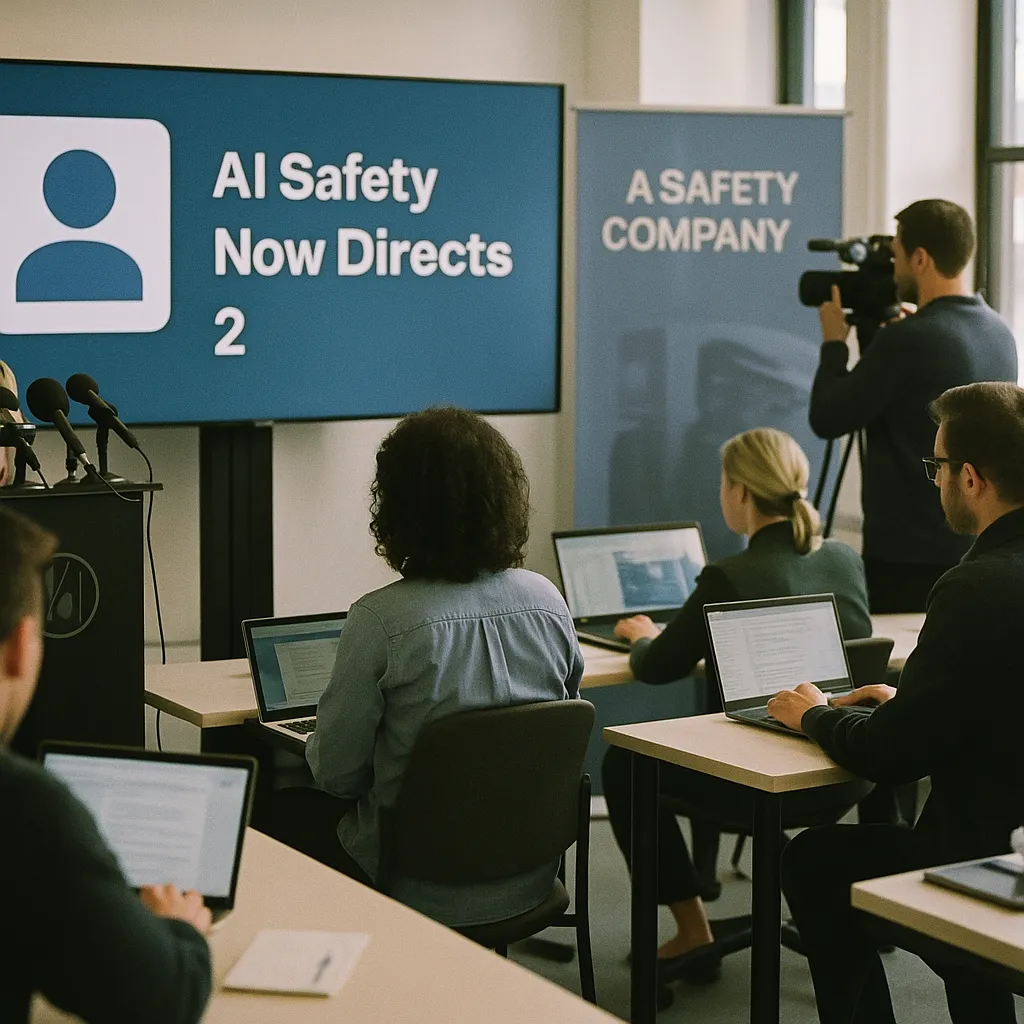
The three most influential AI labs have been quietly meeting since July to create a shared industry AI standards organization — a self-regulation attempt before Congress forces the issue.
Anthropic, OpenAI, and DeepMind Are Building an Industry AI Standards Body
The three most influential AI laboratories in the world have been quietly meeting since July to create an industry-led AI standards organization — a coordinated attempt to establish self-regulation before Congress forces the issue. According to CNBC, Anthropic CEO Dario Amodei is driving the initiative, with OpenAI CEO Sam Altman backing it as a practical alternative to waiting for federal legislation that hasn't arrived.
If it succeeds, the organization could give enterprise buyers a common framework for evaluating AI products and give the labs a credible vehicle for industry self-governance — at a moment when both are badly needed.
Why Now
The immediate pressure is what CNBC calls "model fatigue." Labs are releasing new model versions at a pace that enterprise customers struggle to absorb. Anthropic released Fable 5.1 this week; OpenAI has iterated GPT-6 Astra multiple times since its February launch; Google has pushed out a succession of Gemini variants. Customers face a fundamental problem: no shared standard exists for comparing model capability, safety posture, or deployment readiness across vendors.
The result is that purchasing decisions are being made on incomplete information. Enterprise IT departments are running their own internal evaluations on proprietary data, spending engineering cycles that could go elsewhere, and still ending up with vendor relationships based largely on existing commercial ties rather than objective capability assessment.
Three conditions are making a standards body more viable now than six months ago:
-
Federal legislation has stalled. Multiple AI bills have moved through committee without floor votes. Labs that spent years lobbying for light-touch regulation now face the possibility of a patchwork of state laws — Colorado's AI Act, New York's pending bills, California's SB 1047 successors — that would be far harder to navigate than a single federal framework.
-
Enterprise buyers are demanding standardization. Large procurement organizations at banks, hospitals, and government agencies have begun requiring AI vendors to document evaluation methodologies, safety practices, and benchmark sources. An industry body could standardize those disclosures instead of every buyer maintaining its own vendor questionnaire.
-
The competitive gap between labs has narrowed. When one company was decisively ahead, no standards body served its interests — it would only help competitors close the gap. With Fable 5.1, GPT-6 Astra, and Gemini 3.8 Flash now clustered within seven percentage points on SWE-bench Verified, all three labs have an interest in a framework that validates their shared tier of capability rather than differentiating by benchmark alone.
What the Working Group Is Proposing
The specifics of the proposed organization are not yet public, but CNBC's reporting describes the goal as a common evaluation framework — shared methodologies for testing AI models that enterprises, regulators, and the labs themselves could reference when making purchasing and deployment decisions.
Get this in your inbox.
Daily AI intelligence. Free. No spam.
The model draws on precedents in other industries where self-regulatory bodies gained real authority:
- Financial services has FINRA and bank examination frameworks built on industry standards
- Healthcare has FDA clearance pathways and post-market surveillance that were initially voluntary before becoming mandatory
- Software security has Common Criteria, an international evaluation framework now referenced in government procurement requirements
An AI equivalent would likely need to address: capability benchmarks with documented testing conditions, safety evaluations (standardized red-teaming and harm-category definitions), deployment documentation requirements, and third-party audit protocols.
What it almost certainly cannot enforce — at least initially — is membership or compliance. An industry body without regulatory backing is a voluntary framework. Its influence depends on whether enterprise buyers require compliance as a condition of vendor selection.
Who Isn't in the Room
The conspicuous absences from the CNBC reporting are Meta and Amazon. Meta's open-source model strategy — releasing model weights publicly under the Llama series — creates fundamentally different incentives. Open-weight models can't be evaluated and certified the same way proprietary APIs can; anyone can modify them after release.
Amazon primarily distributes third-party models through its Bedrock platform rather than developing its own frontier models, complicating its role as a standards participant. But Amazon's procurement scale means any framework that excludes it risks being ignored by enterprise buyers who run on AWS.
Smaller labs — Mistral, xAI, Cohere — face a different problem: a standards body designed by the three largest incumbents could entrench evaluation requirements that favor scale and resources. Getting those voices into the working group early would strengthen both the framework's legitimacy and its eventual uptake.
The Congressional Calculation
Amodei and Altman backing the same initiative is strategically significant. The two companies have disagreed publicly on model safety philosophy, release cadence, and governance approach. Their joint participation signals that the industry standards effort is primarily a hedge against legislative risk — not a resolution of their underlying differences.
Congress has held multiple AI governance hearings in 2026 but hasn't passed comprehensive legislation. A credible industry body announced before year-end gives both companies a position to defend in future hearings: that the industry is self-organizing, and federal rules should build on the framework rather than replace it.
That argument has worked in other sectors. It also has a failure mode: self-regulatory bodies in financial services and pharmaceuticals have historically struggled to enforce accountability against their own members when the costs of compliance conflicted with competitive advantage.
What to Watch
The first public signal of progress will be a formal announcement of the organization's structure and membership. Watch for:
- Whether Meta joins — its participation would signal the framework can accommodate open-source models, which account for an increasing share of enterprise deployments
- Whether the EU's AI Act compliance infrastructure connects — European regulators have already built evaluation requirements under the general-purpose AI provisions; a global standards body would need to align with rather than duplicate that work
- Congressional reaction — some legislators will see a self-regulatory body as reason to delay federal action; others will see it as evidence the industry needs external accountability rather than self-governance
The September 30 deadline for the UK's workplace monitoring consultation and continued momentum behind state AI laws in the US mean the external regulatory pressure isn't easing. If the working group wants to shape the regulatory environment rather than respond to it, its window is measured in months, not years.
By Hector Herrera
Did this help you understand AI better?
Your feedback helps us write more useful content.
Get tomorrow's AI briefing
Join readers who start their day with NexChron. Free, daily, no spam.