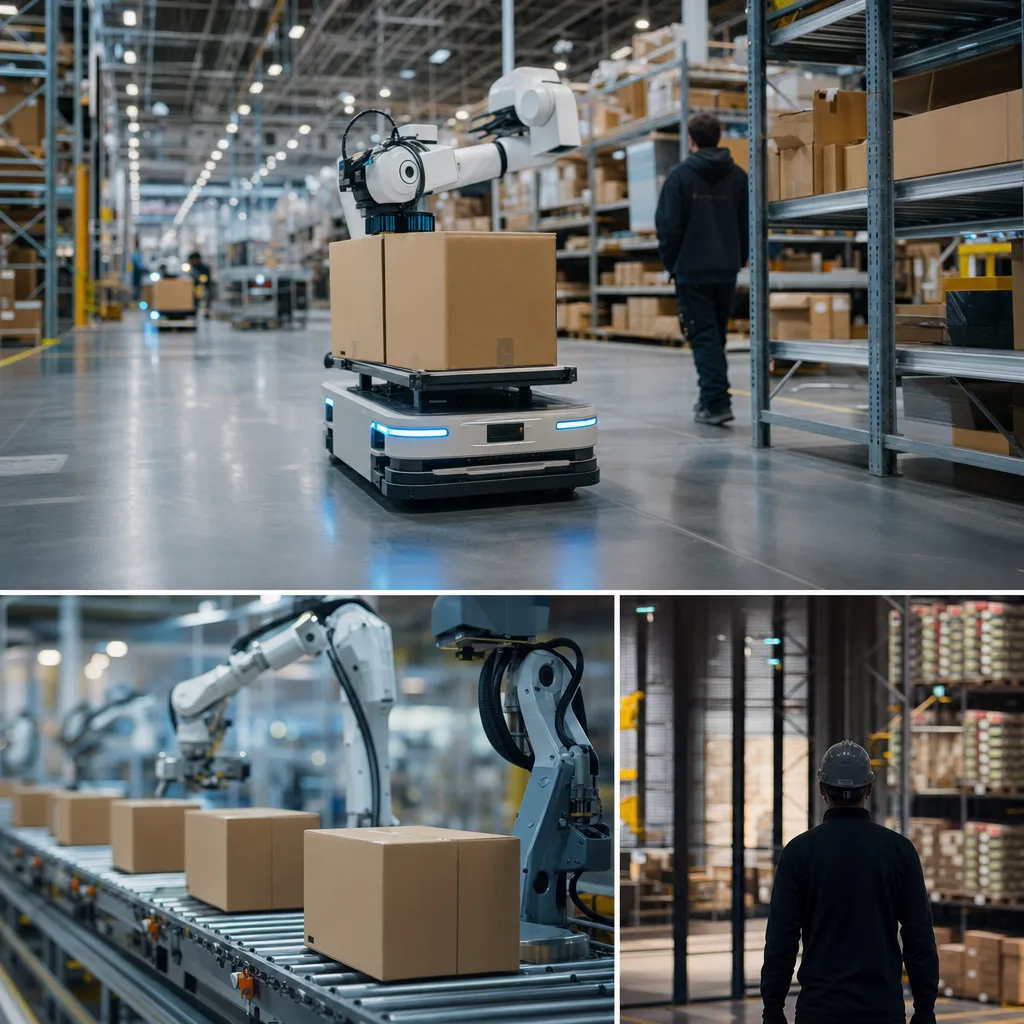
PACK EXPO 2026 demonstrated that AI-powered warehouse robotics has shifted from concept to commercially procurable — systems available for purchase and deployment in existing facilities today.
PACK EXPO 2026 in Chicago last week served as a proving ground for AI-native warehouse robotics, with multiple vendors demonstrating systems that have crossed from prototype to commercially procurable — meaning a manufacturing or distribution operation can buy them today and deploy them in existing facilities without custom integration work. That transition from concept to off-the-shelf is the moment that changes industry adoption curves.
What PACK EXPO showed
Two deployments drew the most attention among packaging and logistics professionals at the show.
CMES Robotics made its U.S. debut with an AI-powered mixed-case palletizer — a robot that builds pallets from boxes of different sizes, weights, and orientations without requiring pre-sorted or uniform input. Mixed-case palletizing has historically been one of the hardest automation challenges in warehousing, because the geometric variability of the task defeats rules-based approaches. CMES's system uses deep learning to infer object properties in real time and plan stable pallet configurations on the fly. The company reports it's currently deployed in active distribution centers in Asia and is now selling into the North American market.
OSARO demonstrated its SightWorks platform, which uses deep learning vision to handle robotic picking, packing, and depalletizing across heterogeneous SKU mixes. SightWorks doesn't require a structured product catalog or pre-programmed object models — the system learns from exposure. For operations running hundreds or thousands of SKUs with frequent additions, that matters: it eliminates the per-SKU engineering work that made earlier pick robots economically marginal outside high-volume single-SKU applications.
Why this show matters for the manufacturing sector
Get this in your inbox.
Daily AI intelligence. Free. No spam.
PACK EXPO is not a research conference. It is an industrial trade show where procurement teams buy equipment. The presence of AI-native robotics solutions in the main exhibition hall — not in a startup zone or innovation corridor — signals that these systems are ready for purchase decisions, not just evaluation.
That shift has been coming for several years. The robotics industry spent 2021 through 2024 dealing with the gap between what AI-powered robots could do in controlled demonstrations and what they could do in the noise and variability of real warehouse environments. High-profile failures — robots that worked in pilots but couldn't handle the product diversity of actual operations — made buyers cautious. The systems being shown at PACK EXPO 2026 are built on that hard-won experience, and the companies showing them have operational references, not just demo videos.
The economics behind the adoption
The business case for AI warehouse robotics has become cleaner as labor markets have stayed tight and wages have risen. Average warehouse associate wages in the U.S. rose 18 percent between 2022 and 2026. Worker turnover in fulfillment centers remains above 100 percent annually at many operations, creating constant training costs on top of wage costs. A robotic system that costs $300,000 to deploy and runs for eight years at a total operating cost of $8 per hour is straightforwardly competitive with human labor in many scenarios — and it doesn't turn over.
The calculation is not universal. Operations with high product variability, complex value-added services, or workflows requiring fine motor dexterity beyond current robotic capability still need human workers for significant portions of their operation. But the range of tasks that fall within robot capability expanded materially this year, and PACK EXPO demonstrated that the expansion is commercially accessible, not just technically demonstrated.
What to watch
Watch adoption rates at mid-market distribution centers — facilities in the 200,000 to 500,000 square foot range that are large enough to benefit from automation but too small to have had dedicated automation engineering resources. That segment has historically lagged large-scale fulfillment operations in robotics adoption. If the off-the-shelf AI robotic systems shown at PACK EXPO reach those mid-market facilities, the total market impact becomes considerably larger than the early adopter curve suggests.
Source: Robotics 24/7
Did this help you understand AI better?
Your feedback helps us write more useful content.
Get tomorrow's AI briefing
Join readers who start their day with NexChron. Free, daily, no spam.