Accenture is backing General Robotics to accelerate fully autonomous physical AI systems in factories and logistics, targeting the 80%+ of large manufacturers projected to deploy robotics by decade's end.
Accenture Invests in General Robotics to Scale Physical AI Across Manufacturing and Logistics
By Hector Herrera | April 19, 2026 | Manufacturing
Accenture has made a strategic investment in General Robotics, an AI-native robotics company, to accelerate fully autonomous operations in factories and logistics facilities. The partnership targets the phase beyond pilot deployments—real production environments, at scale, with measurable output. It is part of a broader industry acceleration that McKinsey projects will put robotics in more than 80% of large manufacturers by the end of the decade.
What Happened
Accenture announced a strategic investment in General Robotics with a focus on deploying physical AI systems—robotics that use AI to perceive, reason about, and act within physical environments—across manufacturing and logistics operations. Financial terms were not disclosed.
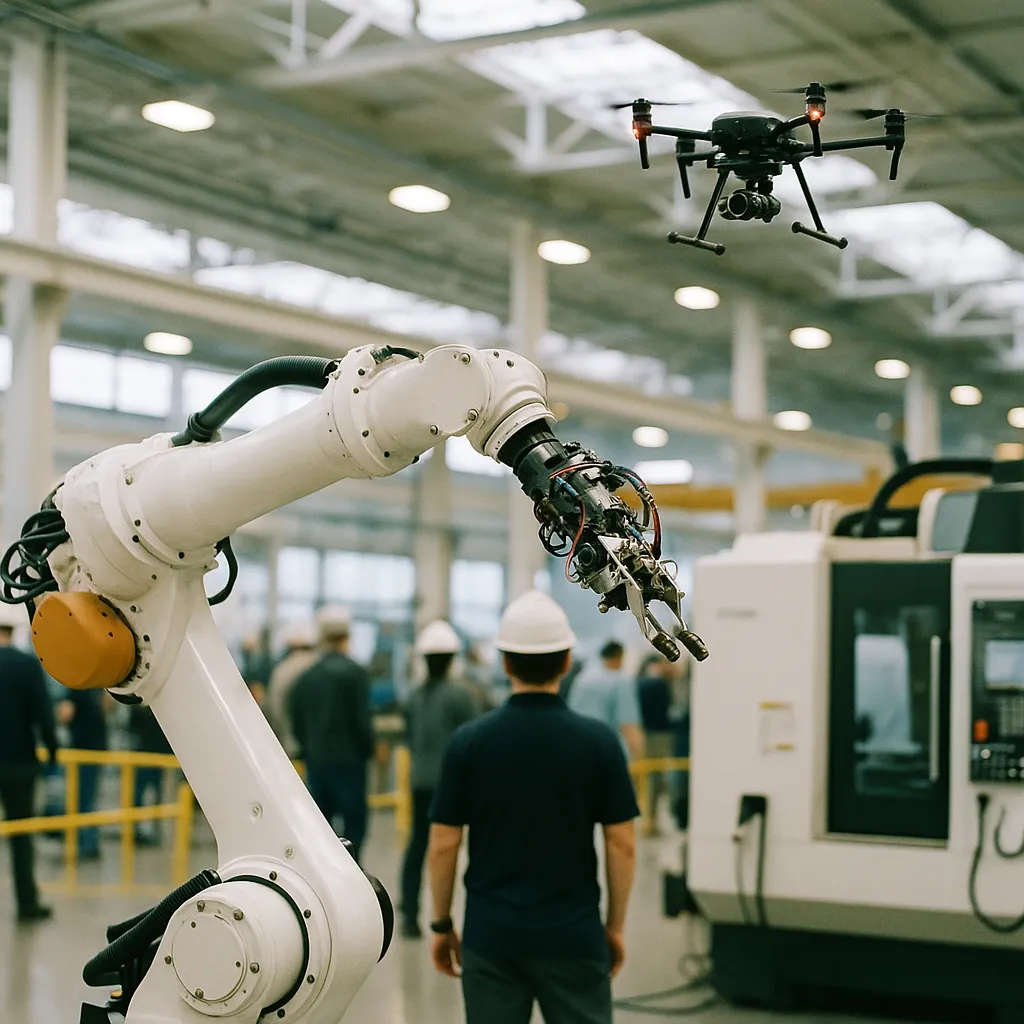
Physical AI (also called embodied AI) refers to AI systems that operate in the physical world: robotic arms, autonomous mobile robots, perception systems that interpret camera and sensor data to make real-time decisions about how to move, pick, place, or route physical objects. It is distinct from software AI, which processes text, images, and data entirely within digital systems.
Accenture brings the enterprise consulting relationships and implementation capacity. General Robotics brings the AI-native robotics technology stack. Together, the goal is to take physical AI from proof-of-concept to full-scale deployment across client operations.
Context
Manufacturing and logistics are two of the largest sectors in the global economy and two of the most labor-intensive. They are also sectors under significant cost pressure from global competition, labor shortages, and supply chain volatility. AI-powered robotics addresses all three pressures simultaneously.
Get this in your inbox.
Daily AI intelligence. Free. No spam.
The technology has matured substantially in the past three years. Early industrial robotics required highly structured environments—precisely positioned parts, controlled lighting, fixed workflows. Modern physical AI systems are adaptive: they can handle variability in part placement, identify defects in real time, and reroute workflows when conditions change. This adaptability is what makes broad deployment feasible.
McKinsey projects that [more than](/finance/majority-americans-ai-personal-finance-2026) 80% of large manufacturers will deploy robotics by the end of the decade. The current figure is significantly lower—the gap between current deployment and that projection represents the market opportunity Accenture and General Robotics are positioning to capture.
Details
- Investor: Accenture (strategic investment)
- Company: General Robotics (AI-native robotics)
- Target applications: Manufacturing operations and logistics facilities
- Goal: Fully autonomous operations at scale—reducing labor dependency, improving quality control and throughput
- Projection: McKinsey estimates 80%+ of large manufacturers will deploy robotics by end of decade
- Deal type: Strategic investment (Accenture becomes both investor and deployment partner)
The "AI-native" designation for General Robotics is significant. Companies built on AI from the ground up—as opposed to traditional robotics companies retrofitting AI onto older systems—tend to have more flexible software architectures and faster capability improvement cycles because they can incorporate advances in foundation models directly.
Impact
For manufacturers: The business case for physical AI in manufacturing centers on three variables: defect reduction, throughput improvement, and labor cost. Each varies by application, but in high-volume production environments—automotive parts, consumer electronics, packaged goods—even small percentage improvements in any of these variables translate to large absolute dollar savings. Accenture's involvement means manufacturers get both the technology and the integration support required to actually deploy it.
For logistics companies: Warehousing and fulfillment are facing relentless pressure from e-commerce volume growth and customer expectations for fast, accurate delivery. Autonomous mobile robots, AI-powered pick-and-place systems, and intelligent sorting technology directly address throughput limitations without requiring proportional headcount increases. The constraint has typically been integration complexity—which is exactly what Accenture's consulting capacity is positioned to solve.
For workers: The automation of physical manufacturing and logistics tasks is the continuation of a decades-long trend, accelerated by AI. The jobs most directly exposed are repetitive manual tasks: picking, packing, sorting, assembly, inspection. Roles involving equipment maintenance, system programming, quality oversight, and exception handling are more durable. The transition period—which is what we are currently in—tends to be harder for workers than either the before or after state, because the displacement and the new role creation don't happen simultaneously.
For the physical AI market: Accenture's strategic investment is a market validation signal. When a major global consulting firm puts capital and delivery capacity behind a technology category, it is betting on client demand. That bet reflects Accenture's direct visibility into what its manufacturing and logistics clients are planning to spend money on. This is not speculative—it is a forward indicator of capital allocation at industrial scale.
What to Watch
The critical question is whether autonomous physical AI systems perform reliably outside controlled environments in production settings with real variability: different products, different shift conditions, equipment wearing down over time. Watch for published case studies from Accenture/General Robotics deployments that include defect rates, uptime metrics, and throughput data from live facilities—not demo environments.
Hector Herrera covers manufacturing and AI for NexChron.
Did this help you understand AI better?
Your feedback helps us write more useful content.
Get tomorrow's AI briefing
Join readers who start their day with NexChron. Free, daily, no spam.