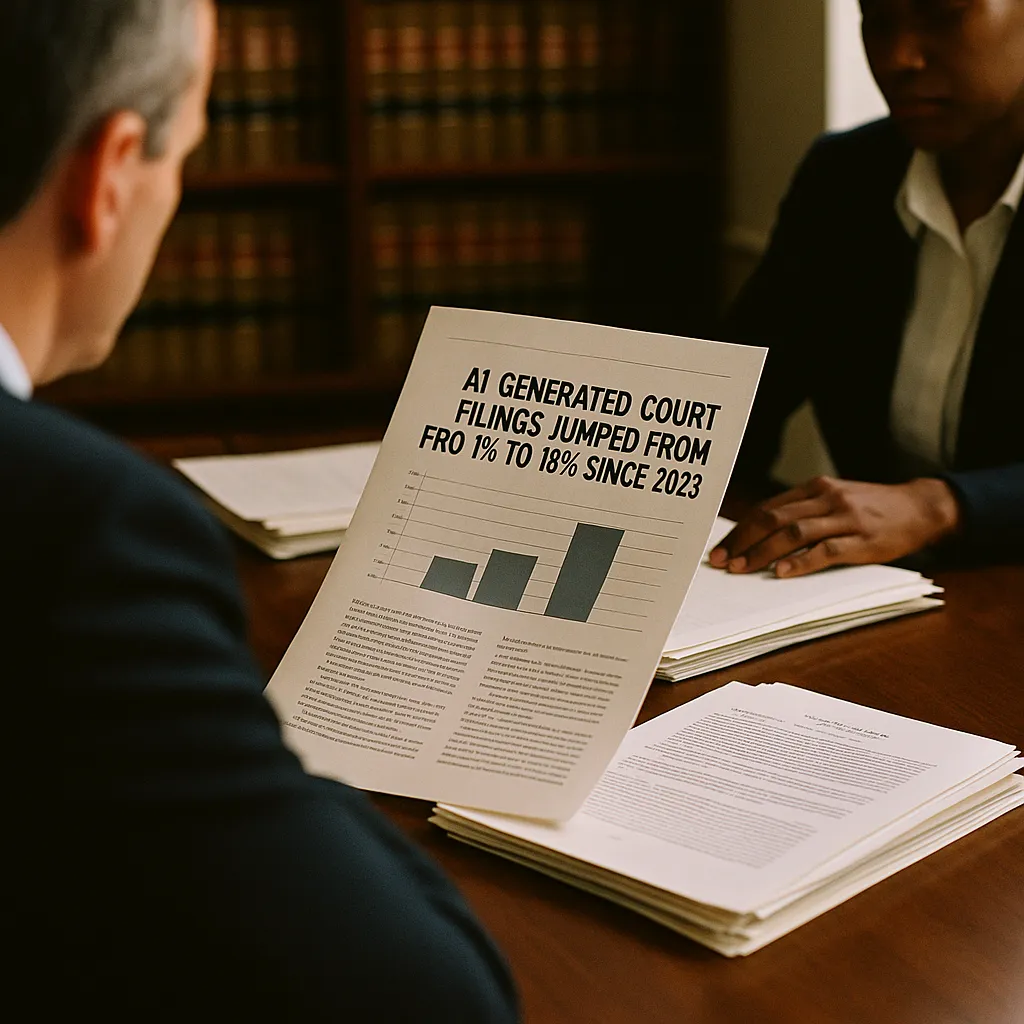
An MIT study of 4.5 million federal civil cases found AI-written court filings jumped from 1% in 2023 to 18% in 2026, while self-filed docket activity surged 158% — threatening to overwhelm federal courts with hallucinated citations and fabricated legal quotes.
AI-Generated Court Filings Jumped from 1% to 18% Since 2023 — and Federal Courts Are Struggling
AI-generated writing now appears in 18% of federal civil court filings — up from just 1% in 2023 — according to an MIT study of 4.5 million federal cases, and the consequences are beginning to strain the judicial system. Judges are encountering hallucinated case citations, fabricated legal quotes, and legal arguments constructed around precedents that don't exist. The researchers warn that courts may need to "basically grind to a halt" if the trend continues without structural intervention.
The study is the first large-scale empirical measurement of AI's footprint in federal litigation, and its findings reframe a problem that courts have mostly addressed through individual sanctions into a systemic infrastructure challenge.
What the MIT Study Found
MIT researchers analyzed 4.5 million federal civil cases using a combination of stylometric analysis and language model detection. Key findings:
- AI-generated writing in court documents: up from 1% in 2023 to 18% in 2026
- Self-represented litigants (people filing without an attorney): up from 11% to 16.8% of federal civil filers
- Docket activity in self-filed cases: up 158% — filings, motions, and responses proliferating from litigants who previously would have run out of steam or money
- Hallucinated citations: judges in multiple districts have now flagged AI-fabricated case citations submitted as real precedent
- Fabricated legal quotes: verbatim quotes attributed to real cases that say no such thing
The researchers' central concern is not that AI is being used — it's that it's being used badly, at scale, without quality control, and in a system that was not designed to absorb the volume increase that easy AI filing enables.
Why This Matters Beyond the "AI Hallucination" Story
The hallucination problem gets the headlines — and it's real. When a pro se litigant (a person representing themselves, without a lawyer) submits a brief citing Johnson v. United States, 584 F.3d 1029 (9th Cir. 2009) and that case doesn't exist, a judge or clerk has to spend time verifying the citation before the court can proceed. Multiply that across thousands of filings per district per year and the cumulative time cost becomes a court resource problem.
But the deeper issue is the 158% surge in docket activity among self-represented litigants. AI has dramatically lowered the barrier to filing a federal lawsuit and to continuing litigation after initial filing. Before AI, self-represented litigants without legal training often hit natural stopping points — the complexity of drafting a motion to compel, or responding to a summary judgment motion, would cause them to withdraw. AI eliminates those friction points. Litigants who would previously have dropped cases can now generate plausible-sounding filings indefinitely.
This creates two distinct problems. The first is meritless case proliferation: cases that would never have been filed, or that would have been abandoned early, now continue through more stages of litigation and consume more judicial resources. The second is the reverse problem — legitimate pro se litigants with valid claims getting drowned in procedurally complex responses from AI-assisted opposing parties, reducing their practical access to justice.
Get this in your inbox.
Daily AI intelligence. Free. No spam.
The Rule 11 Question
Federal Rule of Civil Procedure Rule 11 requires attorneys to certify that the legal contentions in their filings are warranted by existing law or a nonfrivolous argument for extending existing law. The MIT researchers and several legal scholars are now proposing amendments to extend Rule 11 obligations to cover AI-generated content specifically — requiring parties to certify that AI-assisted filings have been verified for citation accuracy and legal accuracy before submission.
The proposal is technically straightforward but raises practical problems. Rule 11 currently applies to attorneys and parties. Self-represented litigants are already subject to Rule 11, but courts have historically applied it with more leniency toward non-lawyers who simply don't know better. An AI-assisted pro se litigant who submits a hallucinated citation may genuinely believe it is correct — they asked a chatbot, it produced a citation, it looked official. Sanctioning them for the chatbot's error raises due process questions.
The alternative being discussed — mandatory disclosure of AI tool use in filings — has different problems. There is currently no reliable technical way to verify whether a document was AI-generated, and the detection tools that do exist have documented false-positive rates that would create a new category of contested motions.
Courts Are Already Responding
Several federal district courts have issued standing orders requiring disclosure of AI tool use in filings. The Northern District of Texas, Eastern District of Texas, and Southern District of Florida are among those with active AI disclosure requirements. The requirements vary significantly: some cover only briefs, some cover all filings, some require certification of human review of AI-generated content.
The Judicial Conference of the United States — the national policy-making body for the federal courts — is reviewing uniform guidance. The MIT study gives that review a concrete empirical basis for the first time.
At the state level, the picture is even more fragmented. Some state courts have moved faster than federal courts on AI disclosure requirements; others have no policy at all.
What to Watch
Watch the Judicial Conference's response to this data, expected in Q3 2026, for whether it moves toward a uniform federal AI disclosure rule or defers to district-level variation. Watch also for Congress to weigh in: several members of the Senate Judiciary Committee have asked the Administrative Office of the Courts for an AI impact assessment, which this MIT study effectively provides. If docket surges continue at the current rate, the resource conversation becomes a budget conversation — and Congress controls the federal judiciary's budget.
The deeper question this study raises is one courts cannot resolve alone: when AI makes it trivially easy for anyone to generate legal-sounding documents, what is the appropriate cost structure for accessing the federal court system? That is a policy question. The courts are currently absorbing the cost. That cannot continue indefinitely.
Hector Herrera covers AI in law and governance for NexChron.
Did this help you understand AI better?
Your feedback helps us write more useful content.
Get tomorrow's AI briefing
Join readers who start their day with NexChron. Free, daily, no spam.