Tuya Smart has upgraded Hey Tuya from a reactive voice assistant to an agentic AI that autonomously orchestrates home, robot, and energy systems—with Matter and Home Assistant compatibility added.
Tuya Smart Upgrades Hey Tuya Into an Agentic AI System Spanning Home, Robot, and Energy
By Hector Herrera | April 29, 2026 | Smart Home
Tuya Smart has upgraded its Hey Tuya voice assistant from a reactive command interface into an agentic AI system capable of autonomous, multi-step orchestration across an entire household ecosystem. The announcement came April 24 at Tuya's 2026 Global Developer Summit, alongside an expansion into three new domains: AI Home, AI Robot, and AI Energy. The move signals that smart home platforms are graduating from voice shortcuts to proactive household management—and one of the largest device platforms in the world is making that transition publicly.
The difference between a reactive voice assistant and an agentic one is not cosmetic. It is architectural.
From Commands to Orchestration
Reactive voice assistants respond to explicit instructions: "Turn off the living room lights." "Set the thermostat to 70." They execute a command and stop. They do not anticipate. They do not adapt. They do not take sequences of actions across multiple systems in response to changing conditions.
Agentic AI is built differently. An agent can observe a state—energy prices rising on the grid, a scheduled departure time, outdoor temperature data—and take a sequence of actions autonomously: pre-cooling the house before the peak pricing window, preparing the departure routine, and adjusting the EV charging schedule to avoid the expensive hours. No command required. The system acted on context.
That is the capability shift Tuya is announcing for Hey Tuya. Whether the real-world implementation delivers on the architectural promise is the question that the next 12 months will answer.
Three New Domains
Tuya's expansion targets three areas where agentic AI adds the most value over reactive automation:
Get this in your inbox.
Daily AI intelligence. Free. No spam.
AI Home covers household management and automation—the coordination layer that sits above individual device commands. An AI Home agent managing morning routines, guest arrivals, security events, and energy consumption simultaneously is doing something qualitatively different from a rules-based automation system that triggers lights at sunset.
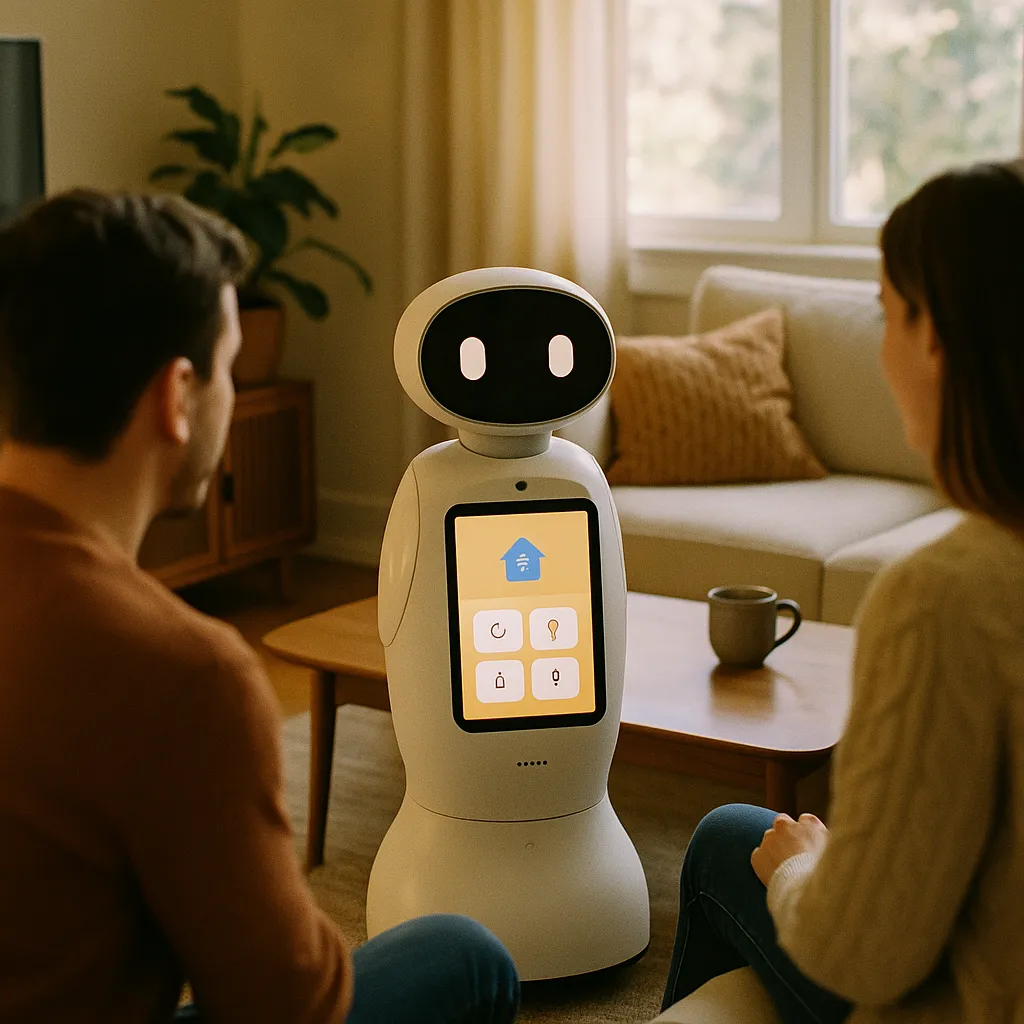
AI Robot integrates with robotic devices, including robotic vacuums, lawn mowers, delivery robots, and the emerging category of household mobile robots. Robots operating autonomously inside a home generate spatial awareness data—where they've been, what they've detected, what they've avoided—that a smart home platform can use. Connecting that data stream to a broader home AI agent creates feedback loops that neither the robot nor the home platform could exploit independently.
AI Energy monitors and optimizes home energy consumption across all connected devices. This domain has the clearest financial value proposition for consumers: an AI Energy agent that shifts loads away from peak pricing hours, monitors for anomalous consumption that might indicate appliance failure, and optimizes EV charging schedules against time-of-use rates delivers measurable dollar savings. That is a different kind of value than ambient convenience.
The Ecosystem Play: Matter and Home Assistant
Tuya added compatibility with Matter—the cross-platform smart home standard—and Home Assistant, the popular open-source home automation platform, in the upgraded Hey Tuya. This matters more than it might appear.
The smart home device ecosystem is fragmented. A typical home might have Philips Hue lights, Ecobee thermostats, Ring cameras, Sonos speakers, and a mix of other devices—none of which were designed to share data with each other. Matter was developed specifically to address this fragmentation, and Home Assistant has built a large community by connecting devices that manufacturers never intended to connect.
By building Matter and Home Assistant compatibility into Hey Tuya, Tuya is telling developers that its agentic platform can orchestrate across the full device ecosystem a household actually has—not just the subset that runs Tuya hardware. That is a more credible agentic story than one that requires device homogeneity.
Tuya operates one of the largest smart home device platforms globally by device count. Adding agentic orchestration to that installed base, with cross-platform compatibility, is a meaningful competitive move.
What to Watch
The performance question is the honest one. Agentic AI in controlled demos behaves reliably. In real homes—with 40 devices from eight manufacturers, firmware update cycles that break integrations, and unpredictable user behavior that creates exceptions the agent wasn't trained for—reliability is harder to sustain.
For competitors—Amazon Alexa, Google Home, Apple HomeKit—the Tuya announcement raises the bar for what "smart home AI" means in 2026. All three have their own versions of agentic home features in development or in early release. The question is which platform delivers reliable agentic orchestration at scale first, because the home AI platform that earns trust early will be difficult to displace.
Watch for real-world developer feedback on the Hey Tuya agentic capabilities over the next six months. The developer community will surface integration failures, edge cases, and latency issues faster than any official QA process. That feedback will be the signal about whether this is a genuine category advance or a feature announcement.
Hector Herrera covers smart home technology and consumer AI at NexChron. Source: StockTitan / Tuya Smart
Did this help you understand AI better?
Your feedback helps us write more useful content.
Get tomorrow's AI briefing
Join readers who start their day with NexChron. Free, daily, no spam.