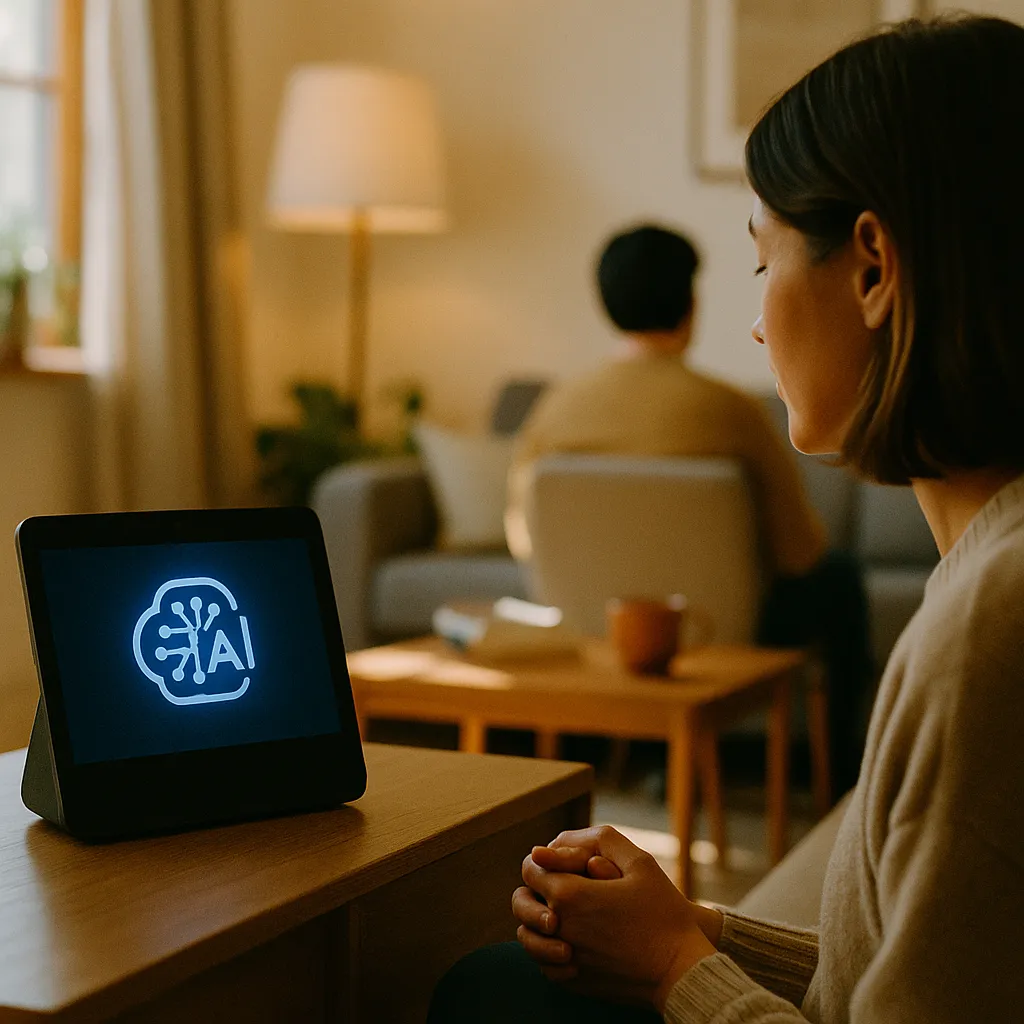
Google revived 'continued conversations' for Gemini on April 24, letting users interact with smart home devices across multi-turn exchanges without repeatedly triggering a wake command.
Google Brings Persistent AI Conversations to the Smart Home With Gemini Update
By Hector Herrera | April 26, 2026
Google reintroduced "continued conversations" to its Gemini for Home experience on April 24, letting users interact with connected devices without repeatedly triggering wake commands. The update is a meaningful step toward what Google wants Gemini to become in the home: a persistent, context-aware AI that handles complex requests — not just a voice command router that requires you to say "Hey Google" before every sentence.
What Changed
Before this update, interacting with a Google smart home device was fundamentally a command-and-response loop. Say the wake phrase. Ask a question. Get an answer. The conversation ends. If you wanted to follow up, you'd trigger the wake phrase again.
According to AI Bucket, the returned "continued conversations" feature allows back-and-forth exchanges without repeated wake commands. A user asking about dinner options can follow up with "what about something lighter?" without re-triggering the assistant. The context carries forward within a session.
Beyond turn-taking, Google is expanding what Gemini can handle in that context window. The example Google highlighted: mood-based entertainment recommendations — a request like "I want to watch something relaxing" that requires the assistant to reason about your preferences, current streaming library, and what it knows about your history, rather than just execute a literal command.
Google Assistant remains the backend for routine device control — lights, thermostat, locks. Gemini handles the more complex, conversational layer. The two systems work in parallel rather than one replacing the other.
Get this in your inbox.
Daily AI intelligence. Free. No spam.
Why This Matters for Smart Home AI
The smart home has been promised as an AI-powered environment for over a decade, but the reality has been disappointing: mostly voice shortcuts for tasks that weren't that hard to begin with. Turning off lights by voice is convenient, but it's not intelligent.
Persistent, context-aware conversation is what makes a smart home AI actually feel useful. The difference between a device that can only respond to explicit commands and one that maintains context across a conversation is significant — it's the difference between a search engine and a capable assistant.
Google's challenge here is trust and reliability. Users tolerate a smart speaker that mishears an occasional command. They won't tolerate a persistent AI that hallucinates follow-ups or forgets what was said two exchanges ago. The feature's reintroduction (this is a "revived" capability, not an entirely new one) suggests Google has worked to address previous reliability issues.
The Competitive Context
Google is competing with Amazon's Alexa+ — a subscription AI assistant that Amazon announced earlier in 2026 with similar ambitions around multi-turn conversation and home context — and with Apple's evolving Siri, which has gained meaningful capability through Apple Intelligence integrations.
The smart home AI race is less about which assistant hears you correctly on the first try and more about which one can handle the kinds of requests that require memory, reasoning, and context across a session. Persistent conversation is the table stakes capability for that competition.
The integration with the broader Gemini ecosystem is also worth noting. A Gemini that knows you from your Google Calendar, Gmail, and search history can theoretically bring that context into a home conversation in ways that a purely device-local assistant cannot. Whether Google uses that integration aggressively — and how users respond to it — will shape Gemini's differentiation.
What to Watch
Whether Google expands continued conversations beyond the current Nest Hub and Nest Mini hardware lineup, and whether the reliability holds up at scale, will determine if this is a meaningful feature or a demo capability. Watch also for whether Amazon responds with an Alexa+ feature drop in the same category — home AI conversation is becoming a direct battleground between the two platforms.
Hector Herrera covers consumer AI and smart home technology for NexChron.
Did this help you understand AI better?
Your feedback helps us write more useful content.
Get tomorrow's AI briefing
Join readers who start their day with NexChron. Free, daily, no spam.