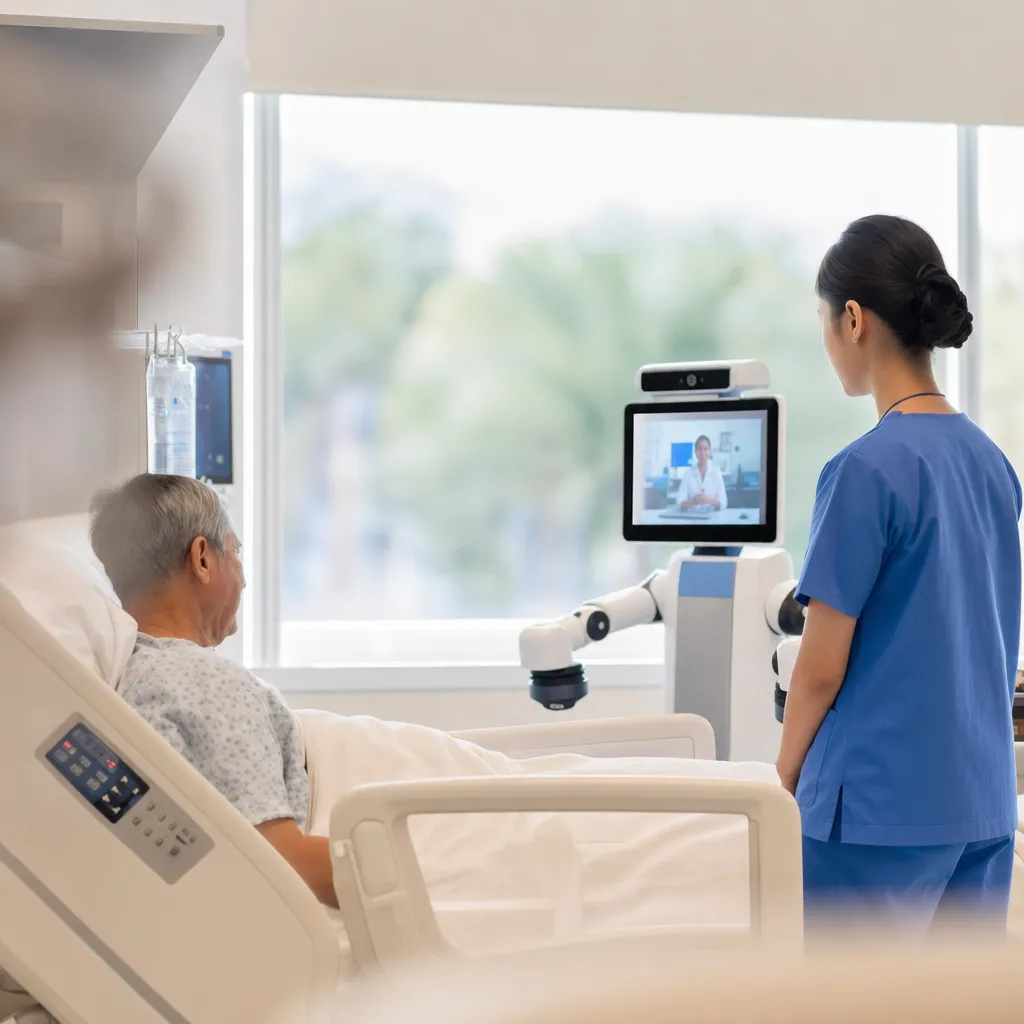
NVIDIA unveiled a healthcare robotics stack — including synthetic clinical data generator Cosmos-H, vision-language-action model GR00T-H, and hospital digital twin Rheo — that lets device makers train surgical robots without scarce real clinical footage.
NVIDIA Launches GR00T-H, Cosmos-H, and Hospital Digital Twin Rheo to Solve Medical Robotics' Training Problem
By Hector Herrera | September 16, 2026 | Health
NVIDIA has unveiled a suite of healthcare-specific AI foundations designed to remove the biggest bottleneck in medical robotics development: the scarcity of usable clinical training data. The stack includes a surgical video dataset (Open-H), a synthetic clinical data generator (Cosmos-H), a vision-language-action model for clinical tasks (GR00T-H), and a hospital digital twin planning tool (Rheo). Together, they let hospitals and device makers train surgical and patient-care robots on synthetic equivalents of clinical footage — without requiring the consent infrastructure, HIPAA compliance overhead, and IRB approvals that have made real-world clinical data collection a multi-year bottleneck for the field.
Medical robotics has lagged general industrial robotics for years, and the primary reason has not been hardware limitations. It has been data.
The Four Components
Open-H is a foundation dataset of real surgical video — providing a base of actual clinical footage for model pretraining in cases where consent and access can be properly cleared. It functions as the real-world anchor for everything built on top of it.
Cosmos-H is a synthetic clinical data generation system. It produces photorealistic simulations of clinical environments, patient-care scenarios, and surgical procedures that can be used for robot training at scale, without requiring additional real patient footage. Think of it as a clinical simulation engine: hospitals and device makers describe what they need their robot to learn, and Cosmos-H generates the synthetic video to train it.
GR00T-H (pronounced "Groot-H") is a vision-language-action (VLA) model — a class of AI that takes visual inputs and natural language instructions and outputs physical actions — specifically tuned for hospital environments. The target applications include nursing assistance, patient positioning, surgical instrument handling, and supply logistics within the facility.
Get this in your inbox.
Daily AI intelligence. Free. No spam.
Rheo is a hospital digital twin blueprint: a spatial AI planning tool that lets health systems model how robots will physically navigate and operate within their specific facilities before a single robot is deployed. It is a simulation layer for physical integration, not just functional training.
Why Synthetic Data Changes the Calculation
Getting real surgical footage requires patient consent, institutional review board approval, hospital data governance agreements, de-identification work, and ongoing compliance monitoring. Done correctly, this process takes years and produces datasets that are specific to one institution's procedures, patient population, and equipment configuration.
Cosmos-H short-circuits this by generating synthetic equivalents at scale. A hospital using the stack can produce arbitrarily large training datasets simulating the procedures relevant to their specific setup — and iterate on that training data as procedures evolve — without touching a single real patient record.
This is the same approach NVIDIA uses in its industrial robotics work through the non-healthcare Cosmos platform, where it has meaningfully accelerated robot deployment in manufacturing. The medical version faces additional regulatory scrutiny — FDA clearance requirements for AI-assisted surgical or patient-care tools don't disappear because training data was synthetic — but it removes a supply constraint that has genuinely limited how many medical robotics companies can reach production deployment.
What This Means for Hospitals and Device Makers
For health systems considering robot deployment:
- Faster development cycles — Building procedure-specific AI capabilities goes from years to potentially months when training data can be generated synthetically.
- Lower data acquisition costs — No patient consent infrastructure required for iterative training improvements.
- Facility-specific customization — Rheo lets a hospital simulate robot deployment in its actual floor plan before committing to hardware procurement.
For medical device companies:
- Reduced reliance on clinical trial footage for robot training — meaningful in early-stage development where clinical access is limited.
- A foundation model starting point in GR00T-H rather than training from scratch — which compresses the time-to-capability curve significantly.
The Regulatory Path
FDA clearance remains the constraint that synthetic training data cannot bypass. Any robot using GR00T-H-derived models that performs or assists with a procedure involving a patient will need FDA 510(k) clearance or De Novo authorization. The synthetic data advantage is upstream of that review — it accelerates how quickly a device maker reaches a product ready to submit for clearance, but it does not change the clearance requirement itself.
What to Watch
The FDA's Digital Health Center of Excellence is the key regulatory actor here. If it publishes specific guidance on synthetic-data-trained medical devices — clarifying what validation evidence is required when training data is machine-generated rather than clinically sourced — that would significantly accelerate the path to cleared products built on this stack. Watch also for NVIDIA's hospital system partnership announcements around Rheo: early adopters will signal whether the digital twin layer is landing as a real planning tool or a demo.
Hector Herrera covers health AI and medical technology at NexChron.
Did this help you understand AI better?
Your feedback helps us write more useful content.
Get tomorrow's AI briefing
Join readers who start their day with NexChron. Free, daily, no spam.