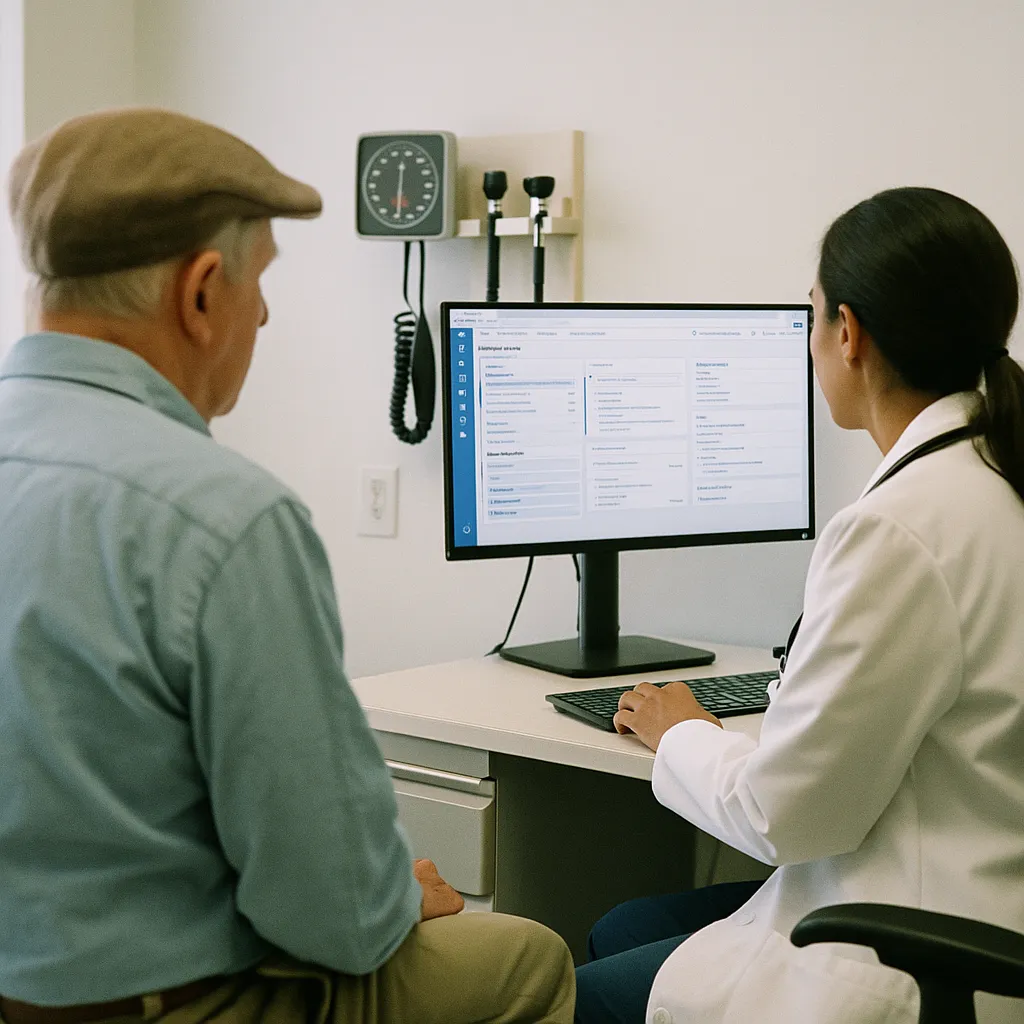
Ambient AI Scribes Are Giving Clinicians Back 13 Minutes Per Patient Visit
Six major U.S. health systems document an average 13-minute reduction in EHR time per visit from ambient AI scribes — but only 32% of users hit the adoption threshold where gains compound.
Why this matters
Six major U.S. health systems document an average 13-minute reduction in EHR time per visit from ambient AI scribes — but only 32% of users hit the adoption threshold where gains compound.
Six major U.S. health systems have documented real, measurable time savings from ambient AI scribes — AI tools that listen to clinical conversations and automatically generate EHR notes — reducing total EHR time by an average of 13 minutes and documentation time by 16 minutes per patient visit. A new American Hospital Association report details what's working, what isn't, and why adoption remains uneven despite results that look compelling on paper.
What Ambient AI Scribes Do
An ambient AI scribe listens to the clinical encounter — physician and patient talking in an exam room — and uses AI to transcribe the conversation and generate a structured clinical note that gets pushed into the EHR (electronic health record) system. The physician reviews and signs off, but the manual documentation burden largely disappears.
This matters because documentation burden is one of the most consistently cited drivers of physician burnout. Studies have found clinicians spend nearly two hours on EHR work for every hour of direct patient care — and much of that work happens after hours, a phenomenon called "pajama time" in healthcare circles.
Average 13-minute reduction in total EHR time per visit
Average 16-minute reduction in documentation time per visit
Clinicians using ambient AI scribes for more than 50% of their visits saw twice the time savings compared to occasional users
The adoption problem:
Only 32% of clinicians with access to the tools used them for more than half their visits
The 50% usage threshold appears to be where productivity gains compound meaningfully
Below that threshold, benefits are real but modest
This gap between tool availability and effective adoption is a recurring pattern in health tech. The technology works when used consistently; inconsistent use produces inconsistent results and makes it harder to build the organizational case for broader deployment.
Get this in your inbox.
Daily AI intelligence. Free. No spam.
Why Adoption Lags
Several factors slow uptake even when clinicians acknowledge the technology works:
Trust and accuracy. AI-generated clinical notes can contain errors. Physicians who catch a significant error lose confidence in the tool, creating a verification burden that can partially negate time savings. Accuracy also varies by specialty — primary care note templates are more standardized than complex specialist encounters.
Workflow integration. Ambient scribes that require a separate login, a separate review interface, or manual transfer into the EHR add friction. The strongest adoption rates occur when the scribe is embedded directly into the EHR workflow rather than sitting beside it as a parallel system.
Training and change management. Clinicians who received structured training and ongoing support — rather than just account access — showed significantly higher adoption rates across all six health systems studied.
The Business Case for Health Systems
At 13 minutes saved per visit, the math is worth running. A primary care physician seeing 20 patients per day saves roughly 4.3 hours of documentation time. Even if half that time goes back to seeing additional patients rather than going home earlier, the productivity gain is significant at scale.
For health systems operating under thin margins and facing persistent physician shortages, ambient AI scribes represent one of the few technology interventions with a clear, near-term return — provided the adoption challenges are addressed rather than assumed away.
The AHA data also suggests that health systems that invest in adoption infrastructure — training, workflow integration, ongoing support — see substantially better results than those that treat deployment as simply making tools available.
What to Watch
Watch for Epic and Oracle Health — the two dominant EHR platforms — to integrate ambient scribes more deeply into their native interfaces. That would remove one of the biggest adoption friction points by eliminating the parallel-tool problem. Also watch for specialty-specific rollouts in fields like radiology and cardiology, where note complexity is high and per-visit time savings could be even larger than the primary care averages documented here.
Hector Herrera is an AI systems architect and the founder of Hex AI Systems. He designs and runs AI systems in production and writes daily about how AI is reshaping business, government and everyday life. 20+ years building for the web. Houston, TX.