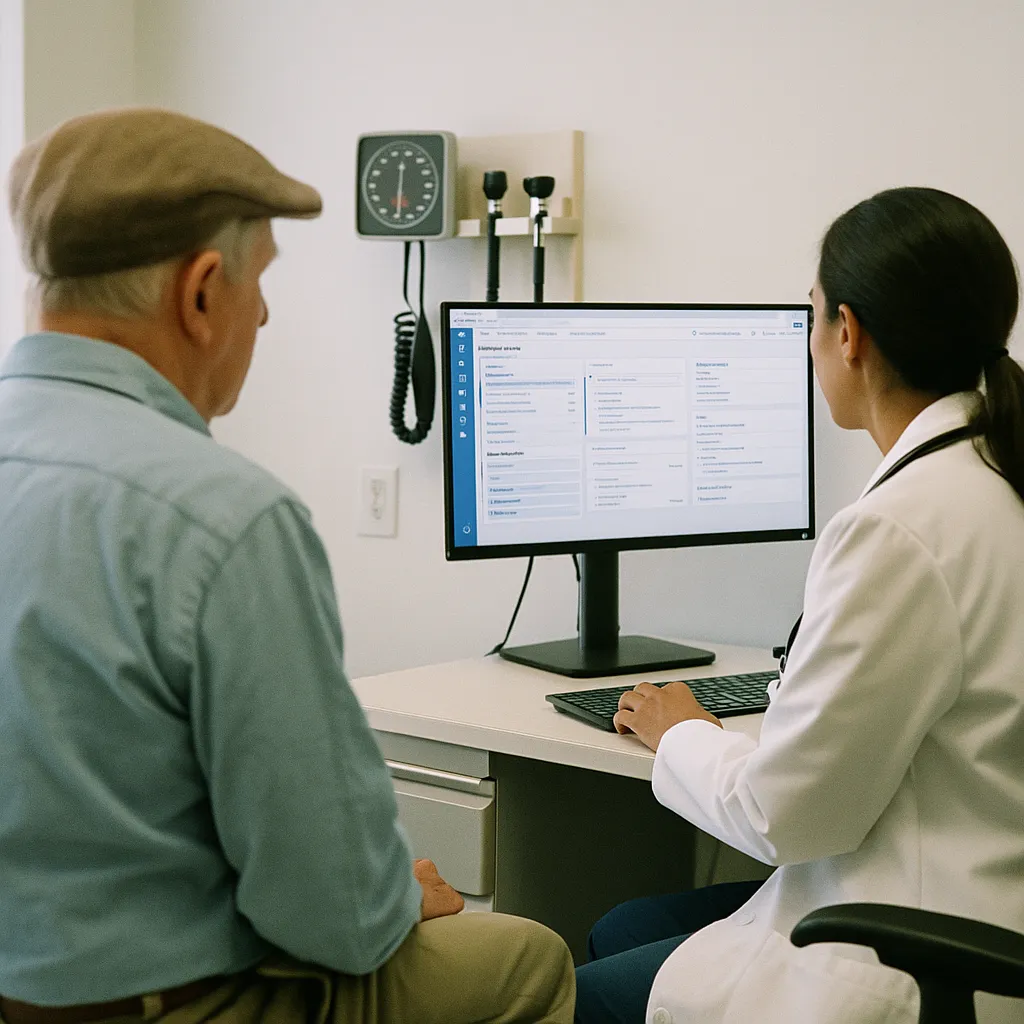
A JAMA study across five academic medical centers found AI ambient scribes cut documentation time by 16 minutes per appointment — clinical evidence health systems have been waiting for before committing to enterprise deployment.
AI Scribes Cut EHR Charting Time by 16 Minutes Per Visit, JAMA Multi-Center Study Finds
By Hector Herrera | April 22, 2026 | Health
Clinical evidence that AI scribes reduce physician documentation time has been building for two years. Now a peer-reviewed, multi-center study in JAMA puts hard numbers on the benefit: 16 minutes saved per appointment on documentation alone, and 13.4 minutes cut from total EHR time across five academic medical centers. The findings matter because they move AI scribe adoption from anecdote to auditable clinical evidence — the standard health systems need before committing to large-scale deployment.
Context
Physician burnout is one of American medicine's most documented and expensive problems. A significant portion of it traces directly to documentation burden. Studies going back a decade show doctors spend more time in their EHR — the electronic health record system — than they spend with patients. Charting, coding, inbox management, and documentation compliance requirements collectively consume 1-2 hours per physician per day at most health systems.
AI ambient scribes work by listening to the patient-physician encounter (with patient consent), generating a structured clinical note in real time, and pre-populating it into the EHR. The physician reviews and edits rather than dictating or typing from scratch. The technology has existed in early form since the late 2010s, but reliability, accuracy, and integration quality have improved sharply since 2024 as large language models became production-ready in healthcare settings.
What the JAMA Study Found
The multi-center JAMA study tracked AI scribe use across five academic medical centers and found:
- Total EHR time reduced by 13.4 minutes per appointment
- Documentation time specifically reduced by 16 minutes per appointment
- Benefit increased with frequency — physicians who used AI scribes more consistently saw larger time savings, suggesting a learning curve and workflow optimization effect
- Intermountain Health, one of the participating health systems, reported a 27% reduction in note time per visit in their cohort
The distinction between total EHR time and documentation time is meaningful. Documentation is the note-writing task — where AI scribes directly intervene. Total EHR time also includes inbox management, order entry, and other tasks the AI scribe doesn't touch. Saving 16 minutes on documentation while saving 13.4 minutes total suggests some physicians reinvest freed time into other EHR tasks, while others recapture it for patients or personal recovery.
The frequency effect is important for deployment strategy. Health systems that deploy AI scribes but don't mandate or strongly encourage consistent use will see diluted results. The technology pays off more the more it's used — which means the ROI case depends heavily on adoption discipline, not just licensing.
Get this in your inbox.
Daily AI intelligence. Free. No spam.
Why Academic Medical Centers Specifically
Academic medical centers are a stringent test environment. They handle complex cases, train residents, operate at high documentation density, and run under intense regulatory compliance requirements. If AI scribes deliver measurable benefit in that environment, community hospitals and specialty practices — which operate with simpler documentation profiles — should see at least comparable gains.
The five-center design also guards against single-institution confounding. One hospital with unusually motivated physicians or a particularly well-integrated EHR system can produce outlier results. Multi-center data is more generalizable.
What This Means for Health Systems
For administrators: This is the clinical evidence standard most health systems have been waiting for before committing to enterprise-wide AI scribe contracts. JAMA-published, multi-center, peer-reviewed — this is the credential that moves AI scribes from pilot-program to procurement conversation.
For physicians: The time savings are real but not uniform. The 27% note-time reduction at Intermountain is the high end; other institutions saw more modest gains. The difference likely reflects how tightly the AI scribe was integrated into existing workflows and how thoroughly physicians were trained to use it efficiently.
For payers and employers: Physician burnout is expensive. Turnover for a single physician costs health systems an estimated $500,000–$1 million when recruitment, onboarding, and lost revenue are factored in. If AI scribes extend physician careers or reduce burnout-driven errors, the ROI extends well beyond the time saved per visit.
For patients: More physician attention and less keyboard time during visits is a meaningful quality improvement, even if it doesn't show up in clinical outcomes data immediately.
What to Watch
The next wave of evidence will focus on accuracy and downstream effects — whether AI-generated notes contain more errors than physician-dictated notes, how those errors affect billing and coding accuracy, and whether the time savings hold at high patient volumes over sustained periods. Several health systems are now running long-term studies on exactly these questions.
Watch also for specialty-specific data. The JAMA study spans multiple specialties, but the gains likely vary significantly between a primary care visit (long, conversational, complex social history) and a radiology read-out (short, structured, highly formatted). Specialty-tailored AI scribe systems are already in development.
The federal government is also paying attention. CMS has opened preliminary discussions about how AI-generated clinical notes factor into documentation requirements and audit standards — a policy question that will shape how aggressively health systems can deploy these tools without creating compliance exposure.
Hector Herrera covers AI in health and medicine for NexChron. This article does not constitute medical or clinical guidance.
Did this help you understand AI better?
Your feedback helps us write more useful content.
Get tomorrow's AI briefing
Join readers who start their day with NexChron. Free, daily, no spam.