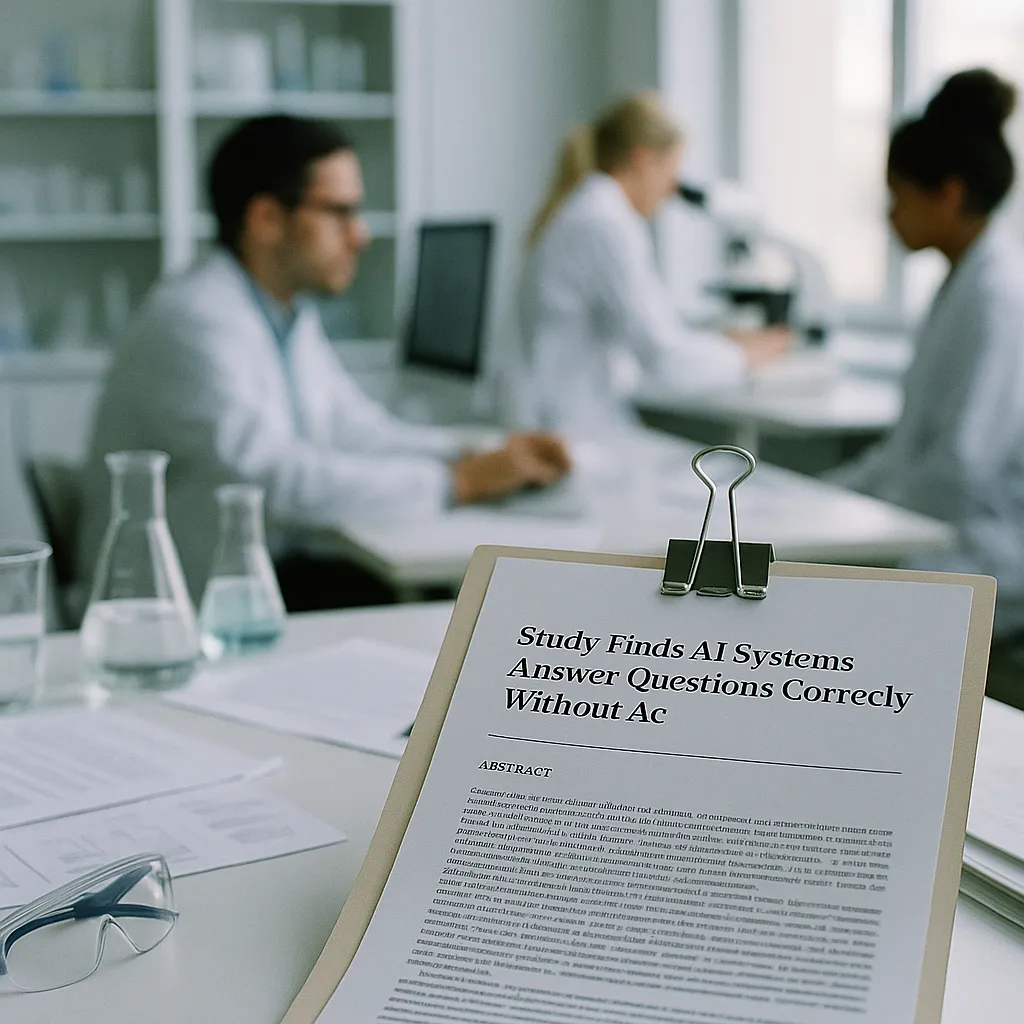
A study published April 29 finds AI systems produce correct answers while fundamentally failing to understand the underlying concepts — challenging benchmarks used to certify AI for high-stakes deployment.
Study Finds AI Systems Answer Questions Correctly Without Actually Understanding Them
By Hector Herrera | May 1, 2026 | Science
A study published April 29 documents a fundamental problem with how AI systems are evaluated: they can pass exams and produce correct answers while failing to grasp the underlying concepts those questions test. The finding challenges the benchmark frameworks used to certify AI as ready for high-stakes deployment and raises immediate questions about whether AI systems currently operating in medicine, law, and education are actually capable of the work they are being trusted to do.
The Research
Research reported by ScienceDaily presents evidence that AI systems demonstrate what researchers describe as a critical gap between answer production and conceptual understanding. The systems achieve correct answers through pattern recognition — identifying that questions structured in certain ways tend to have answers structured in certain ways — without developing an internal representation of the underlying principle the question is testing.
This is distinct from hallucination. When an AI hallucinates, it generates plausible-sounding but factually incorrect information. What this research identifies is a different failure mode: the model produces the right answer through pattern matching rather than reasoning from first principles. Standard benchmarks — the tests used to certify AI capability — cannot tell the difference between those two paths to the same answer.
Why Standard Benchmarks Miss This
The AI evaluation industry has converged on standardized tests — multiple choice exams, coding challenges, logic problems, and professional licensing-style assessments — to certify capability levels. A model that scores 90% on a medical licensing exam gets characterized as performing at a physician level. A model that passes a bar exam gets compared to a licensed attorney.
Get this in your inbox.
Daily AI intelligence. Free. No spam.
The problem is that benchmark performance can be achieved by pattern-matching against training data containing structurally similar questions. The model learns to recognize question formats and map them to answer formats without reasoning from the underlying concept. It performs reliably on familiar problem structures and fails unpredictably in novel contexts — exactly the situations where correct understanding matters most and where incorrect answers cause the most harm.
Where the Gap Is Most Dangerous
The researchers identify the implications as most acute in three domains:
Medicine. A diagnostic AI certified on benchmark datasets may be pattern-matching from familiar symptom clusters it has seen in training data. A genuinely novel presentation — a new pathogen, an unusual demographic, an uncommon drug interaction not well-represented in training data — could expose the comprehension gap at the precise moment when error costs are highest.
Law. Legal AI tools used for research or contract analysis may produce outputs that are formally correct in familiar fact patterns and confidently wrong in edge cases, without the model recognizing or flagging the difference. An attorney who relies on that output faces the consequences.
Education. AI tutoring systems certified on exam performance may be reinforcing the failure mode in the students they teach — modeling pattern matching as a substitute for conceptual understanding. A student who learns from an AI that answers correctly without understanding risks acquiring the same limitation.
What a Better Evaluation Looks Like
The research implies that meaningful AI evaluation needs to test application in genuinely novel contexts — problems that differ structurally from anything in the training data, where reaching the correct answer requires applying the underlying concept rather than recognizing a familiar pattern. That is harder to construct and harder to score. It is also what actually predicts safe deployment in high-stakes environments.
Benchmark scores became the evaluation standard because they are measurable, comparable, and scalable. This research is a formal challenge to whether they are measuring the right thing — and to the deployment decisions that have been made on the basis of those scores.
What to Watch
Watch for the research to surface in regulatory proceedings. If agencies responsible for AI in healthcare (FDA), legal services (state bar associations and courts), or education (state education departments) begin requiring novel-context performance evaluation alongside standard benchmarks before certifying AI for high-stakes deployment, the certified capability levels of currently deployed systems may require reassessment. The timeline for that shift is uncertain, but the evidentiary case for it just strengthened.
Did this help you understand AI better?
Your feedback helps us write more useful content.
Get tomorrow's AI briefing
Join readers who start their day with NexChron. Free, daily, no spam.