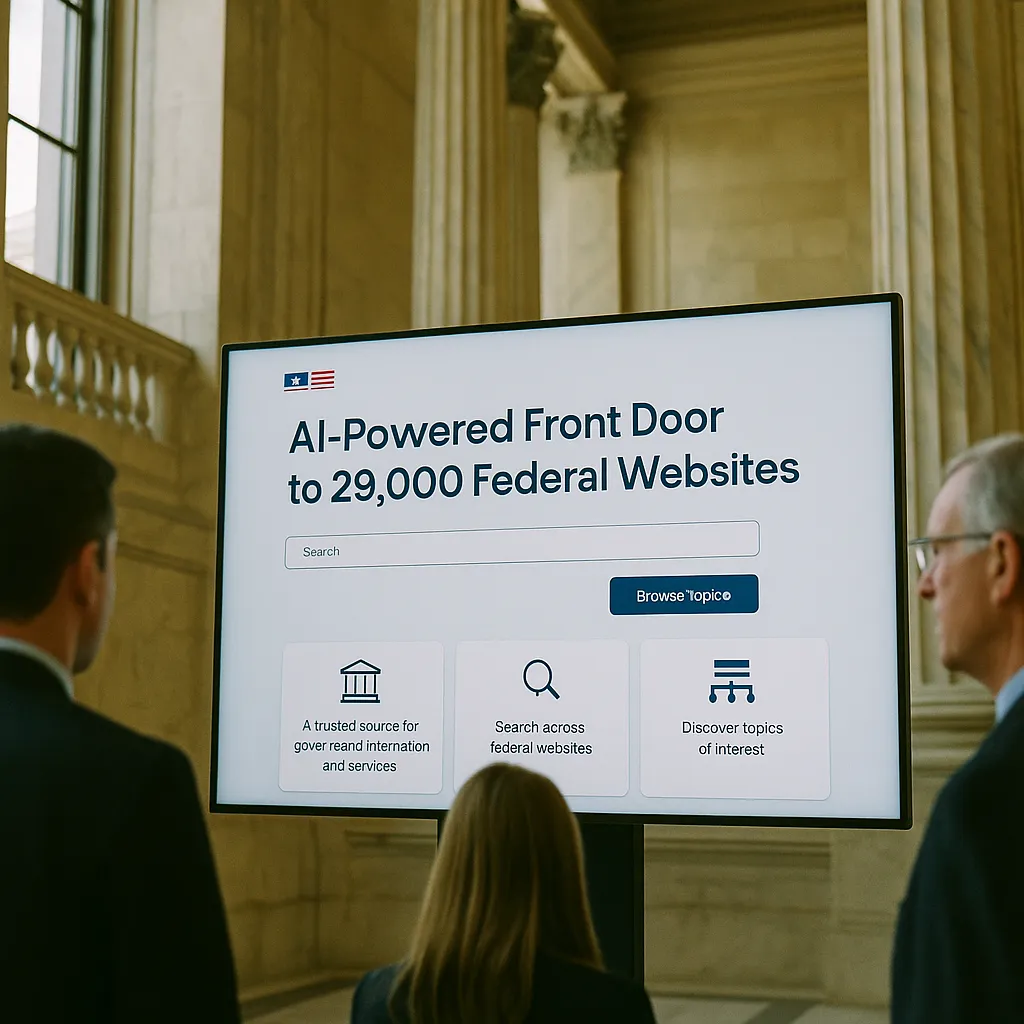
The Trump administration launched America.gov, a chatbot portal powered by Google Gemini and xAI Grok that consolidates 29,000 federal websites into one searchable AI interface.
The federal government launched a single AI-powered front door to roughly 29,000 federal websites today, replacing the fragmented maze of agency portals with a chatbot interface at America.gov. The administration is betting that consolidating access to federal information under one AI layer will make government services usable by the millions of Americans who currently can't navigate them.
President Trump unveiled America.gov at the Andrew W. Mellon Auditorium in Washington, flanked by Elon Musk, Jensen Huang, Vice President JD Vance, and Secretary of State Marco Rubio. Trump signed a supporting executive order at the event, formalizing the rollout.
What America.gov Is
America.gov is a conversational AI portal — type a question or describe what you need, and the system routes you to the right federal resource, form, or service. The backend is powered jointly by two AI systems: Google's Gemini and Elon Musk's Grok (via xAI).
The design was led by Joe Gebbia, the Airbnb co-founder serving as U.S. Chief Design Officer. Gebbia's charge, publicly stated since his appointment, has been to apply product-design discipline to federal digital services — a domain that has historically been underfunded and user-hostile.
At launch, America.gov connects to the full breadth of federal web presence:
- 29,000 federal websites consolidated into one search and chat interface
- Natural language queries — users can ask questions in plain English instead of navigating agency hierarchies
- Two AI models — Gemini (Google) and Grok (xAI) power the responses, though the administration has not detailed how queries are routed between them
Why Two AI Systems
Running two AI models in parallel is unusual for a single product. The most likely explanation is redundancy and political calculus: Musk's involvement through xAI gives the administration an ideological alignment it values, while Google's Gemini provides the technical scale and grounding capability needed for a system that must accurately reflect federal information.
Whether the two models are used for different query types, checked against each other, or simply presented as co-branded is not yet clear from today's announcement. That architecture question matters enormously for accuracy and accountability — if Gemini and Grok produce different answers to the same question about, say, Social Security eligibility or immigration status, users need to know which output to trust.
Get this in your inbox.
Daily AI intelligence. Free. No spam.
What This Replaces
The U.S. federal government's digital presence has been a documented problem for decades. USA.gov has existed in various forms since 2000, but the broader ecosystem of agency websites — each with its own navigation, search, and design language — has consistently ranked among the worst-performing government digital services among peer nations.
The scale of the problem America.gov is addressing:
- Medicare, Social Security, immigration, veterans' benefits, tax filing, passport applications, and federal grants each live on separate agency domains
- Search engines index federal content inconsistently, and many agency sites block or limit crawling
- Older Americans and people with limited English proficiency face disproportionate barriers
- A significant share of calls to federal agency phone lines are navigation failures — people who couldn't find the right website
An AI portal that can answer "how do I renew my passport if I'm traveling in 3 weeks" or "what documents do I need to apply for SNAP benefits" in natural language would, if it works, represent a genuine service improvement for millions of people.
Concerns the Administration Will Need to Address
The launch raises legitimate questions that will be answered in the weeks ahead:
Accuracy and hallucination. Large language models (LLMs — AI systems that generate text based on patterns in training data) can produce plausible-sounding but incorrect answers. For queries about benefits eligibility, legal status, or deadlines, a wrong answer from America.gov has real consequences. The administration has not yet detailed what guardrails, citations, or human review processes are in place.
Privacy. Questions about immigration status, disability claims, or financial hardship are sensitive. The data handling policies for queries submitted to America.gov — and whether that data is shared with Google, xAI, or third parties — will need to be publicly documented.
Accountability. If America.gov gives a user incorrect guidance and they miss a deadline or make a legal error, who is responsible? Federal agencies, or the AI vendors?
Dual-vendor governance. Operating two competing AI systems from two politically connected vendors under the same brand creates unusual governance complexity.
What to Watch
Congress will want answers on the privacy and procurement process — expect oversight hearings. Disability rights and digital equity advocates will test the system against its accessibility commitments in the coming days. The real measure of America.gov's success won't be the launch event; it will be accuracy benchmarks and user error rates over the next 90 days.
Hector Herrera covers government and AI policy at NexChron.
Did this help you understand AI better?
Your feedback helps us write more useful content.
Get tomorrow's AI briefing
Join readers who start their day with NexChron. Free, daily, no spam.