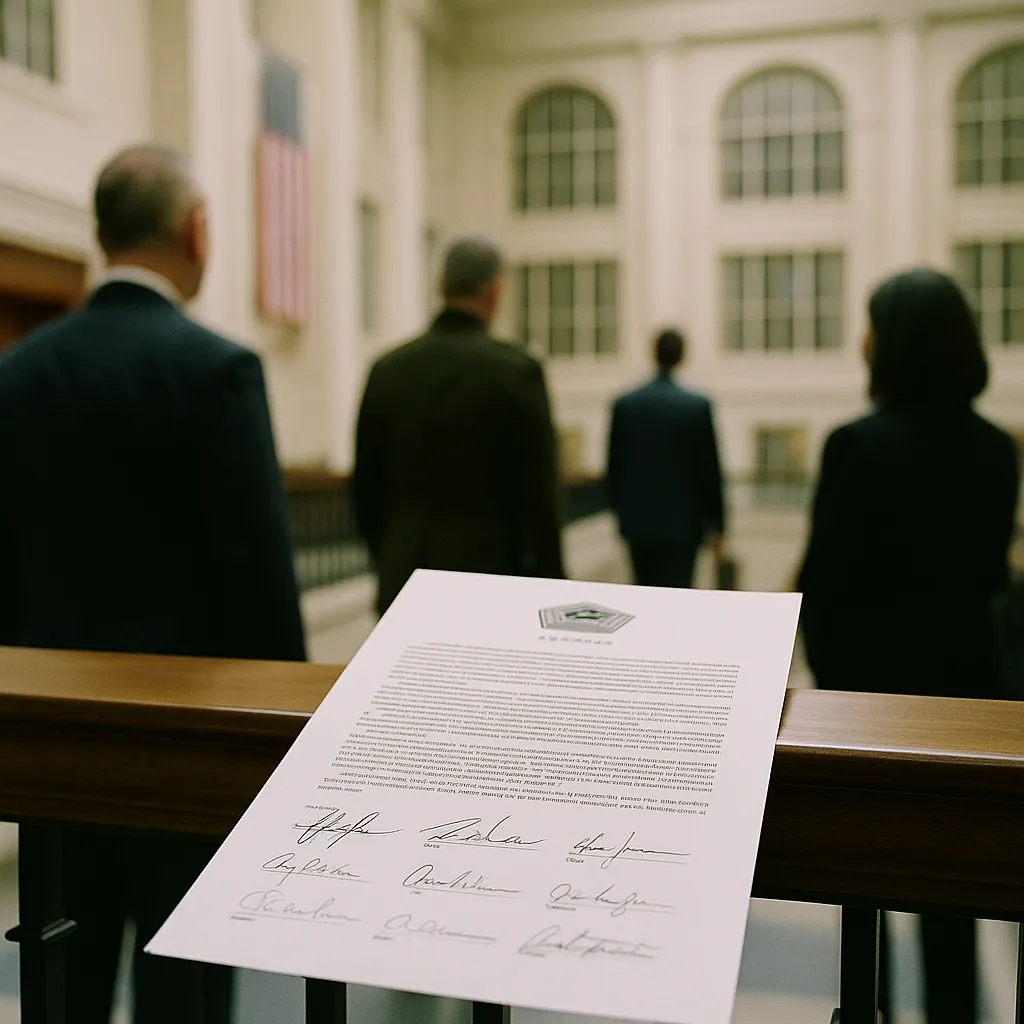
The Pentagon signed AI access agreements with seven tech firms — and excluded Anthropic after the company demanded safety guardrails on military use. The split lays bare the tension between AI safety commitments and defense contracts.
Pentagon Strikes AI Deals With Seven Big Tech Firms, Locks Out Anthropic Over Safety Guardrails Demand
By Hector Herrera | May 2, 2026 | Government
The Department of Defense has signed AI access agreements with SpaceX, OpenAI, Google, Microsoft, Nvidia, Amazon Web Services, and Reflection — and deliberately excluded Anthropic after the company insisted the Pentagon include safety guardrails governing how its AI is used in warfare. The split is the clearest signal yet that safety commitments and defense contracts are on a collision course.
The DoD agreements grant the seven companies access to classified networks for AI-enabled defense applications, according to CNN Business. Anthropic was in discussions for a similar arrangement but refused to finalize a deal without language restricting the most dangerous military applications of its Claude models. The Pentagon declined those conditions. Anthropic walked.
What the Deals Cover
The agreements allow the participating companies to deploy AI tools inside classified DoD environments — the kind of access that enables everything from intelligence analysis to logistics optimization to decision-support in active operations. The specific terms of each company's arrangement have not been publicly disclosed, but the agreements represent a significant expansion of commercial AI into the most sensitive layers of U.S. military infrastructure.
The seven companies that signed:
- SpaceX — likely tied to Starshield, its classified satellite communications arm
- OpenAI — a notable shift from its original charter, which explicitly prohibited military weapons applications
- Google — returning to defense AI after employee backlash over Project Maven in 2018 led to a withdrawal
- Microsoft — building on its existing JEDI and Azure Government relationships
- Nvidia — supplying the GPU infrastructure that underlies most AI military compute
- Amazon Web Services — already deeply embedded in the Intelligence Community through its classified cloud
- Reflection — a smaller AI firm, less publicly known, whose inclusion signals the DoD is diversifying beyond the largest labs
The Anthropic Exception
Anthropic's exclusion is not an accident. The company has staked its identity on responsible AI development — its Constitutional AI approach and its Responsible Scaling Policy are designed to avoid deploying systems in contexts where they could cause catastrophic harm without human oversight. Anthropic has explicitly listed autonomous weapons and systems that remove meaningful human control from lethal decisions as prohibited use cases.
When the Pentagon declined to include use-restriction language in the agreement, Anthropic held its position. The result: the company with arguably the most sophisticated safety infrastructure of any major AI lab is now the only one not on the Pentagon's approved list.
Get this in your inbox.
Daily AI intelligence. Free. No spam.
That's not an embarrassment for Anthropic. It's a policy statement.
Whether it's a sustainable policy is a different question. Anthropic has taken substantial investment from Google and raised capital at a valuation exceeding $60 billion. Its commercial viability depends on enterprise contracts. The U.S. federal government — including defense agencies — represents one of the largest enterprise AI buyers in the world.
What This Means for the AI Safety Debate
The Pentagon outcome exposes a fault line that has been building since the generative AI boom began: the tension between AI companies' public safety commitments and the economic pressure to capture government contracts.
OpenAI's inclusion is particularly striking. The company's original charter, drafted when it was a nonprofit, explicitly prohibited weapons development. Its 2025 policy update revised that language to permit "national security applications" — a shift critics called a betrayal of its founding mission. The Pentagon deal suggests that shift has now translated into operational agreements.
For businesses and developers: The fragmentation matters. If the most safety-constrained AI lab is excluded from government contracts, enterprises with federal customers may face pressure to migrate to alternatives that don't carry the same restrictions. Procurement offices will follow the approved vendor list.
For the AI safety community: Anthropic's stand demonstrates that safety policies can be real — not just marketing. It also demonstrates the cost of that reality. Other labs watching this outcome will draw their own conclusions about where to draw their lines.
For Anthropic specifically: The company retains access to the entire commercial market, including defense contractors who aren't operating on classified networks. But it has now been publicly positioned as the AI lab the U.S. military chose not to work with — a framing that cuts both ways depending on who's reading it.
What to Watch
Watch whether Anthropic's position softens over time, or whether it doubles down and turns the exclusion into a competitive differentiator with enterprise customers who want an AI provider with demonstrated limits. Also watch whether Congress responds — members on both sides have questioned the pace of commercial AI integration into defense systems, and Anthropic's walkout may give those concerns new visibility.
Source: CNN Business
Did this help you understand AI better?
Your feedback helps us write more useful content.
Get tomorrow's AI briefing
Join readers who start their day with NexChron. Free, daily, no spam.