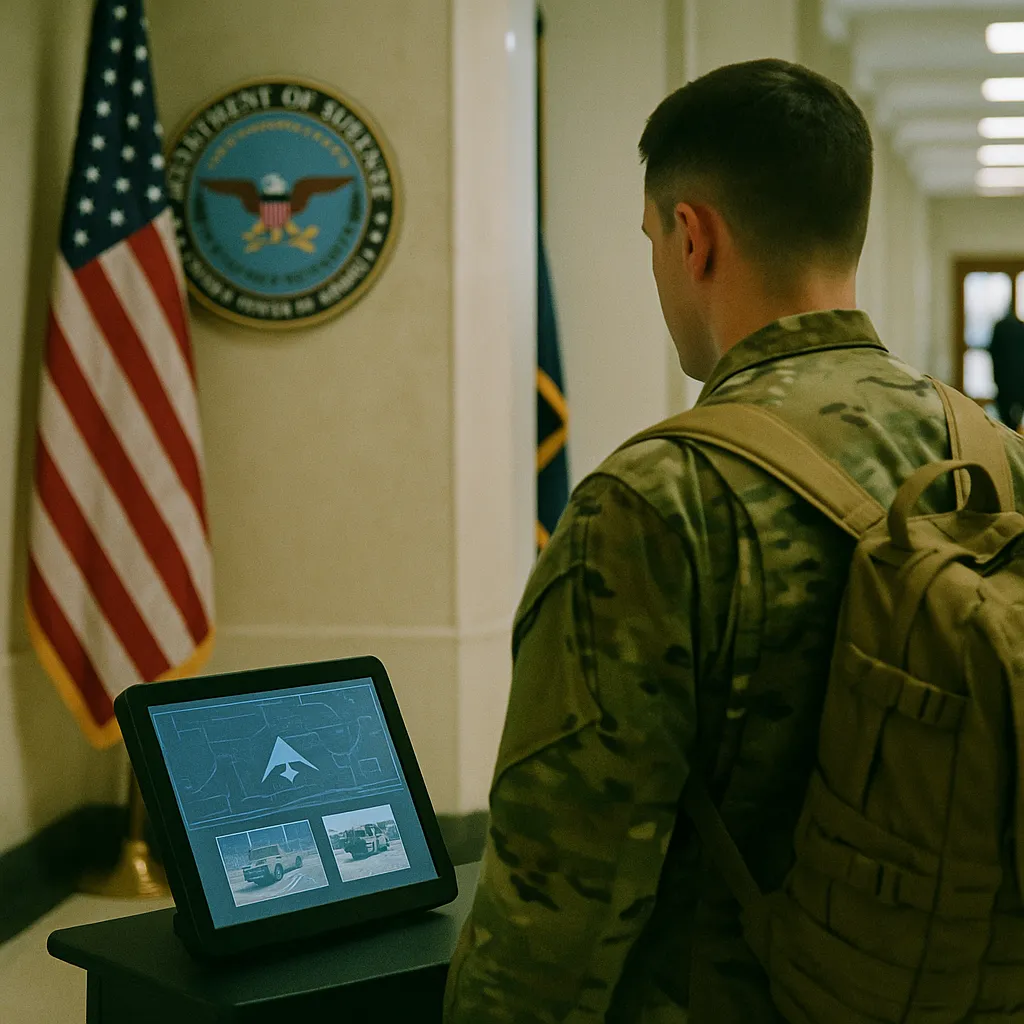
The Department of Defense is deploying AI specifically for contested logistics — moving supplies and personnel when adversaries are actively disrupting communications and supply chains.
Date: 2026-06-08
Slug: pentagon-ai-contested-logistics-supply-chain-2026
SEO Keyword: Pentagon AI contested logistics military
Meta Title: Pentagon Deploys AI to Solve Contested Logistics
Meta Description: The DoD is deploying AI to solve contested logistics — moving supplies when adversaries disrupt communications and supply chains.
Source URLs: ["https://defensescoop.com/2026/06/03/military-technology-contested-logistics/"]
Tags: ["pentagon", "military-ai", "contested-logistics", "defense", "autonomous-planning", "supply-chain", "government-policy"]
The Department of Defense is accelerating AI deployment for one of modern warfare's hardest operational problems: keeping supplies moving when an adversary is actively trying to stop them. This shift marks AI's transition inside the Pentagon from an administrative efficiency layer into a core warfighting capability — one that defense officials say is now central to planning and executing operations that no previous generation of commanders had the tools to automate.
The move, detailed by DefenseScoop, follows sustained internal pressure to address vulnerabilities that near-peer adversary tactics have exposed in traditional U.S. supply chain doctrine. The conclusion at the senior level: human coordination alone is no longer fast enough.
What Contested Logistics Actually Means
The term sounds abstract, but the operational reality is specific. Contested logistics refers to the challenge of moving supplies, equipment, and personnel through environments where an adversary can actively disrupt communications, jam GPS signals, attack supply convoys, or sever the data links that traditional logistics systems depend on. In a conflict with a technologically sophisticated opponent — think a scenario in the Pacific or Eastern Europe — a supply convoy that requires constant radio contact to reroute around a threat becomes a liability the moment that radio contact is severed.
For decades, the U.S. military managed this with human expertise: experienced logistics officers who could make judgment calls in degraded environments, reroute on paper maps, and coordinate through redundant communication channels. That model works in low-intensity conflicts. It breaks under the sustained electronic warfare and anti-access/area-denial (A2/AD) capabilities that China and Russia have spent twenty years developing.
Near-peer adversaries have explicitly studied U.S. logistics as a strategic vulnerability. Targeting supply lines — not just front-line units — is a documented approach in both Chinese and Russian operational doctrine. The lesson the Pentagon drew: the force that can keep its supply chain moving in a degraded information environment wins. The force that can't, stalls.
The AI Applications the Pentagon Is Deploying
Three categories of AI application are at the center of the DoD's contested logistics initiative.
Autonomous route planning and rerouting. AI systems are being trained to generate and continuously update supply routes based on threat data, terrain, available assets, and priority of need — without requiring a human to manually input each decision. When a route is compromised, the system proposes alternatives in seconds rather than waiting for a communications window that may not exist. This is not full autonomy over military decision-making; human commanders authorize movements. But the cognitive burden of generating options under pressure shifts to the machine.
Get this in your inbox.
Daily AI intelligence. Free. No spam.
Predictive demand modeling. AI tools analyze consumption patterns, unit positions, operational tempo, and historical data to anticipate what supplies will be needed, where, and when — before a unit submits a request. In contested environments where requests themselves may not get through, this predictive posture is operationally significant. Units that are resupplied before they run low are units that maintain combat effectiveness; units waiting for resupply in a communications blackout are units that stop.
Decision support under degraded communications. AI systems designed to operate with intermittent or low-bandwidth connectivity are being integrated into logistics command nodes. These tools can process locally available information when cloud or satellite links are unavailable, provide commanders with recommended courses of action, and synchronize with broader command networks when connectivity is restored. The goal is to make the logistics planning function resilient to exactly the conditions an adversary is trying to create.
Why This Matters Beyond the Battlefield
The defense implications are clear. The industrial implications are nearly as significant.
Defense contractors with existing AI and autonomy platforms are positioned to win a new category of DoD contracts. Companies like Palantir, which has built a sustained position in defense data infrastructure, and a range of smaller autonomous systems vendors have been competing for exactly this problem set. The contested logistics initiative provides a defined operational requirement — not a technology demonstration — which moves procurement from research-and-development budgets into program-of-record spending. That is a materially different contracting environment.
For the broader AI-in-defense sector, this also represents a legitimization of AI as an operational capability rather than a force management tool. The distinction matters for how Congress funds it, how the services prioritize it, and how allies integrate with it. AI that helps the Pentagon run its human resources more efficiently is a cost-savings story. AI that keeps a supply chain alive in a shooting war is a deterrence story. The latter commands different levels of institutional investment and urgency.
Military readiness implications are harder to quantify but worth stating plainly. A military that can sustain operations in a degraded logistics environment for longer than an adversary expects changes the calculus of whether a conflict is winnable. The Pentagon's bet is that AI — not just better stockpiling or more logistics personnel — is the mechanism that extends that window.
What to Watch
Several indicators will reveal how seriously the DoD is moving on this.
Watch for contested logistics to appear explicitly in the FY2027 defense budget request as a named program area, not just buried inside broader AI or autonomous systems line items. Named programs attract sustained funding and accountability.
Watch whether Joint Logistics Enterprise (JLEnt) exercises — the massive annual simulations the Pentagon uses to test logistics under stress — begin incorporating AI decision support tools as standard rather than experimental components. When AI moves from the test lane to the main event in exercises, it is being operationalized.
Watch the Indo-Pacific Command specifically. That theater has the longest supply lines, the most complex maritime logistics problem, and the most capable near-peer adversary. Contested logistics AI that gets validated in INDOPACOM exercises will be the version that gets scaled.
The Pentagon has been funding AI for years. What is different now is that the application is specific, the threat is named, and the operational requirement has been defined precisely enough to build to. That is the transition from experimentation to program.
Hector Herrera covers AI in government and defense for NexChron.com.
Did this help you understand AI better?
Your feedback helps us write more useful content.
Get tomorrow's AI briefing
Join readers who start their day with NexChron. Free, daily, no spam.