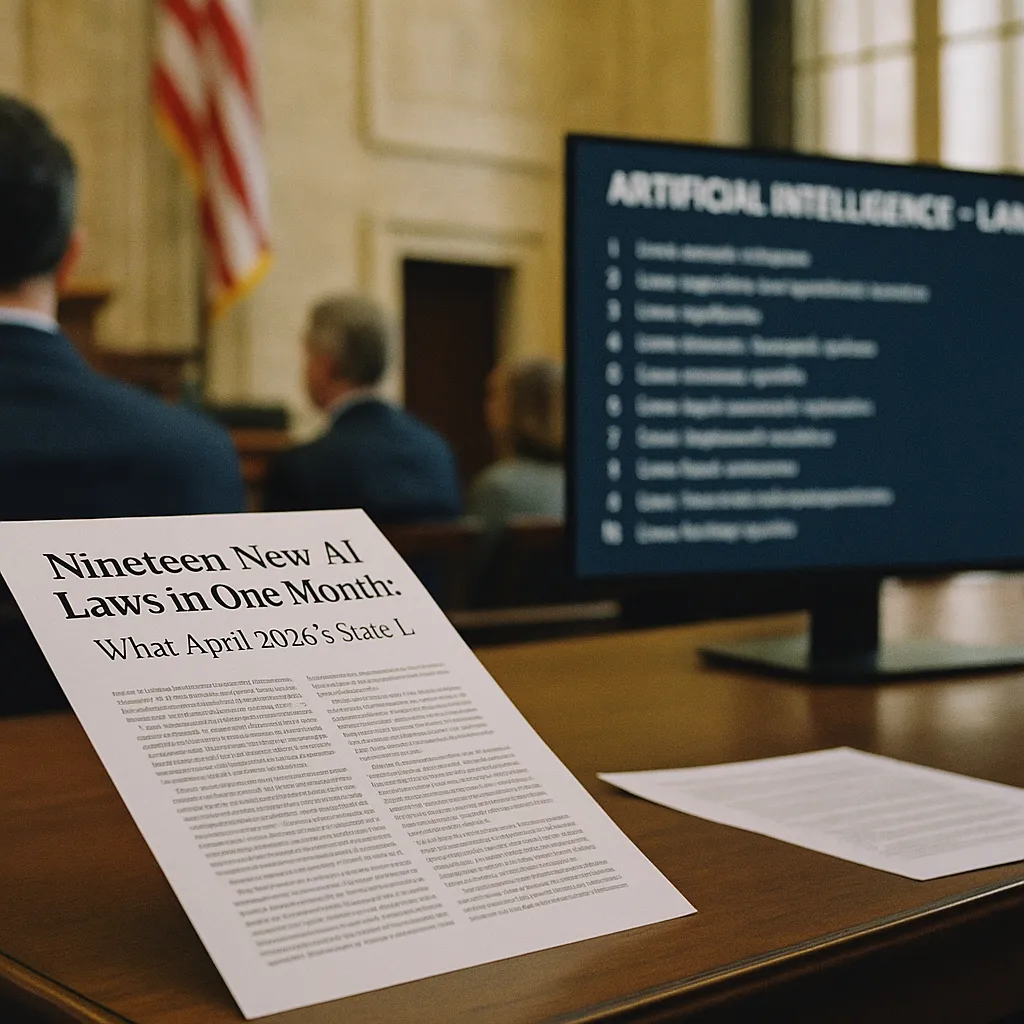
Nineteen state AI bills were signed into law in April 2026 alone — bringing the year's total to 25 — as state legislatures move faster than Congress and directly challenge the White House's preemption push.
19 New AI Laws in One Month: What April 2026's State Legislation Wave Means
By Hector Herrera | April 27, 2026
Nineteen state AI bills were signed into law in April 2026 alone — bringing the year's running total to 25 new AI laws in the United States. The burst of activity is the most concentrated state-level AI legislation in U.S. history, and it arrives directly in tension with the White House's push to let Congress set a single federal standard that would preempt state rules.
Background
State AI legislation has been accelerating since 2023, when Colorado passed its landmark AI Act covering high-risk automated decision systems. But 2026 is a different order of magnitude. Plural Policy's April tracking report documents 19 bills signed in a single month — a pace that, if sustained, would produce over 200 new state AI laws annually.
The drivers aren't abstract. Automated hiring systems that screen out candidates based on AI-scored video interviews. Credit decisioning algorithms that regulators can't audit. Chatbots deployed in government services without clear disclosure to citizens. These are the specific use cases driving urgency in state legislatures, and they're use cases that are live in production right now.
What the April Bills Cover
The 19 new laws span several overlapping categories:
Automated decision-making disclosures — Multiple states now require that individuals be notified when a consequential decision about them (hiring, credit, housing, insurance) was made or significantly influenced by an automated system. Some require the ability to request human review.
Get this in your inbox.
Daily AI intelligence. Free. No spam.
Hiring algorithm regulation — Several bills specifically address AI-scored job applications and video interviews, requiring employers to validate that their AI hiring tools don't produce discriminatory disparate impacts before deploying them.
Consumer AI disclosure — Laws requiring that chatbots and AI-generated content be labeled as such when deployed in consumer-facing contexts, including customer service, health information, and government websites.
Government AI use — A subset of bills impose procurement and transparency requirements when state agencies use AI systems for benefits determination, law enforcement, or regulatory decisions.
The Federal Tension
The White House has been explicit: it wants Congress to pass federal AI standards that preempt state law. The argument is familiar — a patchwork of 50 different state standards is operationally unworkable for companies building AI systems at national scale, and inconsistent rules create compliance arbitrage rather than genuine protection.
That argument has real force. A company operating hiring software in all 50 states can't realistically comply with 50 different disclosure formats, audit requirements, and appeal processes. But the counterargument is also real: federal preemption has historically meant weaker, not stronger, consumer protections in areas like banking and financial services, where state attorneys general often proved more aggressive than federal regulators.
The April legislative surge makes the political math harder. States that passed AI laws this month have constituent stakeholders — worker advocacy groups, civil rights organizations, consumer protection offices — who will oppose federal preemption if it means their state law gets wiped out.
What the Patchwork Looks Like in Practice
For a company deploying AI in HR, hiring, lending, or customer service today, the compliance picture is fragmented:
- Colorado has comprehensive high-risk AI regulations covering consequential decisions.
- New York City has Local Law 144, requiring bias audits for AI hiring tools.
- Illinois has the AI Video Interview Act, requiring consent and disclosure for AI-analyzed interviews.
- California continues advancing multiple AI transparency and anti-discrimination bills.
The 19 April additions layer new requirements — in some cases duplicating existing ones, in others adding novel audit or disclosure obligations. Legal teams at mid-size companies are now tracking AI compliance the same way they track privacy law — as a multi-jurisdiction matrix that requires dedicated counsel.
What to Watch
The next inflection point is whether Congress acts before the midterm cycle makes legislation harder. The White House's preemption push needs a bill introduced and moving in both chambers within the next six months to plausibly become law before 2027. If it stalls, expect the state-level pace to continue — and watch whether states with recently passed laws include explicit anti-preemption language designed to complicate federal override.
Did this help you understand AI better?
Your feedback helps us write more useful content.
Get tomorrow's AI briefing
Join readers who start their day with NexChron. Free, daily, no spam.