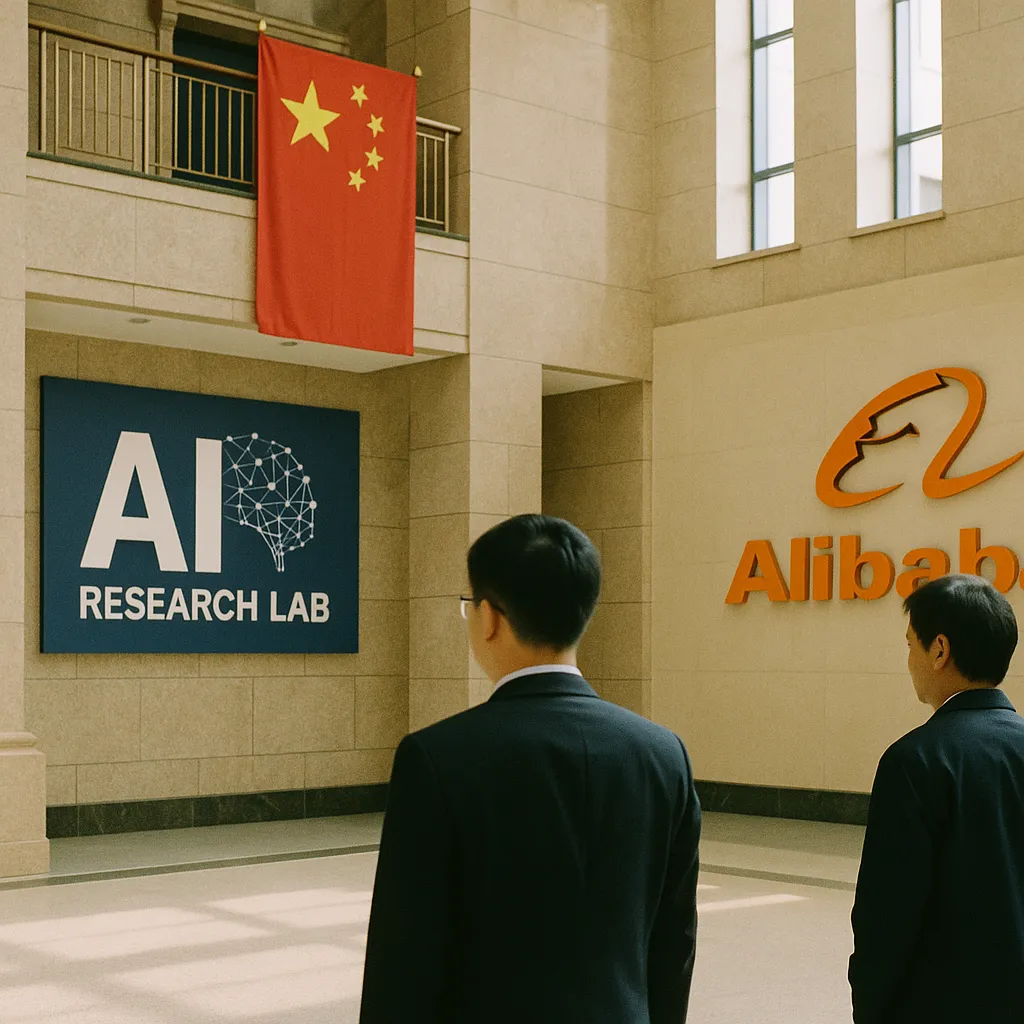
China has extended overseas travel restrictions to senior AI researchers at private firms including Alibaba and DeepSeek, treating top AI talent as a strategic national asset.
China Locks Down AI Talent at DeepSeek and Alibaba with Overseas Travel Bans
By Hector Herrera | May 26, 2026
China has extended overseas travel restrictions to senior AI researchers and executives at private tech firms including Alibaba and DeepSeek, requiring government approval before any international trip. The move signals that Beijing now views its top AI talent as a strategic national asset — one that cannot be allowed to walk out the door.
The restrictions expand a policy that first surfaced in December 2025, when DeepSeek executives were barred from leaving the country. What began as a targeted measure for one high-profile lab has now broadened to cover founders, senior researchers, and executives across private AI companies working on systems Beijing considers strategically significant.
Who Is Affected
According to Bloomberg's reporting, affected individuals include:
- Senior researchers working on advanced AI model development
- Startup founders at companies with strategic AI classifications
- Executives at Alibaba and DeepSeek named specifically in the policy expansion
The restrictions require individuals to obtain government clearance before traveling abroad. The mechanism mirrors controls long applied to defense and state-enterprise workers, now extended explicitly into the private AI sector.
Why Beijing Is Doing This
The logic is straightforward: China's AI labs have become globally competitive, and the knowledge inside those labs — training methodologies, architectural decisions, proprietary datasets — is now considered as sensitive as defense technology.
DeepSeek's January 2025 release of its R1 reasoning model rattled Western AI labs and briefly wiped hundreds of billions from U.S. tech stocks. The model demonstrated that a small, resource-constrained Chinese team could match frontier performance at a fraction of the compute cost. That result made DeepSeek's researchers some of the most sought-after minds in global AI — and made their potential departure a national security concern for Beijing.
Get this in your inbox.
Daily AI intelligence. Free. No spam.
Alibaba's inclusion reflects how broadly Chinese authorities are drawing the line. Alibaba's Qwen model family has also reached frontier-level performance on multiple benchmarks, placing its researchers in the same strategic category.
This is not a new playbook. China has applied similar exit controls to nuclear scientists, military researchers, and key figures in semiconductor development. Extending them to private AI companies marks a formal acknowledgment that large language model research is now military and economic infrastructure, not just commercial software.
What This Means for the Industry
For companies trying to recruit Chinese AI talent, the restrictions add a hard ceiling. Researchers who might consider positions at U.S. or European labs — or who planned to attend international conferences, collaborate with overseas institutions, or present at academic venues — now need government sign-off to do any of it.
The downstream effects reach several areas:
Academic collaboration. Chinese AI researchers have historically been significant contributors to conferences like NeurIPS, ICML, and ICLR. If travel approvals become slow or politically contingent, Chinese participation in global AI research forums will narrow.
Talent competition. U.S. and European AI labs recruiting from Chinese universities will find the pipeline harder to access. Researchers who complete PhDs in China and want to take positions abroad may face new bureaucratic obstacles.
Knowledge transfer controls. The policy functions as a one-directional valve — Chinese labs can still import talent from abroad (and have, aggressively), but exporting talent now requires state permission.
For Western governments watching China's AI trajectory, the travel restrictions carry a different signal: Beijing believes it has something worth protecting. Countries don't lock down talent unless they think the talent represents a real edge.
What to Watch
The immediate question is how broadly the classification of "strategically important" AI work will be drawn. If it stays narrow — targeting only researchers at a handful of named labs — the practical effect is limited. If it expands to cover mid-level engineers at AI startups generally, it becomes a significant structural constraint on China's international research presence.
Watch also for reciprocal signals from Washington. The Biden and Trump administrations both moved to restrict the flow of AI chips and tools into China; talent mobility controls from Beijing may accelerate U.S. discussions about outbound investment rules and research collaboration restrictions in the other direction.
Sources: Bloomberg, May 26, 2026
Did this help you understand AI better?
Your feedback helps us write more useful content.
Get tomorrow's AI briefing
Join readers who start their day with NexChron. Free, daily, no spam.