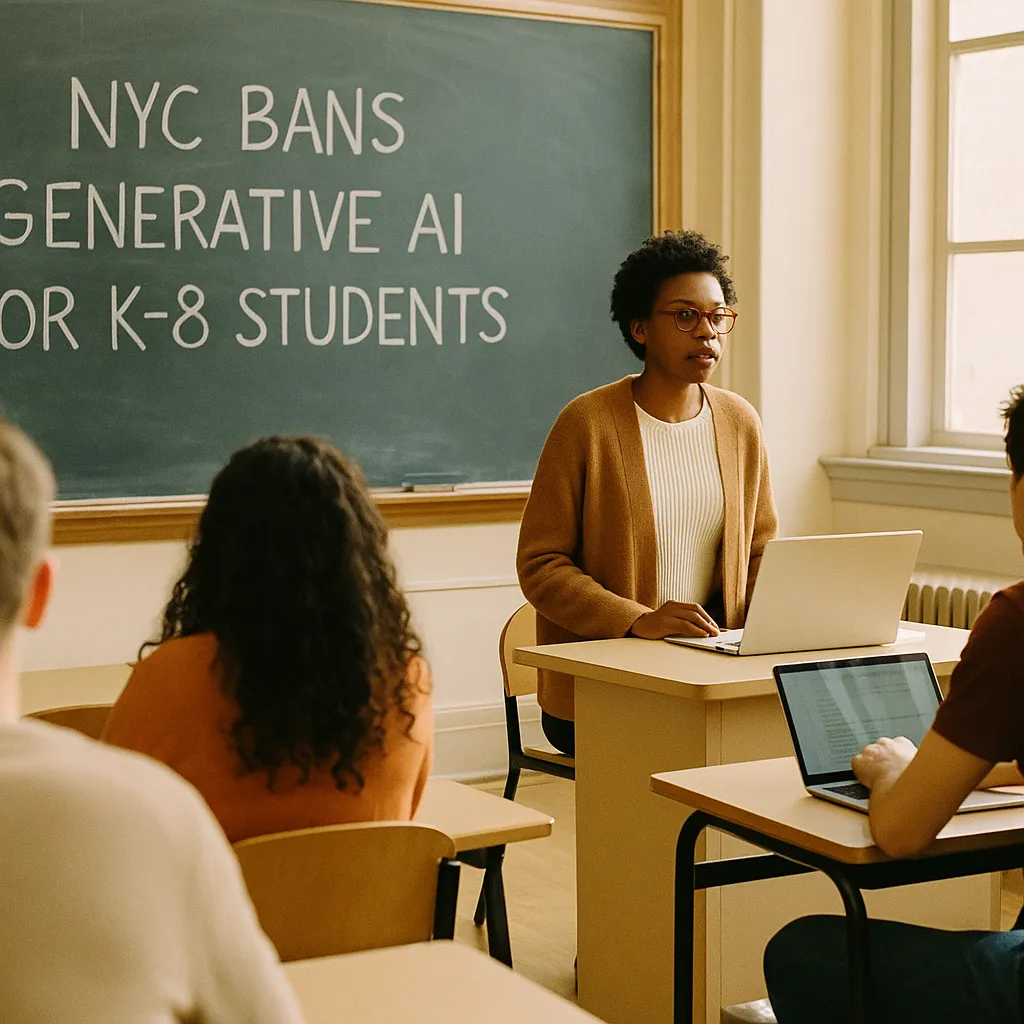
A wave of 134 state bills across 31 states is targeting AI in K-12 and higher education—covering student data privacy, classroom use restrictions, and parental consent—as 85% of teachers and 86% of students already report using AI tools.
134 State AI Education Bills in 31 States: Lawmakers Race to Govern Classroom AI
By Hector Herrera | June 12, 2026 | Education
State legislatures are moving faster on AI in education than on any other AI policy front: 134 bills across 31 states are currently active this session, targeting everything from how schools can use student data to train AI models to whether parents must be notified before an AI tool makes a recommendation about their child. The breadth and pace of this legislative wave reflects a simple reality — AI is already in the classroom, and most of the governance hasn't caught up.
The surge is happening because adoption happened first. Surveys show 85% of teachers and 86% of students now report using AI tools in an educational context, yet only a fraction of school districts have formal AI policies covering data use, equity, or parental rights. The bills landing in state legislatures are, in many cases, a response to parents, teachers, and civil liberties groups demanding answers that school administrators can't yet provide.
What the Bills Cover
The 134 bills span a wide spectrum, but several recurring themes emerge across the 31 states:
Student data privacy is the most common focus. Lawmakers are targeting the practice of AI vendors ingesting student behavioral, academic, and demographic data to improve their models — often without explicit parental consent or district knowledge. Several bills would require vendors to delete student data on demand and prohibit using it for any purpose outside the contracted educational service.
Classroom use restrictions vary widely by state. Some bills would require AI tools to carry disclosure labels — similar to nutrition labels — showing what data they collect, what decisions they influence, and what human oversight exists. Others would outright ban AI-generated grades or AI-driven college recommendation letters without a human reviewing and signing off.
Parental consent requirements are appearing in bills modeled loosely on COPPA (Children's Online Privacy Protection Act), but extended to cover AI decision systems. These would require active opt-in before any AI tool that profiles a student or influences a high-stakes academic outcome can be used.
Higher education is also in scope. Several bills target AI use in college admissions processes, faculty AI grading tools, and the disclosure obligations that universities have when AI-generated content detection tools flag students for academic integrity violations.
Get this in your inbox.
Daily AI intelligence. Free. No spam.
The Demand Side Is Clear
The legislative wave has a concrete trigger. In New York City, parents organized public campaigns after discovering that several AI-powered learning platforms deployed in city schools were sharing anonymized student data with third-party analytics firms. Similar concerns surfaced in Florida, Texas, and California, where school district AI procurement decisions — often made at the IT department level without board approval — drew public scrutiny.
The classroom adoption numbers make the governance gap hard to ignore. When 86% of students report using AI, that means AI is touching homework, test prep, essay writing, and academic guidance on a daily basis. The question isn't whether AI is in the classroom — it's whether anyone is accountable for how it behaves there.
The Federal Complication
Here is where things get complicated. The White House is currently negotiating a federal AI preemption framework with congressional leaders that would override state AI laws in exchange for targeted federal legislation on kids-online safety and AI-generated deepfakes. If that deal closes, a significant portion of the 134 state education bills could be preempted before they ever take effect.
Supporters of the state bills argue that federal preemption in education AI would be dangerous precisely because the harms are local and specific. A data privacy violation in a rural Georgia school district doesn't look the same as one in a Manhattan high school. The populations at risk differ. The vendors differ. Uniform federal rules may not address the most acute local harms.
Critics of the state-by-state approach argue the opposite: 31 different compliance regimes make it impossible for any AI vendor to serve K-12 effectively, which ultimately reduces the availability of the tools that work.
Impact: Who Bears the Cost
School districts are caught in the middle. Compliance with 134 potentially conflicting state standards is not realistic for any district's legal team. The practical effect, in many cases, is that districts pause AI deployments until the legal picture stabilizes — which may mean students in states with aggressive legislation get less access to AI tutoring tools, not more governance.
EdTech vendors face a genuine business problem. Building compliant data pipelines for 31 different state regimes is expensive. Smaller vendors may exit certain state markets entirely, leaving only large incumbents — which is not obviously a good outcome for innovation or equity.
Students and families get something important regardless of whether the bills pass: the legislative attention itself is forcing school boards and superintendents to actually read their AI vendor contracts and ask what data is being collected. That process — even without a new law — is changing procurement behavior.
What to Watch
The critical variable is timing on the federal preemption deal. If Congress passes a federal AI framework before most of these state bills complete their sessions, the landscape changes overnight. Watch Colorado specifically: its comprehensive AI Act takes effect June 30, and it covers AI systems used in educational settings under its high-risk AI requirements. If Colorado's implementation goes smoothly, it will embolden other states to push their bills over the finish line.
Also watch whether teacher unions — which have been notably active in this legislative cycle — push for collective bargaining language covering AI deployment in schools, creating a labor-law pathway that operates independently of state AI statutes.
Sources: MultiState — How States Are Regulating AI in Education
Did this help you understand AI better?
Your feedback helps us write more useful content.
Get tomorrow's AI briefing
Join readers who start their day with NexChron. Free, daily, no spam.