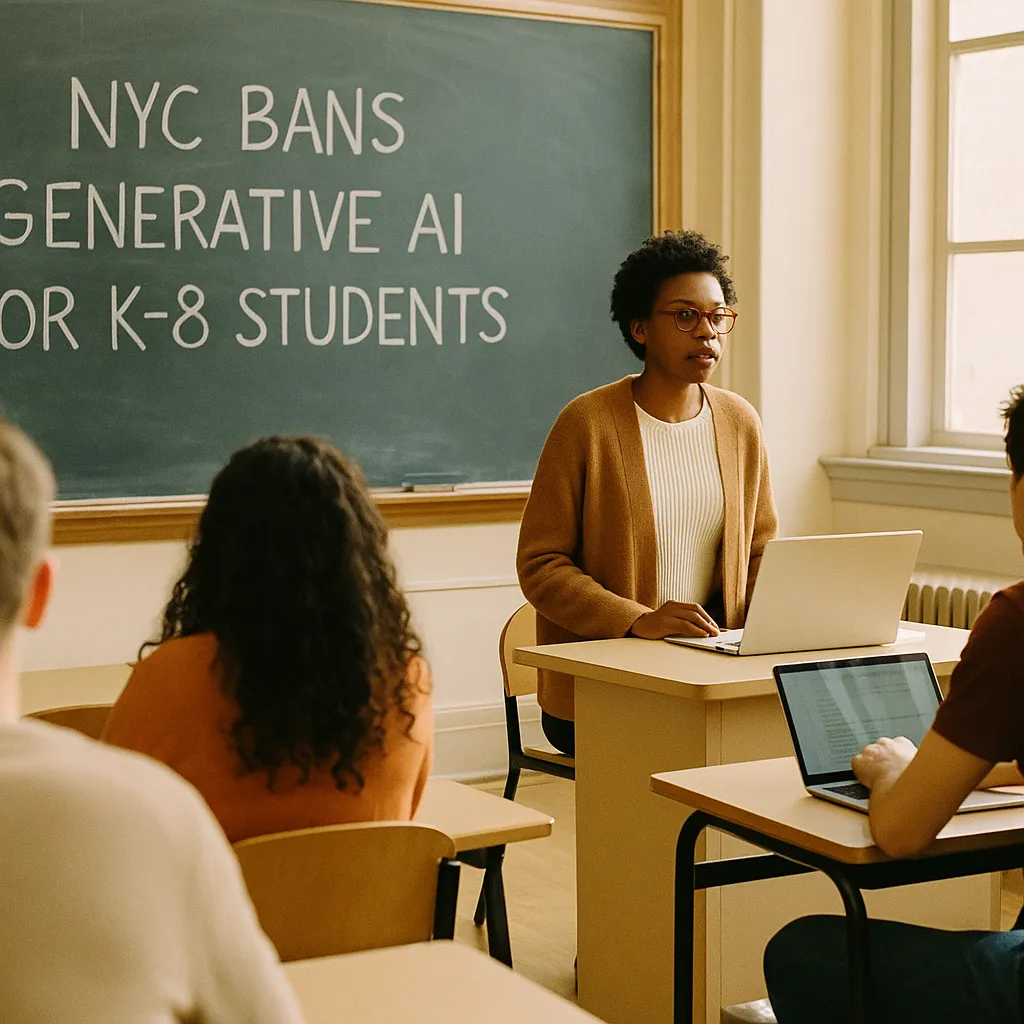
New York City's Department of Education is finalizing an AI playbook that prohibits using AI for grading, student discipline, and IEP decisions — setting a widely watched precedent for the nation's largest school district.
NYC Schools Will Ban AI for Grading, Discipline, and IEPs Under Final Playbook Releasing This Month
New York City's public school system — the largest in the United States with 1.1 million students — is about to set the most detailed AI governance boundaries of any school district in the country. The NYC Department of Education's comprehensive AI playbook, expected to be finalized in June 2026, will explicitly prohibit AI systems from making or significantly influencing decisions about grading, student discipline, and Individualized Education Programs (IEPs) — the legally mandated plans that govern special education services.
The context: School districts nationwide have been scrambling to write AI policies since ChatGPT arrived in classrooms in late 2022. Most have focused on student use — whether students can use AI to complete assignments. NYC's playbook goes further, addressing how schools and teachers use AI as an administrative and instructional tool. The distinction matters: AI that affects a student's grade, their discipline record, or their special education services has direct legal consequences that typical consumer AI use does not.
The Three Absolute Limits
The playbook draws a clear line at decisions that directly affect student welfare and legal rights. Three categories are off-limits for AI:
Grading — AI may assist teachers in developing rubrics, generating feedback suggestions, or flagging patterns across assignments, but the final grade assigned to any student must come from a human educator. Automated grading tools cannot produce final marks.
Student discipline — Decisions to suspend, expel, or apply behavioral consequences cannot be delegated to or significantly shaped by AI systems. Given the well-documented racial disparities in school discipline nationwide, automated discipline systems carry particular legal and equity risk.
Individualized Education Programs (IEPs) — Under the Individuals with Disabilities Education Act, IEPs are federal documents that specify services, accommodations, and educational goals for students with disabilities. They require team meetings with parents, educators, and specialists. AI cannot write, finalize, or determine outcomes in IEP processes.
These aren't soft guidelines — they are categorical bans. Schools that use AI to make these decisions would be out of compliance with district policy and, in the IEP case, potentially with federal law.
What AI Can Be Used For
The playbook isn't prohibitive across the board. NYC DOE has been building toward this policy through a four-phase rollout that included public comment periods and staff training. Approved uses are expected to include:
- Lesson planning and curriculum development — Teachers can use AI to generate draft lesson plans, differentiated materials, and assessment ideas
- Administrative efficiency — Scheduling, parent communication drafts, and report generation
- Tutoring and student support tools — AI-powered tutoring platforms that supplement (but don't replace) teacher instruction
- Accessibility tools — AI-based captioning, translation, and text-to-speech for students with language or learning differences
The distinction the playbook draws is between AI as a productivity tool for educators and AI as a decision-maker over students' academic futures.
Get this in your inbox.
Daily AI intelligence. Free. No spam.
Why NYC's Policy Sets a National Precedent
When the largest school district in the country publishes a detailed AI governance framework, every other district watches. NYC DOE has done this before — its 2023 ChatGPT ban, later reversed after teacher pressure, forced a national conversation about AI in classrooms. This playbook is the matured version of that conversation.
Several factors make the NYC policy particularly influential:
Scale — 1,100+ schools, 75,000+ teachers. A policy that works here gets scrutinized as a model by districts with far fewer resources to develop their own frameworks.
Legal specificity — The IEP prohibition is grounded in federal law. Any district that fails to restrict AI in IEP processes faces genuine IDEA compliance exposure, not just political risk.
Public process — The four-phase rollout with public comment means the policy has already been stress-tested by parents, teachers, disability advocates, and civil rights organizations. That legitimacy makes it harder for other districts to dismiss.
The National School Boards Association and the Council of Chief State School Officers have both indicated they are watching NYC's framework as a reference point for national guidance.
The Equity Argument
Behind the discipline and IEP prohibitions is a specific equity concern: algorithmic decision-making in schools has a documented track record of amplifying existing disparities.
Studies of predictive discipline tools have found that AI systems trained on historical discipline data replicate patterns of disproportionate discipline affecting Black and Latino students. An AI that flags students for behavioral intervention based on patterns in its training data can encode past discrimination into future decisions — while giving administrators the false confidence that "the algorithm said so."
The same concern applies to IEPs. Special education placement decisions have historically shown racial and socioeconomic disparities. Automating components of the IEP process without addressing those underlying patterns would risk scaling the disparity.
By drawing the line at human decision-making for consequential outcomes, NYC DOE is making an explicit values statement: some decisions about children are too important to delegate to systems that can't be held accountable.
What to Watch
The June release will reveal how enforcement is structured — whether violations carry specific consequences or are handled through principal discretion. Also watch for how the playbook handles the gray area of AI-assisted grading tools that currently operate in classrooms, like automated essay feedback platforms. If those tools are classified as grading aids rather than graders, they may survive the prohibition. If they're classified as influencing final grades, vendors selling to NYC schools will need to restructure their products.
Districts in California, Texas, and Illinois — which have been waiting to see how the largest district handles this — are likely to issue their own policies within six months of NYC's final release.
By Hector Herrera
Did this help you understand AI better?
Your feedback helps us write more useful content.
Get tomorrow's AI briefing
Join readers who start their day with NexChron. Free, daily, no spam.