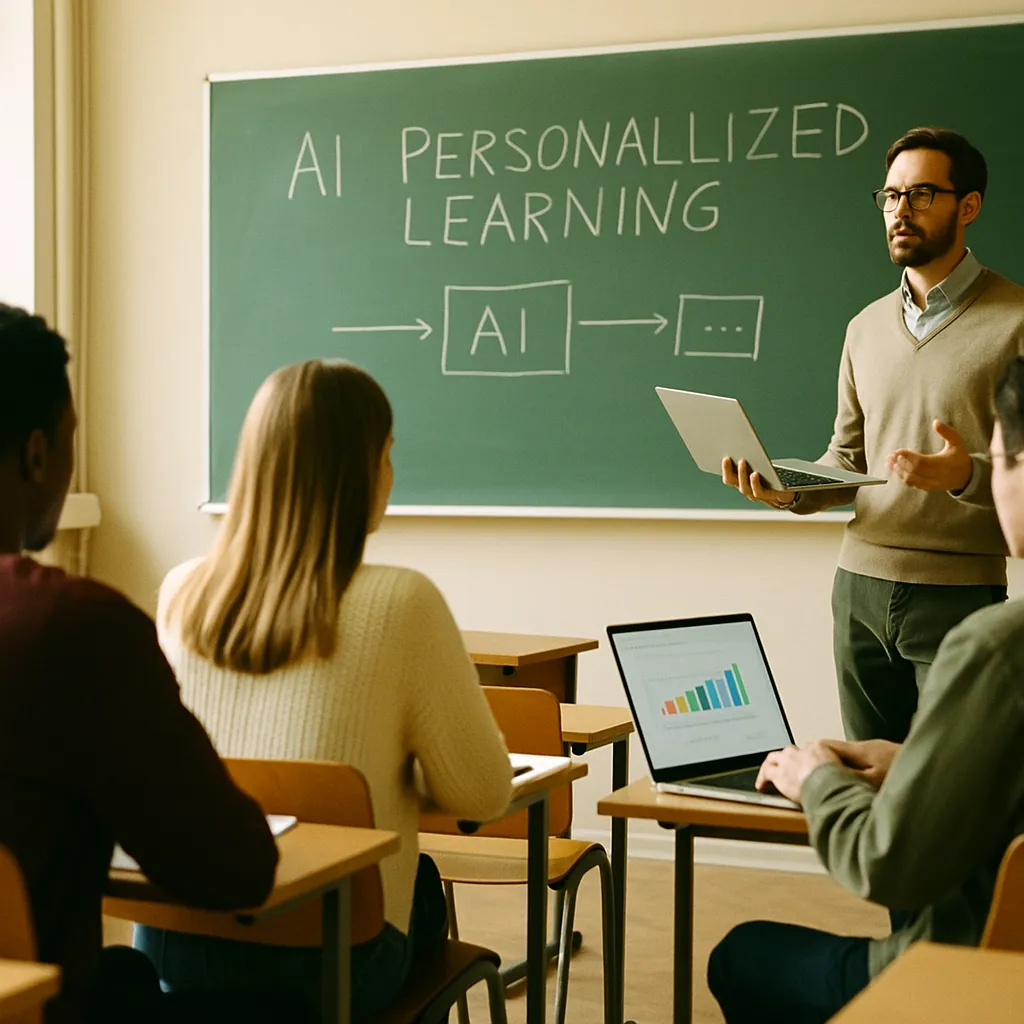
Across K-12 platforms, tutoring apps, and enterprise LMS tools, AI-driven personalization has shifted from differentiated feature to baseline expectation — and legacy publishers are racing to keep up.
AI Personalized Learning Is No Longer a Premium Add-On. It's the New EdTech Baseline.
By Hector Herrera | June 9, 2026 | Education
AI-driven personalized learning has completed a market transition that took less than three years: from differentiated premium feature to baseline product expectation. June 2026 EdTech reporting finds that across K-12 platforms, tutoring apps, and enterprise learning management systems (LMS), adaptive AI is no longer what distinguishes a product — it's what buyers now assume is included. The shift is forcing traditional curriculum publishers to rebuild their core platforms or lose ground to AI-native competitors that entered the market lighter and faster.
What "Baseline Expectation" Actually Means
Three years ago, an AI-powered adaptive learning feature was a differentiator — something an EdTech vendor highlighted in sales decks and used to justify premium pricing. Teachers and district administrators asked "does it have AI?" as a way of distinguishing forward-thinking platforms from legacy ones.
In mid-2026, that question has changed. Buyers now ask: "How does your AI personalization work?" — not whether it exists. The assumption that a learning platform adapts to individual student pace and performance is baked into procurement criteria at districts, tutoring companies, and corporate learning departments alike.
This transition has direct commercial consequences. A vendor that launched a K-12 reading comprehension platform in 2021 with static curriculum and is now bolting on an AI recommendation layer is competing against platforms that were built adaptive-first — where the entire content delivery architecture was designed around AI feedback loops from day one. The bolt-on version rarely matches the native version on instructional responsiveness, and buyers are increasingly sophisticated enough to tell the difference.
Who's Being Squeezed
The firms facing the most pressure are traditional curriculum publishers — companies with deep content libraries, institutional relationships, and adoption inertia in districts, but platforms built on content management systems that were never designed for the real-time data loops that effective AI personalization requires.
These publishers face a difficult choice:
Get this in your inbox.
Daily AI intelligence. Free. No spam.
Rebuild from the core outward. Redesign the platform architecture to treat AI personalization as primary, not as a feature layer. This is expensive, slow, and requires engineering talent that competes with tech-sector compensation.
Partner or acquire. License AI personalization technology from an AI-native EdTech vendor and integrate it into the existing platform. Faster, but often results in the seam showing — AI tools that feel grafted on rather than native.
Accept a narrower market. Focus on districts that value content depth and institutional relationships over platform adaptivity, and accept that the AI-native competitors will win on the adaptive learning positioning.
The third path is a slow retreat — viable in the near term, but unsustainable as adaptive AI becomes assumed infrastructure rather than a differentiator.
The Enterprise LMS Dimension
The same transition is happening in corporate learning. Enterprise LMS platforms that dominated the market through the 2010s — built for compliance training delivery and completion tracking — are being replaced or displaced by AI-native learning experience platforms (LXPs) that adapt content sequences to individual skill gaps, role requirements, and learning velocity.
The corporate learning buyer in 2026 isn't just asking whether an LMS can deliver SCORM courses. They're asking whether it can recommend the next relevant learning path, identify skill gaps against a job role profile, and integrate with performance review data to close the feedback loop between learning and doing. These are AI functions, and they're moving from premium add-on to procurement baseline in enterprise HR technology just as they have in K-12.
What the AI-Native Platforms Have That Bolt-Ons Don't
The structural advantage of AI-native EdTech platforms isn't the AI model itself — the underlying language models and recommendation algorithms are increasingly available as commodity infrastructure from AI providers. The advantage is data architecture: platforms built from the ground up to capture, label, and feed student interaction data back into the adaptive engine have training sets and feedback loops that a retrofit cannot replicate quickly.
A student who has completed 300 sessions on an AI-native platform has generated data that continuously refines that platform's model of how students like them learn. A bolt-on AI layer on a legacy platform starts with far less signal, and the gap compounds over time as the native platform's model improves with scale.
What to Watch
The EdTech consolidation wave this transition is driving hasn't fully arrived yet. Watch for acquisitions of AI-native personalized learning platforms by traditional publishers who've concluded that rebuilding is slower than buying. Also watch whether the IES (Institute of Education Sciences) and third-party EdTech research bodies begin requiring adaptive AI evidence standards as part of their evidence tiers — that would formalize AI personalization as a baseline expectation in federally-funded program evaluation, not just in the commercial market.
Did this help you understand AI better?
Your feedback helps us write more useful content.
Get tomorrow's AI briefing
Join readers who start their day with NexChron. Free, daily, no spam.