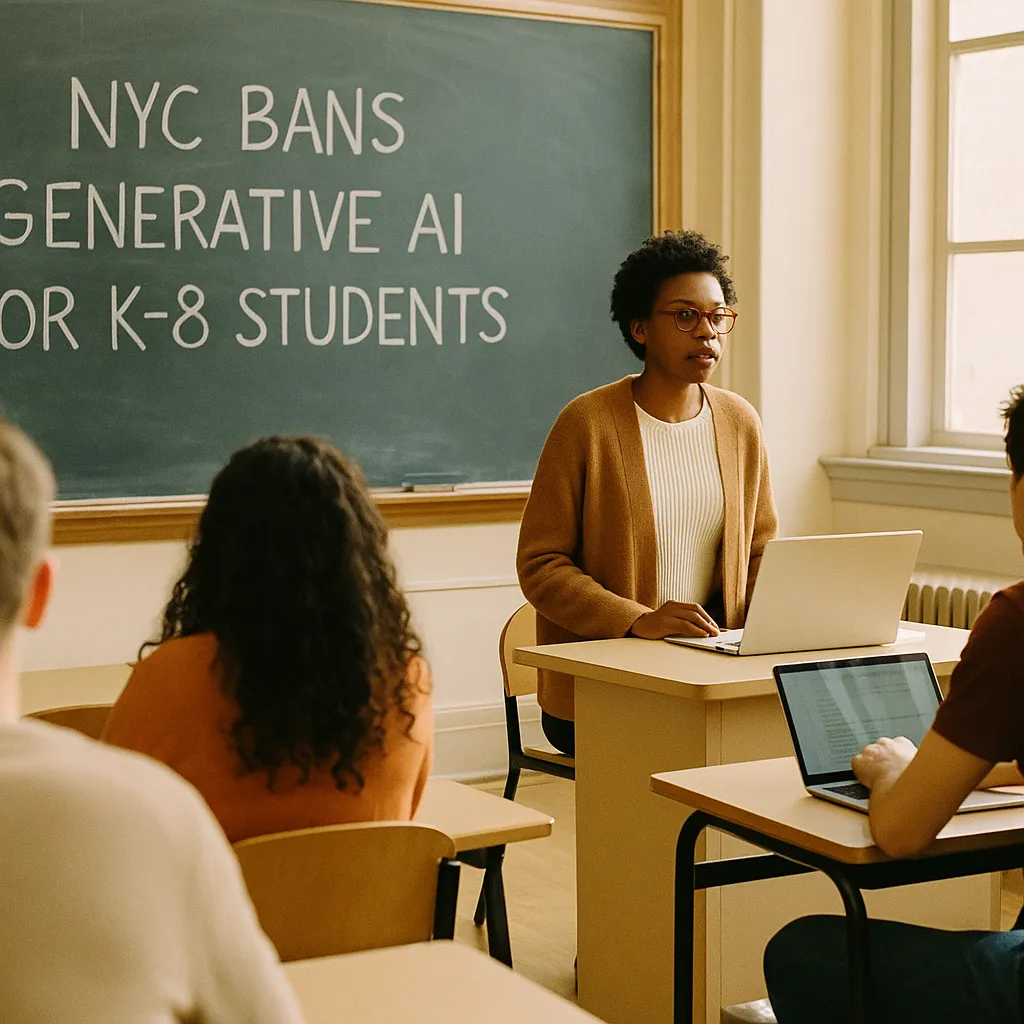
A Stanford SCALE review of 800+ studies found zero high-quality U.S. causal studies on AI's effect on K–12 students — while states legislate and districts deploy at scale.
Stanford Finds Zero High-Quality Causal Studies on AI's Impact on U.S. K–12 Students
By Hector Herrera | June 13, 2026 | Education · Analysis
Stanford researchers reviewed more than 800 academic studies on AI in K–12 education and found only 20 with rigorous enough methodology to draw any causal conclusions — and zero high-quality U.S. studies that measure AI's actual impact on student learning outcomes. The finding, from Stanford's SCALE (Stanford Center for Assessment, Learning & Equity) research group, is not a minor academic footnote. It is a direct indictment of the pace at which states are legislating AI in classrooms and districts are deploying tools at scale, without credible evidence of what those tools actually do to students.
The research has a particular sting to its timing. In 2026, more than 20 states have passed or are advancing legislation on AI in education. Hundreds of districts are mid-deployment of AI tutoring systems, AI grading tools, and AI-powered adaptive learning platforms. Edtech vendors are reporting record sales. The Stanford review found the research base supporting those decisions is functionally nonexistent.
What "Zero Causal Studies" Actually Means
There is an important distinction between correlation and causation in educational research — and it's the difference between "students who used this AI tool scored higher" and "students scored higher because they used this AI tool."
A causal study is designed to isolate the effect of a specific intervention. It typically requires:
- A control group not receiving the intervention
- Random assignment (or a rigorous statistical equivalent) to treatment and control
- Follow-up measurement to see whether gains persist after the intervention ends
What the Stanford review found in the AI education literature is largely observational data: students used AI tools and their performance improved while using them. That tells you the tool is engaging, possibly effective in context, and that students like using it. It does not tell you whether the same students would have improved without the tool, whether the gains transfer to non-AI-assisted contexts, or whether there are costs — in foundational skill development, attention, or long-term learning — that the short-term performance data doesn't capture.
The finding that performance gains fade when the AI is removed is particularly significant. It suggests at least some of the measured benefit is tool-dependent rather than a durable increase in learning. An AI tutoring system that improves test scores while it's being used, but leaves no lasting improvement after it's taken away, is doing something useful — but not necessarily what districts are paying for it to do.
Get this in your inbox.
Daily AI intelligence. Free. No spam.
The 800-Study Landscape
Of the 800+ studies the Stanford team reviewed:
- Most are observational, measuring engagement or short-term performance during AI tool use
- Some are vendor-sponsored studies with obvious incentive problems
- A handful are RCTs (randomized controlled trials) or quasi-experimental designs — and most of those are from outside the U.S., in different educational contexts with different student populations
- Zero meet the bar for high-quality causal evidence about AI's impact on U.S. K–12 students specifically
This is not unusual for a rapidly emerging technology. The edtech research base for tablets, digital textbooks, and online learning was similarly thin in the early deployment years. What's different about AI is the speed and scale of deployment, the cost per seat, and the regulatory activity happening simultaneously.
The Legislation-Evidence Mismatch
State legislatures and school boards are not waiting for research. The pressures driving adoption — teacher shortages, post-pandemic learning gaps, parental pressure, vendor marketing, and genuine urgency around AI preparedness — are real. Districts that wait for a 10-year longitudinal study may be waiting forever.
But the current situation creates a specific risk: policy is locking in procurement and deployment patterns before anyone knows whether those patterns produce the claimed outcomes.
Consider how this plays out in practice. A district signs a three-year contract with an AI tutoring vendor based on that vendor's internal efficacy data and a state mandate encouraging AI adoption. Three years in, the vendor has collected performance data that shows gains during use. The contract renews. The tool is never tested against a control group. The evidence base never improves because nobody has the incentive to fund the study that might produce a null result.
The Stanford finding is an argument for building the evidence infrastructure now — while the tools are being deployed and the contracts are being written — so that in three to five years the field has something to stand on.
What Good Evidence Would Look Like
The researchers are not arguing that AI tools don't work. The argument is that we don't know, and we need to know. A rigorous evidence base for AI in K–12 education would require:
- Independent funding — studies not commissioned by vendors or by districts with skin in the game
- Longitudinal design — following students for at least one to two years after the AI intervention ends to measure persistence of gains
- Varied populations — specifically including low-income students, English language learners, and students with disabilities, who are both the most marketed-to and the least studied
- Multi-outcome measurement — not just test scores, but foundational skill development, engagement, and student agency
Several federal agencies — the Department of Education's Institute of Education Sciences, NIH — fund exactly this kind of research. The Stanford team's implicit call is for that funding to specifically target AI tools at scale.
What to Watch
Watch whether the Stanford finding influences the wave of state AI-in-education legislation currently advancing. If states begin including independent efficacy requirements as a condition of AI tool procurement, that changes the vendor landscape. Vendors with real evidence will have a competitive advantage they currently don't. Districts that are mid-contract should ask their vendors directly: do you have randomized, third-party-validated evidence of learning gains that persist after tool use ends?
Source: Government Technology / Stanford SCALE — Stanford Researchers Find Thin Evidence Behind AI Classroom Tools
Did this help you understand AI better?
Your feedback helps us write more useful content.
Get tomorrow's AI briefing
Join readers who start their day with NexChron. Free, daily, no spam.