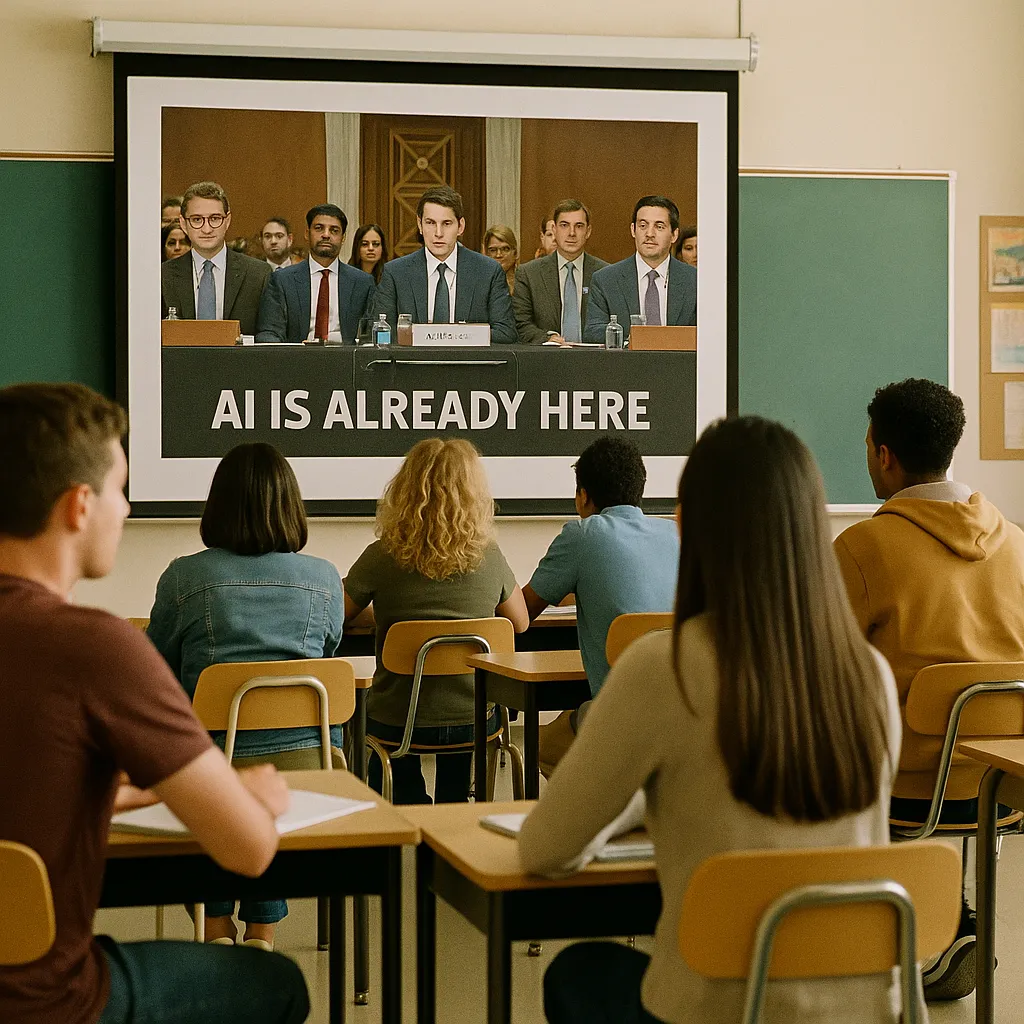
The Senate Subcommittee on Education convened June 17 to address AI in classrooms, with witnesses arguing federal rules must come before the guidance gap becomes permanent.
'AI Is Already Here': Senate Subcommittee Pushes for Federal Classroom Rules as Gap Widens
By Hector Herrera | June 18, 2026 | Education
The Senate Subcommittee on Education and The American Family convened on June 17 to confront a question the federal government has been slow to answer: who sets the rules for AI in American classrooms? Witnesses told the subcommittee that students are already using AI tools daily and that without federal guidance, the gap between how students engage with AI and how institutions understand or manage that use is becoming structurally irreversible.
The hearing produced a clear message from the testimony: the timeline for federal action is not years away. For students now in school, the situation has already arrived.
What the Hearing Covered
According to the Washington Times, the June 17 hearing brought together experts who argued that the framing question before Congress has shifted. The debate about whether AI would reach classrooms is settled—it did. The debate about whether schools would have time to develop measured policies before students began using AI tools is also settled—they didn't. The open question is whether Congress can act on federal standards before the improvised, inconsistent patchwork of school-level and district-level AI policies becomes entrenched enough to be practically irreversible.
The subcommittee's focus was on charting a path toward federal classroom AI rulemaking. Witnesses pressed for clarity on several fronts:
- Minimum disclosure standards — what students and parents should know about when and how AI is involved in instruction, assessment, and content generation
- Academic integrity guidance — a consistent federal framework schools can apply, rather than the current situation where each district interprets the question independently
- Teacher preparation requirements — whether federal education funding should be tied to training teachers on AI tools and their limitations
- Student data protections — how existing federal privacy law (FERPA—the Family Educational Rights and Privacy Act) applies when AI tools process student work and learning behavior
Why the Gap Is Widening
The core problem witnesses described is an adoption asymmetry. Students—particularly high school and college students—have integrated AI tools into their daily workflows at a pace that mirrors how earlier generations adopted search engines and smartphones. The tools are accessible, effective, and often free or inexpensive.
Institutions have moved far more slowly. School boards and district administrators are operating under federal education frameworks written before large language models (LLMs—AI systems that can generate and process text at a sophisticated level) were commercially available. Teachers are developing individual classroom policies that vary in ways creating inconsistent experiences for students moving between courses, teachers, or schools. The absence of federal guidance means every school district is, in effect, running its own uncoordinated experiment on an accelerating timeline.
Get this in your inbox.
Daily AI intelligence. Free. No spam.
The witnesses' concern is that the longer this patchwork persists, the harder it becomes to replace with coherent standards. Schools, teachers, and vendors are building systems and habits around whatever informal norms emerge. Reversing those investments once federal standards eventually arrive will be disruptive and expensive—and the students who moved through school during the gap period will have received inconsistent preparation regardless.
The Federal vs. State Tension
Education policy in the United States is historically a state and local function. The federal government's role in K-12 education is substantial—primarily through Title I funding and special education mandates—but defining curriculum and classroom practice has traditionally resided with states and districts.
AI in education is forcing a reconsideration of that division. The technology does not respect state lines. A student in Kansas using the same AI tools as a student in California will have access to the same capabilities; whether their school allows, restricts, or ignores that use is purely a function of local policy that has no relationship to the technology's actual reach or risk.
The argument for federal action is that baseline standards on data privacy, AI disclosure, and teacher preparation are analogous to federal standards in other areas where the stakes of inconsistency are high—food safety standards, vehicle emissions requirements, civil rights protections in schools. The argument against is that federal education rulemaking is slow, politically contentious, and often less responsive to local conditions than state-level action.
The witnesses on June 17 appeared to land on a middle position: federal minimums on privacy and disclosure, with flexibility for states and districts to go further based on local priorities and resources.
What This Means for Schools Right Now
The practical implication of the hearing is that schools are unlikely to receive federal guidance quickly. The hearing is a signal that Congress is taking the issue seriously, not that action is imminent. Federal rulemaking in education typically takes 12 to 24 months from hearing to final rule.
In the meantime, schools are on their own. Districts that have not yet developed an AI use policy are behind. Districts that have developed policies without an eye toward eventual federal standards may need to revise them. And teachers who have been managing AI informally—allowing it, banning it, or ignoring it depending on personal preference—are operating in a compliance gray zone that is unlikely to stay gray indefinitely.
What to Watch
Whether the Senate subcommittee produces draft legislation or formal recommendations is the immediate next milestone. Subcommittee hearings on technology issues often generate attention without follow-through; the test is whether June 17 produces a concrete bill or regulatory proposal in the next congressional session.
Also watch the Department of Education. Federal agencies have authority to issue guidance to schools under existing law even before Congress acts—and faster administrative action on AI disclosure and data privacy standards could produce real-world changes in school practice without waiting for legislation to move through Congress.
Hector Herrera covers AI in education, government, and society for NexChron.
Did this help you understand AI better?
Your feedback helps us write more useful content.
Get tomorrow's AI briefing
Join readers who start their day with NexChron. Free, daily, no spam.