OpenAI's education division now reaches over one million students in Jordan alone and has launched a formal newsletter for educators, while NYC's 1,700-school system is releasing the most detailed AI governance playbook yet published by a major U.S. district.
OpenAI Education Launches Global Classroom Push as NYC Releases AI Governance Playbook
By Hector Herrera | June 7, 2026 | Education
OpenAI is formalizing its push into global education with a dedicated newsletter and a set of country-scale deployments that now reach millions of students — while New York City's Department of Education is simultaneously releasing the most detailed AI governance playbook yet produced by a major U.S. school district. The two developments together signal that AI in K–12 education has crossed a threshold: it's no longer about pilot programs. It's about systems-level policy and scale.
OpenAI's Global Classroom Footprint
OpenAI Education, the company's dedicated education division, launched The Edu Prompt as its official newsletter for educators and administrators. The newsletter is designed to distribute AI integration guidance, lesson frameworks, and policy templates to teachers and school leaders — a content strategy that supports adoption at the classroom level while OpenAI's enterprise agreements operate at the national level.
The national-scale numbers are significant:
- Estonia: 20,000 students and 4,600 teachers are now active users of OpenAI-powered educational tools, representing meaningful penetration in a country with roughly 135,000 K–12 students total.
- Jordan: The AI Education Assistant program is engaging more than 1 million students, making it one of the largest single-country deployments of AI in public education anywhere in the world.
- Kazakhstan: 84,000 educators have completed AI-readiness training — a workforce development initiative designed to build institutional capacity before classroom adoption scales.
These aren't proof-of-concept pilots. They're operational deployments at national scale, with teacher training infrastructure and curriculum integration built in.
What OpenAI Education Is Selling
The product underlying these deployments is ChatGPT's educational interface, configured with school-appropriate guardrails and integrated into existing learning management systems. OpenAI has been deliberate about packaging this as a governance-first offering: school systems get data privacy commitments, content moderation tuned for minors, and administrator dashboards that give district IT teams visibility into usage.
Get this in your inbox.
Daily AI intelligence. Free. No spam.
That packaging is a direct response to the single largest barrier to AI adoption in K–12: trust. Teachers and administrators need to know what the system can see, what it stores, and what happens when it makes a mistake. OpenAI's education pitch is built around answering those questions before they're asked.
NYC's Governance Playbook
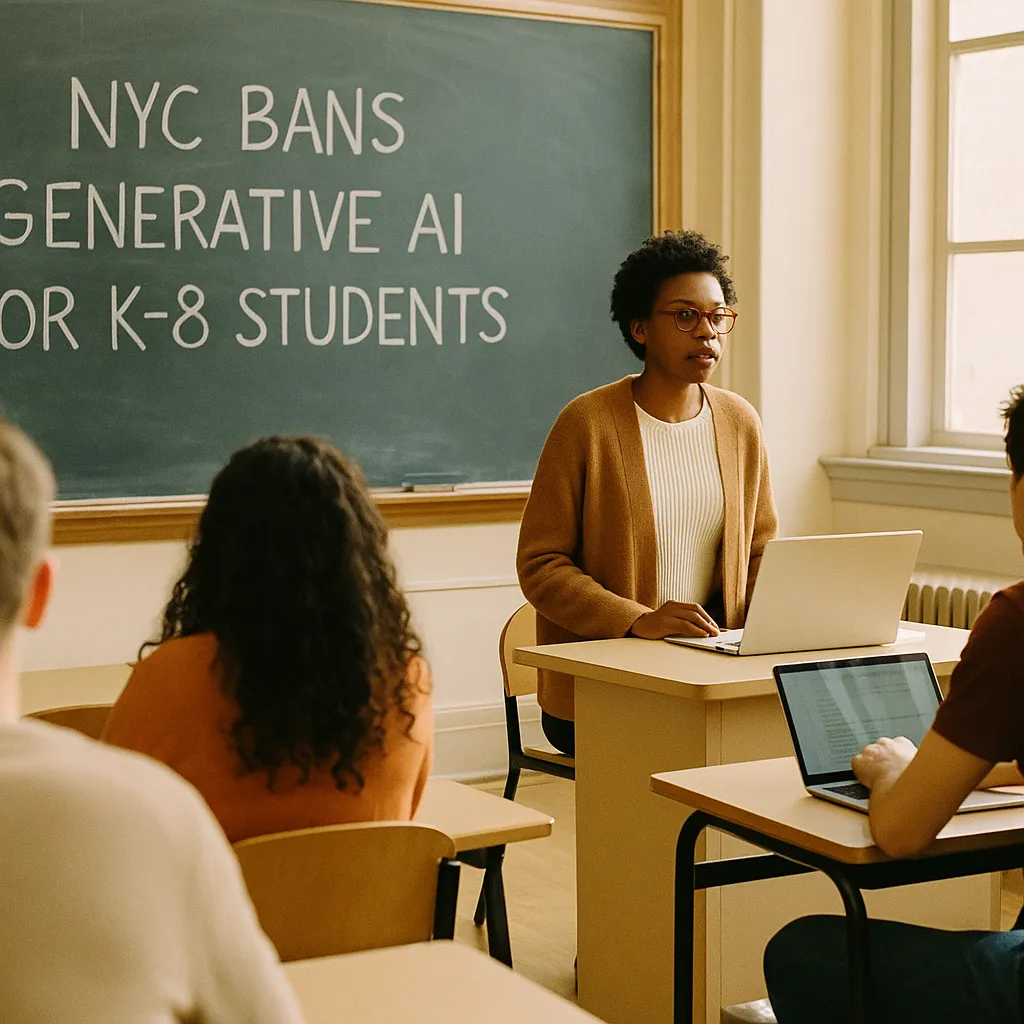
The New York City Department of Education serves 1.1 million students across 1,700 schools — the largest public school system in the United States. Its forthcoming AI governance playbook is, by scale alone, one of the most consequential AI policy documents in U.S. public education.
According to EdTech Innovation Hub, the playbook covers:
- Approved use cases for AI tools in instruction, assessment, and administrative work
- Data governance standards specifying which student data can be processed by AI systems and under what conditions
- Academic integrity frameworks that address AI-assisted work without defaulting to blanket bans
- Teacher preparation requirements — professional development that must be completed before AI tools are used in classrooms
The NYC playbook matters beyond New York. District administrators across the country have been watching for a large-district model they can adapt. When a 1.1-million-student system publishes its framework, it becomes the de facto template for dozens of mid-size districts that lack the staff to build one from scratch.
The Policy Gap It Fills
Federal guidance on AI in K–12 education remains limited to general principles. The Department of Education's 2023 AI report and subsequent guidance documents have pointed directions without providing operational detail. State-level guidance varies widely — a handful of states have published frameworks, most have not.
This creates a policy vacuum that individual districts are filling themselves, with results that range from thoughtful to improvised. A well-constructed playbook from NYC — with the legal review, vendor evaluation, and stakeholder consultation that a large district can fund — raises the floor for districts that would otherwise be navigating this alone.
What to Watch
OpenAI is not alone in the education market. Google Workspace for Education reaches an estimated 170 million students globally, and Microsoft is integrating Copilot into its education enterprise agreements. The competition for institutional relationships with school systems is intensifying — and governance credibility is the differentiating factor, not raw model capability.
Watch for whether other large U.S. districts follow NYC's lead with public governance playbooks, and whether state education agencies begin requiring districts to publish AI governance frameworks as a condition of using AI tools in classrooms. The NYC document could accelerate that policy pressure significantly.
Sources: EdTech Innovation Hub
Did this help you understand AI better?
Your feedback helps us write more useful content.
Get tomorrow's AI briefing
Join readers who start their day with NexChron. Free, daily, no spam.