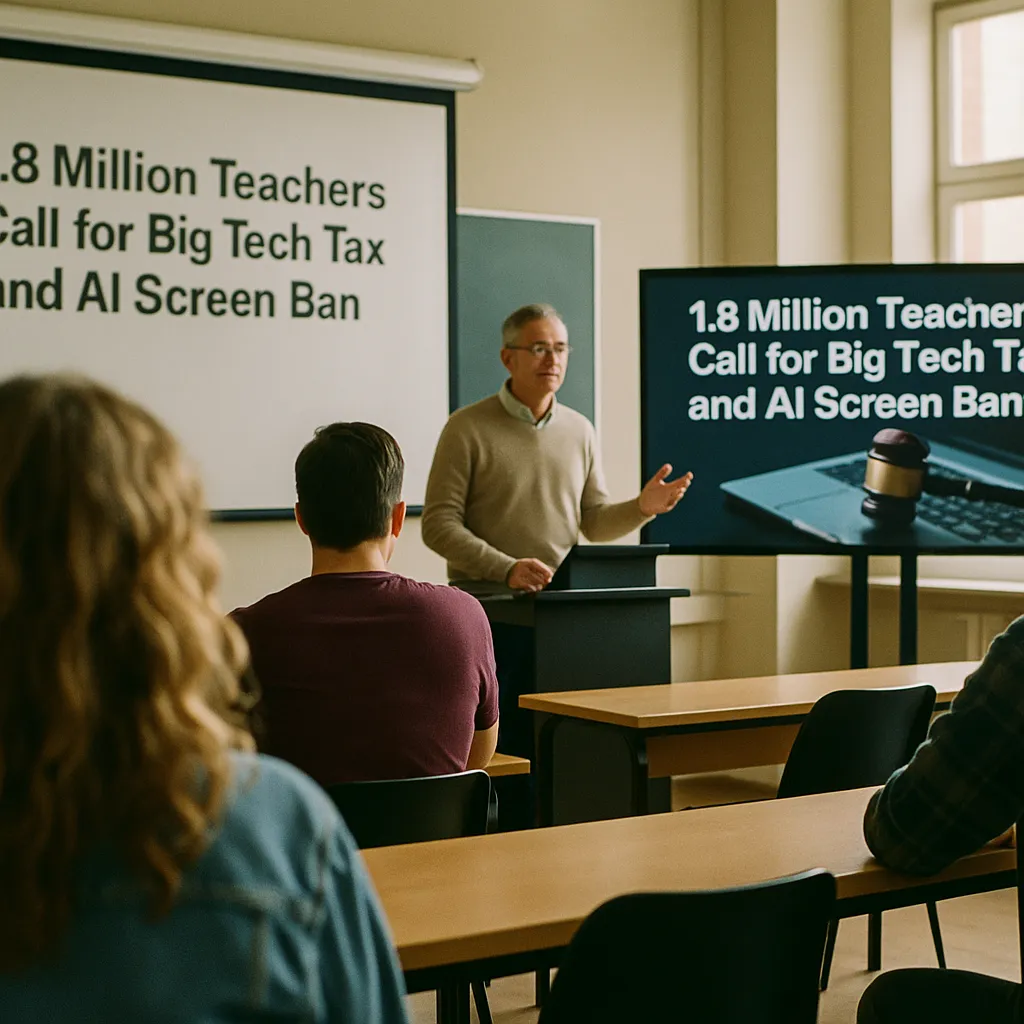
The American Federation of Teachers released a sweeping AI policy platform demanding a Big Tech revenue levy to fund schools and banning AI-enabled screens from elementary classrooms.
The American Federation of Teachers — the nation's second-largest teachers union, representing 1.8 million members — released a sweeping AI policy platform calling for a levy on Big Tech revenues to fund public education and a ban on AI-enabled screens in elementary school classrooms. It is the most aggressive institutional response yet from organized labor to the unchecked integration of commercial AI tools into K-12 schools, and it arrives with enough political weight to shape state-level legislation in 2026.
Why the AFT Is Acting Now
AI tools from Google, Microsoft, and a fast-growing roster of edtech startups have moved into classrooms without the kind of safety review, evidence base, or teacher input that typically precedes curriculum decisions. The AFT argues that the technology industry profits from student data and school infrastructure while contributing little to the public education system it increasingly depends on for deployment scale.
The union's platform, released in May 2026 and reported by Education Week, addresses three failures it says current federal and state policy has not corrected: funding inequity, student developmental safety, and professional displacement of teachers.
The Five Core Demands
1. A Big Tech revenue levy. The AFT wants Congress to impose a fee on major technology company revenues and direct proceeds to public education. The mechanism mirrors digital services taxes enacted in France, Spain, and the UK — where tech companies pay a percentage of revenues earned from users in those countries. The union has not specified a rate, but the principle is clear: companies earning revenue through student data and school deployment should contribute to the education system they depend on. Coming from a 1.8-million-member organization with close ties to Democratic lawmakers, that framing has real legislative traction.
2. AI and screen bans in elementary classrooms. The platform calls for prohibiting AI-enabled screens in kindergarten through grade 5, pending independent safety research. The rationale is developmental: young children's literacy, numeracy, and social development are better served by human-mediated instruction, and the research base for AI-assisted learning at early ages does not yet support confident claims of benefit. Sweden banned smartphones in schools in 2024; the UK followed with guidance restricting phone use across all grades. The AFT's proposal extends that logic specifically to AI-powered screens.
Get this in your inbox.
Daily AI intelligence. Free. No spam.
3. Mandatory teacher training before deployment. Any school system deploying AI tools must provide funded, substantive teacher training before the tools enter classrooms — not after. The AFT argues that current practice inverts this order, placing tools in front of students and leaving teachers to figure them out independently. The proposal would make pre-deployment training a condition of vendor contracts, not an optional add-on.
4. Student data privacy protections. The platform demands clear statutory limits on how student data generated through AI interactions can be retained, monetized, or shared by technology vendors. The two major federal student privacy statutes — FERPA and COPPA — were written before generative AI existed. They were not designed to address what happens when a student's daily interactions with an AI tutor become a training dataset.
5. A moratorium on student-facing AI tools pending safety research. The AFT calls for a pause on new student-facing AI deployments until an independent body — separate from the vendors — publishes safety and efficacy research. This is the demand most likely to face legal challenge, but it signals the union's position: the current pace of deployment has outrun the evidence.
The Political Context
The AFT represents a significant electoral constituency. It endorsed Vice President Harris in 2024 and maintains active relationships with Democratic members on the House and Senate education committees — the committees that would need to act on a Big Tech levy or federal student data privacy update.
The tech industry's counter-argument is well-rehearsed: AI tools are equity interventions, giving lower-income students access to personalized tutoring previously available only to those with wealthy parents. That argument has real force in districts where the alternative to AI tutoring is no tutoring at all. The AFT's response is that equity arguments should not substitute for safety evidence — and that the populations most likely to be harmed by unvalidated AI tools are the same lower-income students the industry claims to be helping.
What to Watch
A federal Big Tech revenue levy is improbable in a Republican-controlled Congress. But the elementary screen ban and the moratorium on student-facing AI tools are more viable at the state level, where curriculum and school safety decisions are made. Watch Connecticut, California, and New York — three states with strong union influence and active AI education legislation already in motion. If any of the three adopts even a partial version of the AFT platform, it creates precedent for the other 47.
By Hector Herrera
Did this help you understand AI better?
Your feedback helps us write more useful content.
Get tomorrow's AI briefing
Join readers who start their day with NexChron. Free, daily, no spam.