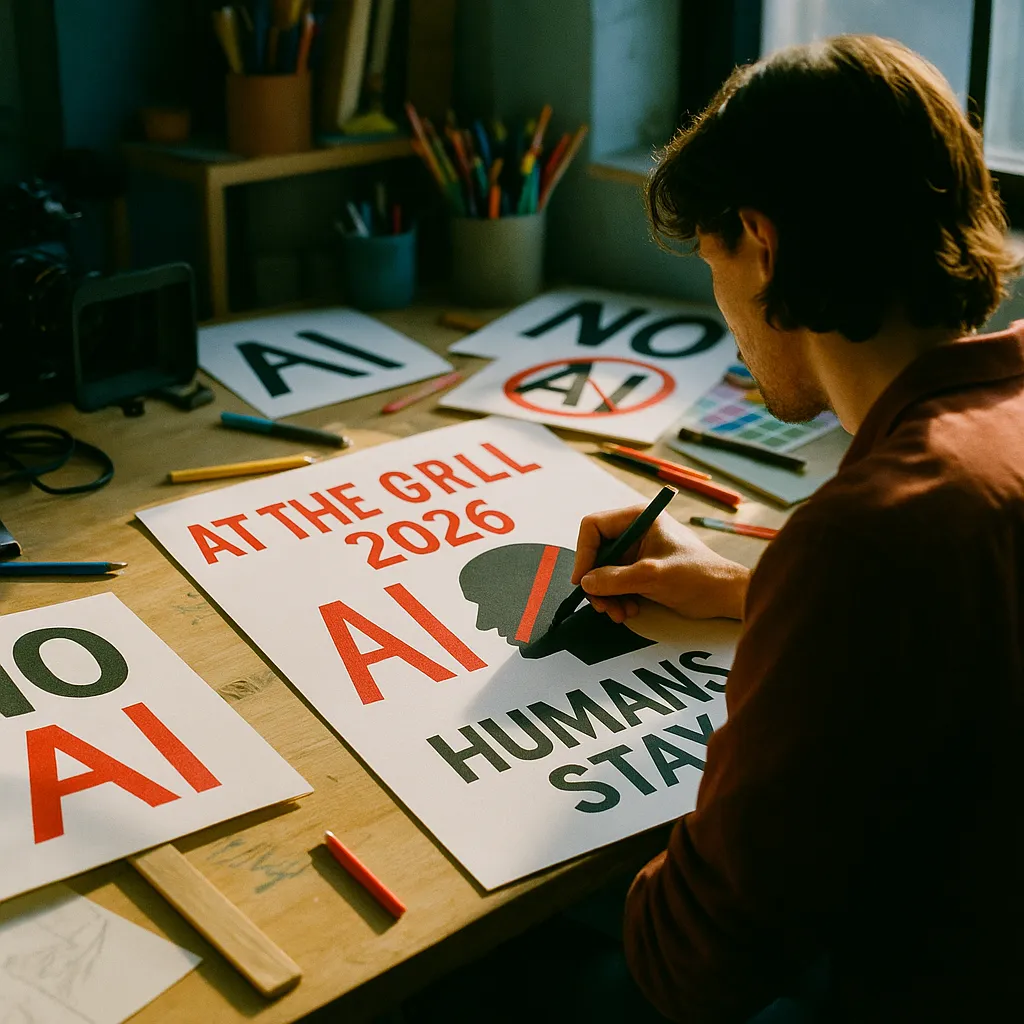
Working filmmakers at TheGrill 2026 drew explicit limits around what AI is permitted to replace in production—pushing back against a wave of fully automated creative pipelines from platforms like CapCut.
At TheGrill 2026, filmmaker Eliza McNitt drew a line that growing numbers of directors and writers are enforcing in their own work: human creative involvement in AI-assisted film production is not optional, it is the defining condition that separates legitimate filmmaking from content manufacturing. The remarks reflect a fault line that is widening across the entire entertainment industry as platforms accelerate AI filmmaking toolkits and working creatives push back.
Why it matters: TheGrill is one of the industry's premier annual conferences on the intersection of entertainment, technology, and media business. When a filmmaker stakes out a hard position on human creative control there—not in a union meeting, but in a room full of the people building and funding AI production tools—it signals where the industry's creative community is drawing its boundary.
What McNitt Said
According to The Wrap's coverage of TheGrill 2026, McNitt argued on October 1 that human involvement must remain non-negotiable throughout the AI-assisted production process. The position wasn't a rejection of AI tools—McNitt has used AI in her own work—but a rejection of fully automated pipelines where AI generates, assembles, and distributes content with humans in a reviewing or approving role rather than an originating one.
The distinction matters because the two use cases are commercially diverging. Platforms like CapCut, Runway, and Pika are actively courting filmmakers and creators with toolkits that progressively automate more of the production workflow: script-to-storyboard, storyboard-to-animatic, animatic-to-rough cut. The question is not whether AI assists human filmmakers, but whether the creative chain is anchored in human intention or human review.
The Two Sides of the Fault Line
The platform argument is straightforward: AI production tools lower the cost of filmmaking, democratize access to cinematic production quality, and open storytelling to people who lack traditional production resources. CapCut's AI filmmaking features have been adopted by millions of creators globally. Runway's Gen-3 and subsequent models can generate broadcast-quality footage from text descriptions. From the platform perspective, human involvement is a dial—how much or how little—not a binary.
Get this in your inbox.
Daily AI intelligence. Free. No spam.
The filmmaker argument, articulated by McNitt and echoed by the broader creative community, is that film is not a production output—it's a communication between a human consciousness and an audience. When the human is removed from the originating creative decisions—what story, what perspective, what emotional truth—the result is content that resembles filmmaking without performing its function.
This isn't just an aesthetic argument. It is increasingly a legal and commercial one. Studios purchasing completed films and series want clear provenance on the creative decisions behind the work. SAG-AFTRA and the WGA have negotiated explicit AI disclosure requirements. Distribution platforms operating in the EU now face obligations under the AI Act to disclose AI-generated content to audiences. The regulatory environment is codifying what the creative community is asserting on principle.
Where AI Actually Belongs in Production
The working consensus emerging from conversations like TheGrill's is that AI has a legitimate and expanding role in film production at several specific points:
- Pre-production visualization — concept art, location scouting composites, costume design variations, and previsualization that reduces the cost of exploring creative options before production begins
- Post-production acceleration — visual effects cleanup, color grading assistance, sound mix preparation, and subtitle/accessibility workflows that don't involve creative origination
- Research and development — using AI to analyze how audiences respond to narrative structures, pacing choices, and genre conventions without automating the decisions themselves
What working filmmakers are resisting is AI in the creative origination layer: story concept generation, character and dialogue development, and directorial decision-making about what the camera captures and why.
The Commercial Stakes
The commercial case for maintaining human creative control is not purely idealistic. Audiences have consistently demonstrated they can distinguish AI-generated content from human-originated work, and that distinction affects their engagement. The streamer audience data behind subscription retention consistently shows that original, auteur-driven projects generate disproportionate subscriber loyalty compared to high-volume, algorithmically optimized content libraries.
Hollywood's recent history is instructive: studios that invested heavily in algorithm-driven content development to optimize for streaming metrics found that the resulting libraries—optimized to satisfy average preferences—failed to generate the passionate audiences that drive long-term platform value. AI-generated film pipelines risk the same dynamic at a much larger scale and much lower cost.
What to Watch
The battle lines will clarify over the next 12 months as the first fully AI-generated feature films—some already announced for 2027 release—reach audiences. If they underperform, the industry will have data to support the human-creative-control position. If they find audiences, the conversation will shift from principle to contract terms. Either way, the outcome will reshape what the major studios, streamers, and talent agencies will accept from filmmakers working with AI tools.
Did this help you understand AI better?
Your feedback helps us write more useful content.
Get tomorrow's AI briefing
Join readers who start their day with NexChron. Free, daily, no spam.